
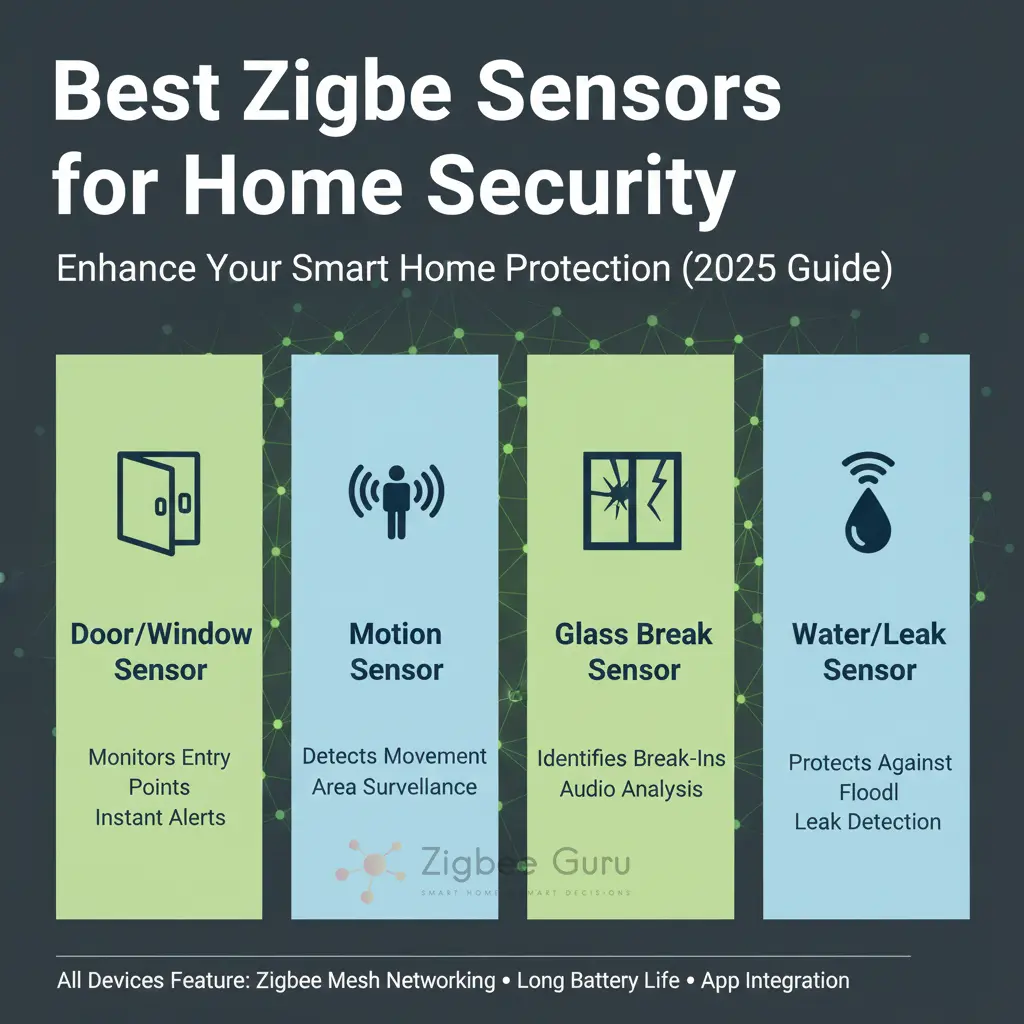
Keeping your home secure is no longer just about a traditional alarm panel. Modern security means real-time alerts when doors open, motion is detected, glass is disturbed, or a leak appears in the basement. For this kind of perimeter and indoor monitoring, Zigbee sensors are one of the most reliable and power-efficient options available in 2026.
Unlike Wi-Fi gadgets that flood your network and need frequent charging, Zigbee security sensors form a low-power mesh that runs locally, keeps working even if the cloud is down, and can deliver multi-year battery life on a coin cell. They cover everything from doors and windows to motion, presence, glass break and sirens.
In this guide, we’ll break down the best types of Zigbee sensors for home security, explain what to look for (range, tamper detection, LQI, dBm, battery chemistry), and show how to design a robust mesh that integrates cleanly with platforms like Home Assistant, SmartThings, Aqara and Philips Hue — while staying ready for Matter and Thread.
Table of Contents
- Why Zigbee for Home Security?
- Core Types of Zigbee Security Sensors
- How to Choose the Right Zigbee Security Sensors
- Best Zigbee Door & Window Contact Sensors (2026)
- Best Zigbee Motion & Presence Sensors (2026)
- Advanced Zigbee Security Sensors (Glass, Vibration, Sirens & Safety)
- Designing a Reliable Zigbee Security Mesh (Range, LQI & Routers)
- Zigbee Security Sensors in a Matter/Thread World
- Conclusion
- FAQ About Zigbee Security Sensors
Why Zigbee for Home Security?
Zigbee is a low-power wireless protocol built on IEEE 802.15.4, designed for sensor networks and automation rather than high-bandwidth tasks. For security, that’s ideal: door contacts and motion sensors send tiny packets of data, but they need to do it reliably and instantly when something happens.
Key advantages for security use-cases:
- Local mesh operation: Zigbee sensors talk to nearby routers and a hub or coordinator. Your alarm automations can still work even if the internet is down.
- Low energy usage: Properly tuned Zigbee sensors can run for years on a single coin cell, which is critical for perimeter devices you don’t want to touch every few months.
- Mature ecosystem: There are well-tested Zigbee devices for contact, motion, sirens, smoke, CO, water leak, glass break and more.
If you’re new to Zigbee in general, you can first read the foundational guide: What Is Zigbee? A Complete 2026 Guide.
Core Types of Zigbee Security Sensors
For home security, you’re typically combining several sensor types to cover the perimeter (doors, windows), the interior (rooms, corridors, stairwells) and critical risks (fire, CO, water leaks).
| Sensor Type | Primary Security Use | Typical Zigbee Examples* |
|---|---|---|
| Door/Window Contact | Detects opening/closing of doors, windows, garage side doors, balcony doors. | Aqara Door & Window Sensor T1, Philips Hue Secure Contact Sensor, Sonoff SNZB-04P, various Tuya TS0203-based contacts. |
| Motion / Presence | Detects movement in rooms, corridors, staircases; can trigger alarms or lights. | Aqara Motion Sensor P1, frient Motion Sensor / Motion Sensor Pro, mmWave presence sensors like Aqara FP300. |
| Vibration / Tilt | Detects attempts to force a window, move a safe, or tamper with outdoor equipment. | Aqara Vibration Sensor and similar Zigbee tilt/vibration devices from Tuya-based brands. |
| Glass Break / Sound | Detects characteristic frequencies of breaking glass or high noise in defined zones. | Specialized Zigbee glass break sensors (often region-specific, sometimes integrated into multi-sensors). |
| Safety Sensors | Smoke, CO, heat, water leak – more “life safety” than intruder alarm but often part of the same system. | Zigbee smoke/CO detectors, leak sensors (from frient, Aqara, Tuya OEMs, etc.). |
| Sirens & Alarm Devices | Provide audible/visual alerts, often with strobe and different tones for fire vs intrusion. | Zigbee sirens from frient, Heiman and various OEM brands. |
*Examples are indicative and not exhaustive. Exact availability varies by EU country and smart home platform.
Guru tip: Think in zones, not in individual sensors. Cover the perimeter (contacts), high-value paths (motion/presence) and critical risks (smoke, CO, leak) with overlapping detection.
How to Choose the Right Zigbee Security Sensors
Not all Zigbee sensors are equal. Cheap re-branded OEM devices can behave poorly on the mesh, spam the network or ignore parts of the standard. When you choose security sensors, focus on reliability and RF performance first — aesthetics and “smart” extras second.
- Protocol & Version: Prefer Zigbee 3.0 devices from reputable vendors; they generally offer better interoperability, security and battery management.
- Battery Life & Cell Type: Look for multi-year claims on standard cells (CR2032, CR2450, CR2477, CR2) and check user reports where possible. Sensors like Aqara Motion P1 and Sonoff SNZB-04P explicitly target 5-year battery lifetimes.
- Tamper Detection: For security zones, prioritize sensors with tamper switches that trigger an alarm if the case is opened or the unit is pried off the wall. Frient Motion Sensor Pro, for example, includes tamper protection.
- RF Performance (LQI / RSSI): Devices should maintain a strong LQI (Link Quality Indicator) and RSSI (dBm) to their parent router. As a rule of thumb, aim for LQI > ~150 and RSSI better than −75 dBm for critical security sensors.
- Integration & Ecosystem: Check that the sensor is well supported by your primary hub/platform (Home Assistant, Zigbee2MQTT, deCONZ, SmartThings, Aqara, Hue, etc.), ideally with native support rather than custom quirks.
- Form Factor & Mounting: Slim contacts for modern aluminium frames, adjustable motion sensors with swivel mounts for corridors, IP-rated housings for outdoor or semi-outdoor use.
Guru tip: For truly critical points (front door, safe room), consider dual-technology: e.g. contact sensor + motion + camera, or vibration + contact on the same window.
Best Zigbee Door & Window Contact Sensors (2026)
Door and window contacts are your perimeter foundation. For Zigbee, the “best” choices in 2026 combine solid RF behaviour, reliable reporting and long battery life, while staying compact enough for EU-style frames.
- Aqara Door & Window Sensor T1
Compact magnetic contact sensor with Zigbee 3.0 support, good battery life and integration with Aqara hubs and many Zigbee controllers. A strong choice for mixed ecosystems (Apple, Google, Alexa) when paired with an Aqara hub acting as a bridge.
👉 Check Price on Amazon - Philips Hue Secure Contact Sensor
Zigbee 3.0 contact sensor tightly integrated into the Hue ecosystem. When used with a Hue Bridge, it can participate in both Hue Secure and lighting automations, and takes advantage of Hue’s mature Zigbee stack and firmware updates.
👉 Check Price on Amazon - Sonoff SNZB-04P
Zigbee 3.0 contact sensor with built-in tamper alert and advertised >5-year battery life on a CR2477 cell. Often used in budget-friendly installations and well supported in Zigbee2MQTT and other DIY platforms.
👉 Check Price on Amazon - Frient / Tuya-based Contacts
Several brands (frient, some Tuya OEMs) provide slim contact sensors that integrate well with specific alarm platforms or gateways. These can be good choices when you’re standardizing on a particular vendor’s ecosystem.
👉 Check Price on Amazon
Look for models with strong magnets and clear documentation of the maximum gap (typically 15–20 mm). Poor magnet alignment is one of the most common real-world failure modes for contacts. See also: Best Zigbee Door/Window Sensors 2026
Guru tip: Always test contacts with the alarm armed while gently flexing the door or window. Some cheap sensors pass home “open/close” tests but fail when the frame moves under wind load.
Best Zigbee Motion & Presence Sensors (2026)
Motion and presence sensors cover the interior: hallways, staircases, living rooms, and areas where intruders would need to pass. In 2026 you can choose between classic PIR motion sensors and newer mmWave presence sensors that detect even small movements.
- Aqara Motion Sensor P1
Zigbee 3.0 motion sensor with up to 5-year battery life, adjustable sensitivity, configurable detection timeout and a built-in light sensor. Excellent for combining security and lighting automations in one device.
👉 Check Price on Amazon - Frient Motion Sensor / Motion Sensor Pro
Zigbee motion sensors that can also report light and temperature (Motion Sensor Pro), with tamper protection and flexible mounting options. Well suited to EU homes where one sensor often handles both occupancy and security.
👉 Check Price on Amazon - Aqara FP300 Presence Multi-Sensor
A newer battery-powered presence sensor combining PIR with 60 GHz mmWave radar, plus temperature, humidity and light. It supports Zigbee and Matter over Thread, making it an interesting bridge between classic Zigbee security and next-gen IP-based automations.
For corridors and stairwells, classic PIR sensors with wide fields of view (150°–170°) are usually enough. For high-value rooms where someone might stay still (home office, bedroom with safe), mmWave-based presence sensors add a second layer that can detect breathing-level motion.
Guru tip: Don’t set all motion sensors to “instant trigger” in alarm mode. Use entry/exit delays and different arming profiles (perimeter-only vs full) to avoid false alarms when relatives or cleaners have legitimate access.
Advanced Zigbee Security Sensors (Glass, Vibration, Sirens & Safety)
Beyond basic contacts and motion, Zigbee supports a wide range of specialist security and safety sensors. The CSA explicitly lists access control, leak detection, emergency sensors (fire, smoke, CO) and glass break as key Zigbee safety use-cases.
- Vibration / Tilt Sensors: Ideal for patio doors, roof windows, safes, outdoor cabinets and even garage doors. They can trigger an alert when someone attempts to force or lift something, before an entry contact opens.
- Glass Break Sensors: Analyze sound patterns to detect breaking glass. Useful for large glass doors or windows where placing contacts is difficult or where an intruder might break glass and climb through without opening the frame.
- Sirens: Zigbee sirens with loud piezo buzzers and strobes can act as both intruder deterrents and fire alerts. Some integrate backup batteries so they can sound even if mains power is cut.
- Safety Sensors (Smoke, CO, Heat, Leak): These are not strictly “security” but should be treated as part of the same protection layer. Zigbee smoke/CO detectors and water leak sensors can raise alarms locally and via your smart home app if something goes wrong.
For most homes, you don’t need every exotic sensor. Start with contacts + motion, then add vibration/glass and safety sensors where risk and budget justify them.
Guru tip: A well-placed leak sensor under a boiler, washing machine or water heater can save you more money than any other sensor in your house — and it’s still Zigbee.
Designing a Reliable Zigbee Security Mesh (Range, LQI & Routers)
The smartest sensor is useless if the packet never reaches your hub. For security, mesh quality is as important as sensor choice. Zigbee relies on routers (mains-powered devices like plugs, in-wall switches, some bulbs) to relay messages from sleepy battery sensors back to the coordinator or hub.
- Router Density: Aim for at least 1–2 good Zigbee routers per 50 m² of floor area, more in heavy masonry buildings. Corridors and stairwells are prime spots.
- Placement: Avoid putting routers behind metal cabinets, in utility boxes with lots of cables, or directly next to Wi-Fi access points.
- LQI & RSSI Monitoring: Use your platform’s diagnostics (e.g. Zigbee2MQTT map, deCONZ graph, vendor tools) to check that security sensors maintain LQI > 150 and decent RSSI values to their parent routers.
- Channel Planning: In 2.4 GHz, choose a Zigbee channel (e.g., 15, 20 or 25) that avoids overlap with your Wi-Fi channels 1/6/11 as much as local regulations allow.
- Coordinator Quality: For larger installations, consider pro-grade USB coordinators or high-quality hubs rather than re-using a budget stick built into a random gateway.
Guru tip: For critical zones (front door, main entry corridor), make sure each sensor has at least two good RF paths back to the coordinator via different routers. Mesh redundancy matters when you really need the alarm to fire.
Zigbee Security Sensors in a Matter/Thread World
With Matter and Thread arriving, many people wonder whether it still makes sense to invest in Zigbee sensors. The answer, for 2026, is “yes — but choose your hubs carefully.”
A growing number of vendors (Aqara, Philips Hue, major router and hub manufacturers) now offer Matter-capable hubs that speak Zigbee to devices internally and expose them as Matter accessories to Apple Home, Google Home, Alexa and SmartThings. This lets you keep using robust Zigbee contacts and motion sensors while controlling them via modern IP-based platforms.
At the same time, vendors are starting to launch dual-protocol sensors (like Aqara’s FP300) that support Zigbee today and Matter over Thread as your network evolves. This gives you a clean migration path without throwing away existing devices.
For a deeper architectural discussion of how Zigbee fits alongside Matter and Thread, see: What Is Matter & Thread? Will Matter Kill Zigbee?
Conclusion
The “best” Zigbee security sensors in 2026 are not a single model or brand, but a well-designed mix: reliable door and window contacts on every perimeter opening, motion or presence coverage in key rooms and corridors, and carefully chosen safety sensors and sirens to handle fire, CO and leaks.
Zigbee remains one of the strongest choices for this job: mature, low-power, proven in thousands of real homes, and increasingly bridged into modern Matter ecosystems. Choosing good Zigbee 3.0 sensors, placing them in a solid mesh with enough routers, and integrating them via a capable hub gives you a security system that is local-first, extensible and future-aware.
As Matter and Thread grow, your Zigbee security layer doesn’t become obsolete — it becomes the quiet, stable backbone behind your more visible smart home automations.
FAQ About Zigbee Security Sensors
Here are answers to the most common questions people have when choosing Zigbee sensors for home security.
- Are Zigbee sensors reliable enough for real home security?
Yes, when installed correctly. Zigbee is widely used for professional-grade safety and security use-cases, including access control, leak detection and emergency sensors. The key is to design a robust mesh (enough routers, good placement, proper channels) and choose well-supported devices from reputable vendors. - Can I mix Zigbee security sensors with traditional alarm systems?
In many setups, yes. Some hubs and alarm panels support Zigbee directly; others can integrate via gateways or relay outputs. A common pattern is to let Zigbee handle rich automations and notifications, while a small, wired alarm panel covers a few critical doors and PIRs as a backup. - Do Zigbee sensors still work if my internet is down?
If your hub or coordinator is local (Home Assistant, dedicated hubs, many vendor bridges), then yes: Zigbee sensors will still trigger automations and local alarms if the internet connection fails. You will only lose remote notifications or cloud-dependent features. - How often do I need to change batteries in Zigbee security sensors?
For good Zigbee 3.0 devices, multi-year lifetimes are realistic. Many contact and motion sensors advertise 3–5 years on a single cell under normal use. Heavy traffic areas or very frequent reporting (e.g. temperature every minute) will reduce this, but yearly battery changes should not be the norm. - Is there any point in buying Zigbee sensors now that Matter exists?
Yes. Matter is an application-layer standard; it does not replace Zigbee radios overnight. Zigbee security sensors are mature, cost-effective and widely deployed. By using hubs that can bridge Zigbee into Matter ecosystems, you get the best of both worlds. - Can Zigbee be jammed easily?
Like any radio technology, Zigbee can be affected by intentional jamming. However, this typically requires specialized equipment and intent. For most residential scenarios, good channel planning, mesh redundancy and the combination of multiple sensor types (contacts, motion, cameras) provide a high level of practical security.



