
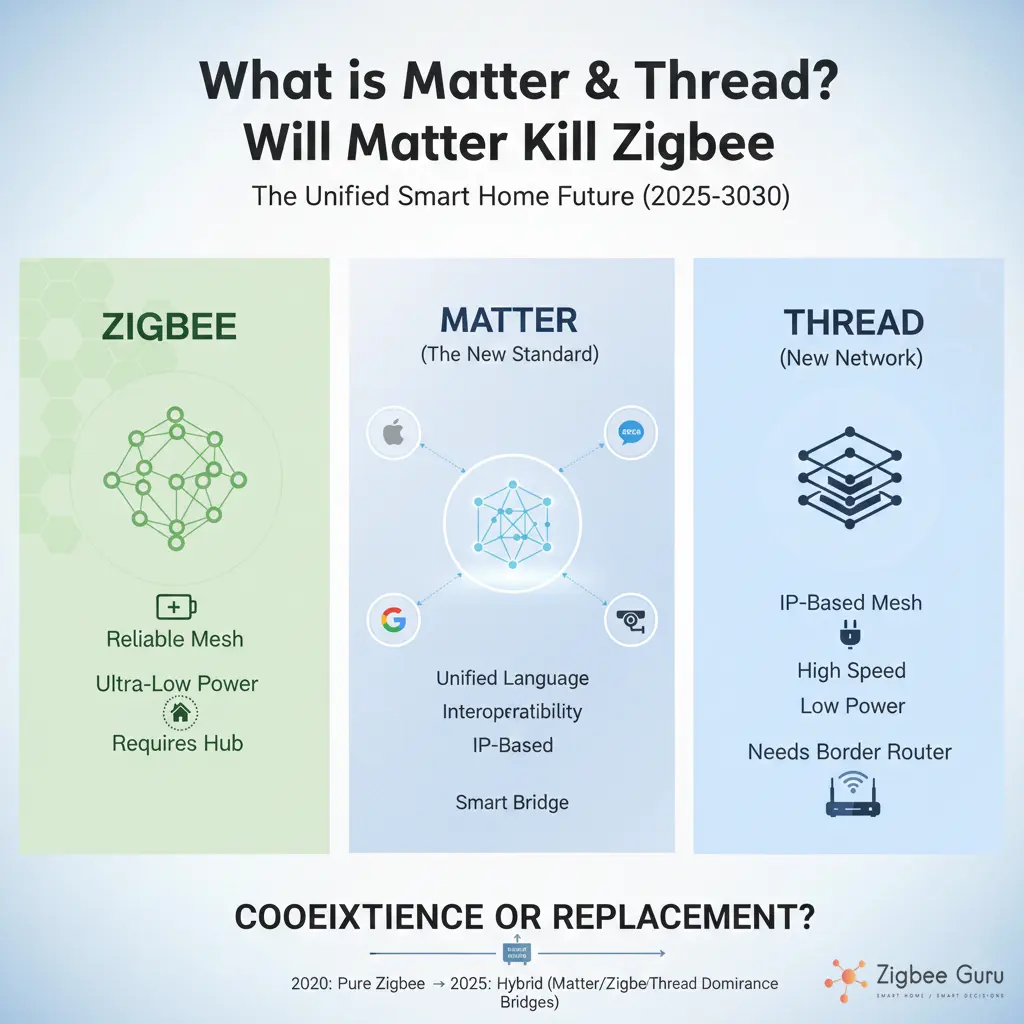
The smart home world is in the middle of a transition. For years, Zigbee and proprietary hubs powered most sensors, switches and plugs. Now Matter and Thread promise a unified, IP-based future where devices from Apple, Google, Amazon, Samsung and many others just work together — without vendor lock-in or fragile cloud bridges.
This guide explains what Matter and Thread really are, how they fit together technically, how they compare to Zigbee at the radio and application layers, and whether Matter + Thread will eventually “kill” Zigbee or simply sit alongside it. The goal is to give you a realistic 2025–2030 view so you can design a smart home that won’t feel obsolete in a few years.
We’ll look at architecture, RF behaviour (IEEE 802.15.4, IP vs non-IP), battery life, interoperability, and migration patterns — from pure Zigbee installations to fully hybrid Matter/Thread/Zigbee homes.
Table of Contents
- Matter & Thread: High-Level Definition
- Matter Architecture: Controllers, Fabrics & Multi-Admin
- Thread Fundamentals: IPv6 Mesh on IEEE 802.15.4
- Matter over Thread: How They Work Together
- Zigbee in 2025: Strengths, Weaknesses & Zigbee 4.0
- Matter & Thread vs Zigbee (Technical Comparison)
- Will Matter Kill Zigbee? A 2025–2030 Outlook
- Design Patterns for Hybrid Matter–Thread–Zigbee Homes
- Conclusion
- FAQ About Matter, Thread & Zigbee
Matter & Thread: High-Level Definition
Matter is an IP-based application layer protocol developed by the Connectivity Standards Alliance (CSA) to unify smart home devices under a single, open standard. It defines how devices describe themselves (clusters, attributes) and how they are controlled, using IPv6 over existing transports like Wi-Fi, Ethernet and Thread.
Thread is a low-power IPv6 mesh networking protocol built on top of IEEE 802.15.4 radios at 2.4 GHz (the same physical layer used by Zigbee). Thread provides the network layer — secure, self-healing mesh, address assignment, routing — but does not define the application semantics itself.
In other words:
- Matter = the language and device model (application layer over IP).
- Thread = the low-power IP mesh that carries Matter packets for small devices.
- Zigbee = an older but very mature non-IP mesh protocol that also runs on IEEE 802.15.4 radios and powers a huge installed base of sensors, bulbs and relays.
Most “Matter over Thread” devices you see in 2025 are exactly that: Matter as the application layer, Thread as the mesh, IEEE 802.15.4 as the radio.
Matter Architecture: Controllers, Fabrics & Multi-Admin
To understand Matter’s impact on Zigbee, it’s important to get the basic architecture right. At a high level, every Matter network needs at least one Matter controller, and devices join one or more fabrics (secure trust domains, similar to Zigbee networks).
- Matter Controller
A device (smart speaker, hub, router, or local server) that can commission new Matter devices, manage credentials, create automations and act as a control point. Examples include Apple HomePod mini, Google Nest Hub (2nd gen), Amazon Echo (4th gen), SmartThings hubs and Home Assistant running a Matter integration. - Fabric
A secure group of devices that share cryptographic material and trust the same controller(s). A single physical device can belong to multiple fabrics; this is how Multi-Admin works. - Multi-Admin
The ability for one Matter device to be used simultaneously by multiple platforms (for example, controlled from both Apple Home and Google Home). Each platform represents a separate fabric; the device shares its model and state consistently across all of them.
From a user’s point of view, this means you can add a Matter bulb once and let different household members control it with their preferred ecosystem — without duplicate “bridge of a bridge” hacks.
From an engineering point of view, Matter standardizes commissioning, device description and security, but it does not dictate the underlying radio beyond “must carry IPv6”. That’s where Thread and Wi-Fi come in.
Thread Fundamentals: IPv6 Mesh on IEEE 802.15.4
Thread is a secure, mesh networking protocol designed specifically for connected homes and buildings. It uses IEEE 802.15.4 radios at 2.4 GHz (the same physical layer as Zigbee), but the stack above the radio is completely different: Thread is fully IPv6-based.
Key Thread concepts:
- Mesh Topology: Every routing-capable node can forward packets, similar to Zigbee routers. The mesh is self-healing and can reroute around failures.
- Low-Power Focus: Thread is optimized for sleepy end devices (battery sensors, switches). The protocol allows devices to sleep most of the time and query their parent when needed.
- IPv6 Native: Every Thread node has IPv6 addresses. This makes routing, addressing and bridging to the wider IP world straightforward.
- Application-Agnostic: Thread doesn’t define the application semantics. Matter (and potentially other application layers) run on top of Thread.
Because Thread and Zigbee share the same physical layer (IEEE 802.15.4 at 2.4 GHz), they can interfere if not channel-planned properly — just like multiple Zigbee networks can. Logically, however, they are very different: Zigbee is a full-stack non-IP protocol, while Thread is pure IPv6 mesh.
Thread Border Routers
A Thread Border Router (TBR) connects a Thread mesh to the rest of your IP network (Ethernet/Wi-Fi/LAN). It routes IPv6 packets between the Thread mesh and your home network and often also acts as a Matter controller at the same time.
- Apple: HomePod mini, HomePod (2nd gen) and Apple TV 4K act as Thread Border Routers for Apple Home.
- Google: Nest Hub (2nd gen), Nest Hub Max and Nest Wifi Pro provide Thread Border Router functionality for Google Home.
- Amazon: Echo devices and Eero mesh routers increasingly bundle Thread Border Router roles with Matter controller capabilities.
In early deployments, each vendor often created its own Thread mesh, leading to multiple parallel meshes in the same house. Thread 1.4 and updated certification rules (mandatory after 2026) are designed to fix this by forcing border routers to share one common infrastructure network across brands.
Matter over Thread: How They Work Together
When people talk about “Matter devices”, they usually mean Matter over Thread or Matter over Wi-Fi. The technical stack looks like this:
Application: Matter
Transport: IPv6 (UDP/TCP, usually UDP)
Network: Thread mesh (for low-power) or Wi-Fi/Ethernet (for high-bandwidth)
Radio: IEEE 802.11 (Wi-Fi) or IEEE 802.15.4 (Thread, same as Zigbee)
The important point: Matter is not “replacing” Thread or Wi-Fi — it is using them as IP transports. What Matter replaces is the fragmented, vendor-specific application layers that used to sit on top of Zigbee, Z-Wave, Wi-Fi, proprietary hubs and clouds.
- Wi-Fi / Ethernet Matter devices: ideal for always-powered devices such as cameras, speakers, bridges and appliances.
- Thread Matter devices: ideal for low-power, low-bandwidth devices such as sensors, remotes, switches and some lighting.
- Zigbee devices: often live behind a bridge (Hue, Aqara, SmartThings), which itself may present as a Matter Bridge to the rest of the ecosystem.
Key takeaway: Matter is the common “language” on top of IP. Thread is the low-power IP mesh. Zigbee remains a non-IP mesh that can be bridged into Matter, not something Matter directly “speaks”.
Zigbee in 2025: Strengths, Weaknesses & Zigbee 4.0
To answer “Will Matter kill Zigbee?”, you need to know where Zigbee stands today. Zigbee 3.0 (built on Zigbee PRO R22) remains the dominant non-IP mesh protocol in consumer smart homes, especially for budget sensors, plugs and relays.
- Huge installed base: Millions of devices from vendors like Philips Hue, IKEA, Aqara, Tuya, Sonoff, etc.
- Excellent battery life: Mature Zigbee sensors commonly achieve multi-year battery life in real EU homes.
- Low device cost: Zigbee silicon is cheap and well-understood; BOM costs are still very attractive.
- Non-IP simplicity: For tiny devices, Zigbee’s lean stack can still be more efficient than a full IPv6 + Matter stack.
At the same time, Zigbee is evolving. The newly announced Zigbee 4.0 update brings better security, improved battery life via scheduled communication and features like batch commissioning for easier setup of many devices at once. It also introduces “Suzi” (Sub-GHz and Zigbee), allowing certified devices to operate in sub-GHz bands (around 800 MHz in Europe) for better long-range and outdoor coverage.
Zigbee 4.0 remains backward-compatible with existing Zigbee 3.0 and Smart Energy devices and will roll out gradually through new products and some firmware updates — meaning Zigbee is not just frozen while Matter moves forward.
Weaknesses remain:
- Non-IP nature: Zigbee needs bridges and custom integrations to talk to IP systems.
- Interoperability fragmentation: Despite Zigbee 3.0, vendor-specific clusters and quirks still exist.
- Brand confusion: Users must choose hubs (Hue, Aqara, SmartThings, DIY USB sticks) and often stick to one vendor for best results.
This is exactly the pain point Matter tries to solve at the application layer.
Matter & Thread vs Zigbee (Technical Comparison)
The table below compares Matter+Thread and Zigbee across multiple dimensions: stack structure, radio, battery life, interoperability and migration strategy.
| Aspect | Matter over Thread | Zigbee 3.0 / 4.0 |
|---|---|---|
| Application Layer | Matter (IP-based, standardized data model across vendors) | Zigbee Cluster Library + vendor extensions |
| Network Layer | IPv6 mesh (Thread) | Zigbee PRO mesh (non-IP) |
| Radio Layer | IEEE 802.15.4 at 2.4 GHz (same PHY as Zigbee) | IEEE 802.15.4 at 2.4 GHz; Zigbee 4.0 also adds Suzi sub-GHz option |
| Interoperability | Designed for cross-ecosystem compatibility (Apple, Google, Amazon, Samsung) | Hub-centric; interoperability improving but still often vendor-specific |
| Battery Life (2025) | Good, but early Matter/Thread sensors often underperform mature Zigbee devices | Excellent; multi-year battery life common in real deployments |
| Commissioning | Standard QR / setup code; multi-admin by design | Vendor-specific; improved with Zigbee 3.0, Zigbee 4.0 batch commissioning |
| Migration Path | New devices launch with Thread radios; legacy bridged via Matter Bridges | Existing installs continue to work; can be bridged into Matter platforms |
| Best Use Cases | New, premium low-power devices where interoperability is a must | Cost-sensitive sensors, retrofits, and mature ecosystems like Hue, Aqara |
Practically speaking, Matter+Thread wins on long-term interoperability and clean IP integration, while Zigbee still wins today on battery life, cost and sheer installed base.
Will Matter Kill Zigbee? A 2025–2030 Outlook
Short answer: No — but Matter will change Zigbee’s role.
From 2025 onward, it’s realistic to expect the following:
- New premium devices go IP-first: Many new sensors, switches, appliances and energy devices launch as Matter over Thread or Matter over Wi-Fi, especially in mid/high-end segments.
- Zigbee continues in cost-sensitive and legacy roles: Budget sensors and retrofits will keep using Zigbee because silicon, stacks and tooling are mature and cheap.
- Bridges become the “translators”: Hubs like Aqara, SmartThings and Hue keep running Zigbee internally but expose devices as Matter accessories to Apple/Google/Amazon ecosystems.
- Zigbee 4.0 extends Zigbee’s life: Sub-GHz options, Zigbee Direct and improved commissioning make Zigbee more attractive for outdoor, long-range and professional deployments.
In other words, Matter will likely dominate the user-facing application layer for new products, while Zigbee survives “behind the scenes” as a field bus and in the long tail of existing devices — especially where ultra-low cost or extreme battery life are key.
Guru verdict: Matter will not kill Zigbee. It will increasingly sit in front of Zigbee — via bridges and multiprotocol hubs — while new devices gradually move to Matter over Thread.
Design Patterns for Hybrid Matter–Thread–Zigbee Homes
Most real EU homes in 2025–2030 will be hybrid. Here’s how to design such a system without losing your mind.
1. Choose Your Primary Ecosystem & Controllers
- If you’re mostly on Apple, use HomePod mini / Apple TV 4K as your primary Matter controller + Thread Border Router.
- If you’re mostly on Google, use Nest Hub (2nd gen) / Nest Hub Max / Nest Wifi Pro as your core.
- If you’re mostly on Amazon/Alexa, recent Echo + Eero setups can provide Matter controller + Thread Border Router.
- If you’re DIY / Home Assistant, combine a Matter-capable Home Assistant instance with a robust multiprotocol radio (Zigbee + Thread) and, when possible, an OpenThread Border Router implementation.
2. Treat Zigbee as a Field Bus
- Keep using Zigbee for cheap sensors, legacy relays and stable lighting.
- Run these through a strong Zigbee coordinator or vendor hub.
- Prefer hubs that can act as Matter Bridges, so your Zigbee devices show up as Matter accessories in your main ecosystem.
If you’re new to Zigbee or want a deep dive on its roles (Coordinator, Router, End Device), see the dedicated guide: What Is Zigbee? A Complete 2025 Guide.
3. Use Thread for New Low-Power Devices
- When buying new sensors or switches and the price is reasonable, prefer Matter over Thread — especially from vendors with a good update track record.
- Verify that your home already has at least one reliable Thread Border Router in a central location.
- Keep an eye on Thread 1.4 support (expected standard for border routers from 2026) to avoid fragmented meshes.
4. Plan RF & Channel Allocation
Because Zigbee and Thread share the same IEEE 802.15.4 band, treat them like two separate Zigbee networks from an RF perspective:
- Aim to separate Zigbee and Thread channels as much as possible.
- Also avoid overlapping both with your 2.4 GHz Wi-Fi channels (1/6/11).
- Use diagnostics (LQI/RSSI, network maps) in your Zigbee stack and any Thread tools your platform provides.
5. Migrate Gradually, Not All at Once
- Don’t rip out stable Zigbee networks solely “because of Matter”.
- When replacing devices, choose Matter/Thread where it makes sense and where real device support exists in your ecosystem.
- Let bridges and multiprotocol hubs do the translation so you can run Zigbee and Matter side by side for many years.
Conclusion
Matter and Thread are not just marketing buzzwords — they are a serious attempt to fix the smart home’s biggest problem: fragmentation. Matter standardizes the application layer over IP, while Thread provides a resilient, low-power IPv6 mesh that finally gives small devices a first-class place in the IP world.
Zigbee, meanwhile, is far from dead. It remains a mature, cost-effective, battery-friendly mesh protocol with a huge installed base and a clear evolution path via Zigbee 4.0. In practice, Matter will sit above and in front of Zigbee for a long time: bridges translate, hubs aggregate, and users see a unified Matter layer while Zigbee continues to do reliable field work underneath.
The smart home of the next decade will not be “Matter or Zigbee”; it will be Matter + Thread + Zigbee + Wi-Fi, each doing what it does best. If you design with this in mind — choosing solid controllers, planning RF, and using bridges strategically — you get a system that is both future-aware and backward-compatible.
FAQ About Matter, Thread & Zigbee
Here are answers to the most common questions people ask when trying to understand Matter, Thread and whether Zigbee still makes sense in 2025.
- Does Matter replace Zigbee?
No. Matter is an IP-based application layer that runs over transports like Thread, Wi-Fi and Ethernet. Zigbee is a non-IP mesh protocol built on IEEE 802.15.4. They operate at different layers. Zigbee devices can be exposed to Matter ecosystems via bridges and hubs, but Matter does not “speak Zigbee” directly. - Is Thread the successor to Zigbee?
Thread is a modern IPv6 mesh that uses the same 2.4 GHz IEEE 802.15.4 radio as Zigbee but a completely different stack above the PHY. In new designs, Thread is often chosen instead of Zigbee so devices can speak IP and Matter natively. However, Zigbee will remain in service for many years due to cost, maturity and installed base. - Are Matter/Thread sensors as battery-efficient as Zigbee?
Not yet in most real-world deployments. While Thread is designed for low power, the IPv6 + Matter stack introduces additional overhead. Many early Thread/Matter sensors currently underperform well-tuned Zigbee sensors in battery life. This should improve as silicon and firmware mature, but Zigbee still holds an advantage in ultra-low-power scenarios today. - What do I need to use Matter over Thread?
You need at least one Matter controller (Hub, smart speaker, or app running on a local server) and at least one Thread Border Router. In practice, many consumer devices (HomePod mini, Nest Hub 2nd gen, Echo + Eero, SmartThings hubs) combine both roles in one box. - Can Zigbee and Thread interfere with each other?
Yes. Both use the same 2.4 GHz IEEE 802.15.4 band, so poor channel planning can cause collisions and retries, just like with overlapping Zigbee networks. Good practice is to choose channels carefully and monitor link quality (LQI/RSSI) on critical paths. - Should I stop buying Zigbee devices now?
Not necessarily. If you already have a strong Zigbee network and your use case is cost-sensitive sensors, thermostats, relays or retrofits, Zigbee still makes a lot of sense in 2025. For brand-new deployments where budget allows and ecosystem support is mature, adding Matter/Thread devices on top of that foundation is a good long-term strategy.



