
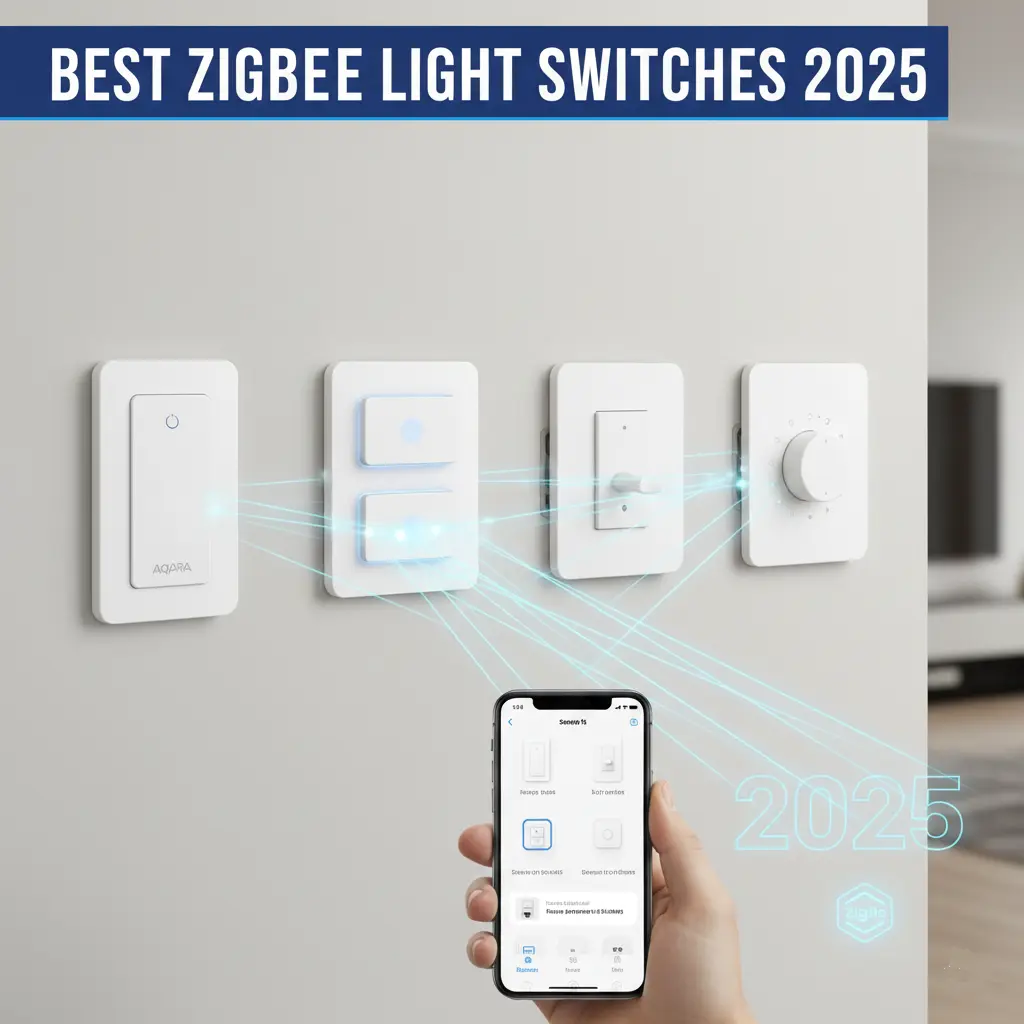
Zigbee light switches are one of the most efficient ways to make lighting smart without replacing every bulb. They sit directly in the electrical circuit, support traditional wall control and extend your Zigbee mesh as always-on routers.
The challenge, especially in European homes with mixed wiring standards, is choosing switches that are safe, compatible with your hub and reliable over time. Many budget models look similar but behave very differently once installed behind a wall box.
This guide focuses on the best Zigbee light switches available in 2026, with an emphasis on EU wiring (230 V, neutral/no-neutral setups), mesh stability and platform support rather than pure aesthetics or brand hype.
Table of Contents
- Zigbee Light Switch Basics
- Key Criteria for Choosing Zigbee Switches
- Best Aqara Zigbee Light Switches
- Best Sonoff Zigbee Light Switches
- Best Tuya-Based Zigbee Light Switches
- Best Battery-Powered Zigbee Wall Switches
- Compatibility with Hubs and Platforms
- Installation and Safety Tips
- Conclusion
- FAQ: Zigbee Light Switches
Zigbee Light Switch Basics
Zigbee light switches replace or augment traditional wall switches while communicating over the Zigbee protocol on IEEE 802.15.4, typically at 2.4 GHz in Europe. They can be in-wall modules hidden behind existing fronts, or full replacement wall plates with integrated radio and electronics.
Unlike smart bulbs, which require power at all times, smart switches maintain the familiar user interface of a physical rocker or button. At the same time, they participate as routers in the Zigbee mesh (if mains powered), improving coverage and reliability for nearby sensors and devices.
For a broader background on how Zigbee networks operate, you can refer to the general overview in What Is Zigbee?. Understanding coordinators, routers and end devices helps when planning how many smart switches your home actually needs.
Key Criteria for Choosing Zigbee Switches
Choosing a Zigbee light switch is primarily about matching wiring requirements, load type and platform compatibility. A well-selected switch should behave like a normal wall control for other occupants while remaining fully controllable from your Zigbee hub or gateway.
- Neutral vs no-neutral: many older EU installations lack a neutral in the wall box. You must choose hardware that explicitly supports your wiring.
- Load type and rating: confirm compatibility with LED drivers, low-wattage loads and maximum current at 230 V AC according to local regulations.
- Mesh role: mains-powered switches normally act as routers, so radio quality and antenna design matter for network stability.
- Platform support: verify that your model is supported by your Zigbee hub, ZHA, Zigbee2MQTT or deCONZ before buying multiple units.
| Switch Type | Description | Typical Use |
|---|---|---|
| In-wall relay module | Compact module behind existing switch | Retrofit in EU wall boxes without changing the visible hardware |
| Full replacement wall switch | Complete front plate with Zigbee electronics | Modern look, easier wiring in new or renovated installations |
| Battery-powered wireless switch | No mains connection, sends Zigbee commands only | Scene control, additional switches without new wiring |
Practical rule: start by checking the wiring in your wall box, then choose the switch type and brand that cleanly matches your electrical and platform constraints.
This upfront analysis prevents typical issues such as flickering LEDs, unresponsive routing or switches that cannot be safely installed under EU electrical standards.
Best Aqara Zigbee Light Switches
Aqara H1 EU (With Neutral): The Aqara H1 EU with neutral is a robust Zigbee wall switch for 230 V installations that include a neutral conductor. It supports single and double rocker variants, works as a Zigbee router and integrates cleanly with Aqara hubs as well as many third-party platforms. 👉 Check Price on Aliexpress
Aqara H1 EU (No Neutral): Designed for older EU wiring, the no-neutral version uses small leakage current and often requires a minimum LED load or a bypass device for best performance. It is a good choice where pulling a new neutral wire is not practical but smart control is still required. 👉 Check Price on Aliexpress
Aqara switches are generally well-documented, have clear CE marking and are supported by multiple ecosystems. For users planning to mix Zigbee switches with other Aqara sensors, staying within this brand simplifies maintenance and firmware updates.
Best Sonoff Zigbee Light Switches
Sonoff ZBMINI / ZBMINI-L: These compact in-wall modules sit behind existing wall switches and turn them into Zigbee-controlled devices. The ZBMINI requires a neutral wire, while the ZBMINI-L is designed for no-neutral scenarios and low-wattage LED loads when installed according to Sonoff’s guidelines. 👉 Check Price on Amazon
Sonoff TX Zigbee Wall Switch Series: The TX series combines capacitive touch fronts with integrated Zigbee radios for direct wall replacement. They are suitable for new installations or renovations where a modern aesthetic and clear status indication are desired, while still acting as mesh routers for nearby devices. 👉 Check Price on Amazon
Sonoff devices are widely used in DIY setups with Zigbee2MQTT and ZHA, offering a balance between cost and reliability. As always, verify the exact model variant and regional compatibility before mixing them with other vendors in the same installation.
Best Tuya-Based Zigbee Light Switches
Tuya In-Wall Zigbee Relay Modules: Generic Tuya-based relay modules are among the most affordable options for converting traditional switches into smart ones. Many models offer single or dual-channel outputs and are compact enough for standard EU back boxes when wiring is done carefully. 👉 Check Price on Amazon
Tuya Zigbee Glass Wall Switches: These full replacement switches feature touch-sensitive fronts and often support one to three gangs per plate. Internally they use Tuya Zigbee modules and can operate with Tuya gateways or open platforms that support the relevant clusters and fingerprints. 👉 Check Price on Amazon
Quality and firmware behaviour can vary between Tuya manufacturers. It is recommended to cross-check specific model numbers against community compatibility lists for Zigbee2MQTT or ZHA before ordering multi-packs for large installations.
Best Battery-Powered Zigbee Wall Switches
Aqara Wireless Remote Switch (Single / Double Rocker): This battery-powered switch can be mounted like a regular wall plate or used as a handheld remote. It is ideal for creating multi-way control without additional wiring, or for triggering complex scenes in modern Zigbee installations. 👉 Check Price on Amazon
IKEA TRÅDFRI Wireless Dimmer and Shortcut Buttons: IKEA’s wireless controls provide simple on/off, dimming and scene triggers at a low cost. They integrate well with the IKEA gateway and can often be paired directly with other Zigbee coordinators used in EU homes. 👉 Check Price on Amazon
Wireless switches do not control mains power directly but send Zigbee commands to other devices. This makes them particularly useful for renters or for locations where modifying fixed wiring is not allowed or would be impractical.
- Use wireless switches to add extra control points near beds or sofa areas.
- Repurpose them as scene controllers that manage multiple lights and blinds at once.
- Label buttons or document their functions to keep the system intuitive for all users.
Compatibility with Hubs and Platforms
Zigbee light switches interact not only with your electrical wiring but also with your hub, coordinator and automation software. Home Assistant users typically choose between ZHA, Zigbee2MQTT and deCONZ, all of which support a wide variety of switches with different feature sets.
Vendor-specific hubs, such as those from Aqara, IKEA or multi-ecosystem controllers, can expose connected switches to higher-level systems through bridges or Matter integrations. This allows Zigbee switches to coexist with Wi-Fi, Thread and other protocols inside a unified smart home environment.
Before standardising on a specific product line, confirm that the dimming modes, scene reporting and multi-gang configurations are correctly recognised by your chosen platform, not only the basic on/off function. This avoids surprises once the devices are embedded in the walls. More details about choosing a zigbee hub.
Installation and Safety Tips
Installing Zigbee light switches involves working with 230 V AC circuits, which can be hazardous. Local regulations in EU countries typically require that fixed wiring modifications are carried out by qualified electricians, especially in shared or rented buildings.
- Always isolate the circuit at the distribution board and verify absence of voltage before handling conductors.
- Follow the manufacturer’s wiring diagram exactly, paying attention to line, load, neutral and earth terminals.
- Ensure that the installed device and its enclosure maintain required clearance and heat dissipation inside the wall box.
- After installation, test both manual operation and Zigbee control from your hub before closing up and finalising the automation logic.
Even when a device is marketed as “DIY friendly”, compliance with national electrical codes and CE-related safety standards should remain the primary consideration. A correctly installed, certified Zigbee switch should then operate for years with minimal intervention.
Conclusion
The best Zigbee light switches for 2026 combine solid electrical design, good radio performance and broad platform support. Aqara, Sonoff and selected Tuya-based models cover most EU wiring scenarios, while wireless switches add flexible, non-invasive control options.
By matching switch type to your wiring, selecting devices known to work well with your hub and paying careful attention to installation practices, you can create a responsive, low-power lighting system that feels natural to use for everyone in the home.
Once the core circuits are stable, you can expand gradually with additional scenes, dimming and presence-based control, knowing that the underlying Zigbee switching layer is robust and standards-compliant.
See also: Best Zigbee Bulbs: EU Voltage Full Review
FAQ: Zigbee Light Switches
This FAQ addresses the most common questions from users planning to replace or upgrade their existing light switches with Zigbee-based alternatives.
- Do I need a neutral wire for Zigbee light switches?
Many Zigbee switches require a neutral for stable operation with LED loads, but some “no-neutral” models are designed for older EU installations. Always check the product specification against your actual wiring before purchase. - Can Zigbee light switches work with existing non-smart bulbs?
Yes. In most cases, Zigbee switches simply control the mains supply to standard bulbs or fixtures. Dimming may require compatible dimmable drivers and switches specifically rated for that purpose. - Do Zigbee switches act as routers in the mesh?
Most mains-powered Zigbee switches behave as routers, forwarding traffic for nearby devices. This helps extend coverage, especially in larger apartments or multi-storey homes. - Are battery-powered wireless switches a full replacement for wired switches?
Wireless switches are excellent for scene control and additional control points, but they do not physically break the circuit. For safety and legal reasons, at least one hard-wired switching device or breaker is normally required per lighting circuit. - Will my Zigbee switches still work if the internet goes down?
In typical configurations using local Zigbee coordinators or hubs, switching and automations continue to work without internet access. Cloud-based features such as remote control from outside the home may be temporarily unavailable.



