
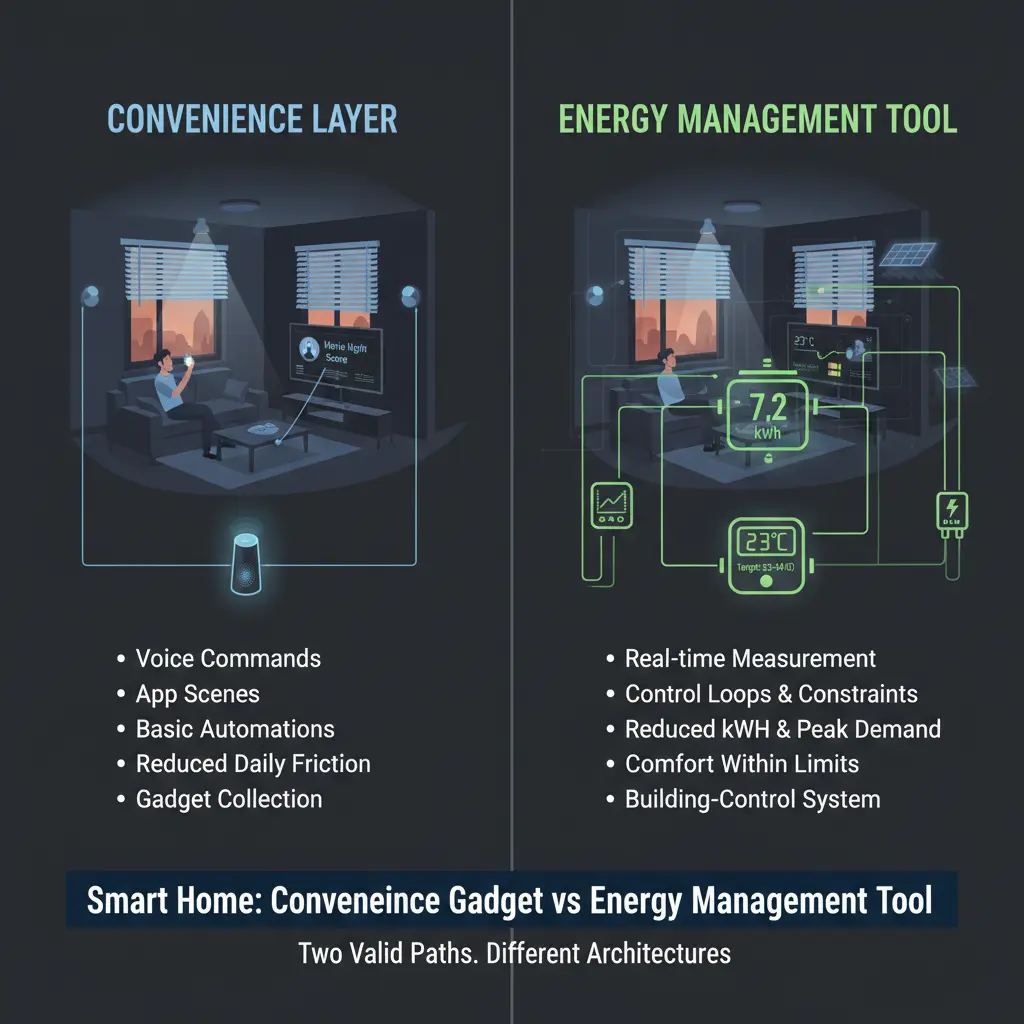
A “smart home” can mean two very different things. One version is a convenience layer: voice commands, app scenes, and a few automations that reduce friction in daily life.
The other version is an energy system: measurement, control loops, and constraints designed to reduce kWh and peak demand while keeping comfort within defined limits. It behaves more like a small building-control system than a gadget collection.
Both are valid, but they produce different architectures, different failure modes, and different expectations. Mixing them without a plan is how homes become noisy, unstable, and expensive.
A convenience smart home asks: “Can I control it?” An energy smart home asks: “Can I control it predictably, with measured impact?”
The Two Smart Homes: Definitions That Matter
Convenience automation optimizes user experience. It focuses on interaction: turning things on/off, triggering scenes, and reacting to presence in a way that feels responsive.
Energy management optimizes a physical system. It relies on sensing, timing, thermal inertia, and sometimes external signals (tariffs, weather, PV output). The goal is measurable: lower energy, fewer peaks, and stable comfort bands.
When you know which “smart home” you are building, your device choices, network design, and automation logic become simpler and more robust.
- Convenience: interaction-first, “works most of the time” is often acceptable.
- Energy tool: predictability-first, failures have a cost and must be engineered out.
- Hybrid: possible, but only if the control layer remains stable and measurable.
Convenience Gadget Architecture: What It Optimizes
A convenience setup is typically event-driven: button pressed, motion detected, sunset reached, “movie scene” activated. The main requirement is responsiveness and acceptable reliability.
This architecture tolerates heterogeneity. Devices can be cloud-based, vendor hubs can coexist, and state can be “eventually correct” as long as the experience feels smooth. The energy-management version is far less forgiving, which is the core of choosing between local and cloud execution for each automation.
The common failure mode is complexity creep: too many apps, inconsistent device state, and automations that trigger at the wrong time because they are not tied to stable measurements.
- Best fit: lighting scenes, convenience switches, simple presence routines.
- Key risk: state drift (devices and apps disagree on what is on/off).
- Hidden cost: maintenance time grows with device count and vendor diversity.
Energy Management Architecture: Control Loops and Constraints
An energy-focused smart home is feedback-driven. It measures variables (temperature, humidity, power, occupancy) and applies control within boundaries (comfort bands, schedules, safety limits).
It is not “more automation.” It is better automation: fewer rules, clearer intent, and explicit priorities. For example: prevent overheating, avoid short-cycling HVAC, and limit peak load before it hits a tariff threshold.
The engineering challenge is stability. Control must remain correct under packet loss, device sleep cycles, and changing external conditions.
- Sensing: reliable measurement beats “smart” guesses.
- Actuation: deterministic control points (thermostats, valves, relays) with known behavior.
- Logic: explicit thresholds, hysteresis, and fail-safe defaults.
Convenience vs Energy: Engineering Differences
Both approaches can use the same radios and ecosystems, but they ask different questions. The table below shows where design priorities diverge in real EU homes.
| Dimension | Convenience Gadget | Energy Management Tool |
|---|---|---|
| Primary goal | Better user experience | Measured energy/comfort optimization |
| Automation style | Scenes and triggers | Feedback control + constraints |
| Reliability target | Good enough | Predictable and testable |
| Data needs | Minimal | Continuous sensing + logging |
| Network tolerance | Occasional delays acceptable | Delays must be bounded and handled |
| Failure mode | Annoyance | Cost, discomfort, or equipment stress |
EU Realities: 230V, Dense RF, and Heating-Centric Homes
European homes have a specific profile: 230V infrastructure, common radiator heating, and dense apartment RF environments. These factors change which devices are practical and which automations remain stable.
In many EU apartments, 2.4 GHz is crowded. Zigbee and Thread (IEEE 802.15.4 at 2.4 GHz) must coexist with Wi-Fi, Bluetooth, and neighbors. Energy automations should be designed to degrade gracefully under interference.
Compliance matters too. Devices sold in Europe should meet CE/RED requirements, but for your design, the bigger question is operational: can the system behave safely and predictably under local power and RF constraints?
The EU Commission’s own definition puts this in context. Under Commission Delegated Regulation (EU) 2020/2155, the SRI is designed to measure “the capability of buildings or building units to adapt their operation to the needs of the occupant and the grid, and to improve their energy efficiency and overall performance.” For EU homes, that “adapt to the grid” clause is not abstract — it directly references demand-response scenarios where your heating, cooling, and EV charging respond to real-time grid signals.
- 230V switching: treat it as electrical work with safety constraints, not “just a smart relay.”
- Apartment RF: design for packet loss and retries, especially on 2.4 GHz.
- Heating inertia: control strategies must respect thermal lag (radiators and slab heating).
Protocols and Roles: Zigbee, Thread, Matter, and Where They Fit
Matter is an application layer over IP, and it often rides on Wi-Fi or Thread. Thread uses 802.15.4 plus IPv6/6LoWPAN, while Zigbee uses 802.15.4 with its own application profiles. Each choice affects network behavior and tooling.
For energy management, device behavior and observability matter more than slogans. You want predictable reporting intervals, stable routing, and the ability to diagnose failures. If you need a Zigbee refresher, start with What Is Zigbee? and the technical references at Zigbee.org.
Role clarity is critical: a controller coordinates onboarding and policy, and a Thread Border Router connects Thread to your IP network. Without the right roles in place, “supported” devices can still behave inconsistently.
- Zigbee: strong for sensors and low-power mesh, with mature diagnostics via platforms like ZHA or Zigbee2MQTT.
- Thread: IP-native mesh with Matter alignment, but requires Border Router coverage planning.
- Matter: simplifies interoperability, but depends on controller maturity and network quality.
Designing for Measurement: From “Smart” to “Quantified”
The difference between a gadget home and an energy tool is measurement. If you cannot measure power, temperature, and runtime, you cannot verify savings or detect regressions after an update.
Start small: measure one circuit, one room, or one HVAC zone. Then automate against those measurements with simple logic: setpoints, schedules, and hysteresis. Avoid complex rule chains until you have stable data.
Over time, logging turns troubleshooting into engineering. You can see whether a change helped, whether it added latency, and whether it created new peaks.
- Choose metrics: kWh/day, peak W, comfort band (min/max temperature), and HVAC runtime.
- Define constraints: safety limits, minimum off-time for compressors, maximum relay switching frequency.
- Validate: compare before/after with the same occupancy and weather conditions where possible.
Practical Checklist: Building the Energy Tool Without Losing Convenience
You can keep convenience features while treating energy as the primary system. The key is layering: a stable control layer underneath, and optional “experience” features on top that can fail without breaking comfort.
Keep your critical paths local and deterministic where possible. If an automation impacts heating, hot water, or safety, it should not depend on fragile cloud links or unreliable presence inference alone.
Finally, design for maintenance. EU homes are long-lived; your system should survive router changes, phone replacements, and vendor app redesigns with minimal rework.
- Separate critical from cosmetic: comfort control must work even if voice assistants fail.
- Plan RF and placement: treat 2.4 GHz as a shared resource, not an infinite one.
- Use hysteresis: avoid rapid on/off switching in heating and dehumidification logic.
- Prefer observability: choose devices and stacks that expose logs, LQI/RSSI, and state history.
- Document roles: controller ownership, Border Router locations, and network settings.
Conclusion
A smart home is not one thing. The convenience version is about interaction; the energy version is about controlled physical systems with measurable outcomes.
In EU homes, the difference becomes concrete: 230V constraints, dense 2.4 GHz environments, and heating-centric comfort demands reward predictable architectures and punish fragile rule chains.
If you treat the smart home as an energy tool first, convenience features become safer to add. You build a system that behaves well under stress, not just one that looks smart on a good day.
See also: Best Zigbee Thermostats for EU Homes (2026), Best Zigbee Energy Meters for Heat Pumps & AC Units (2026)
FAQ
- Can a convenience-focused smart home still save energy?
Yes, but savings are usually incidental and harder to verify. Energy management requires measurement, defined constraints, and control logic that remains stable over time. - What is the minimum setup to treat a smart home as an energy tool?
A small set of reliable sensors, at least one controllable load (heating zone, hot water, or major appliance), and logging of energy and comfort metrics. - Why does RF reliability matter more for energy automation?
Because delays and missing state can cause wrong control decisions. In heating and load control, timing and correctness directly affect comfort and cost. - Is Matter enough to guarantee good energy management?
No. Matter improves interoperability, but energy outcomes depend on device behavior, controller maturity, and network stability. - How do I avoid “automation complexity creep”?
Keep rules simple, prefer measurement-driven logic, and separate critical control from convenience scenes. Add complexity only after you can observe and validate outcomes. - What is the biggest EU-specific pitfall?
Assuming 2.4 GHz is clean in apartments. Zigbee/Thread coexist with Wi-Fi and neighbors, so placement and channel planning matter for long-term stability.



