
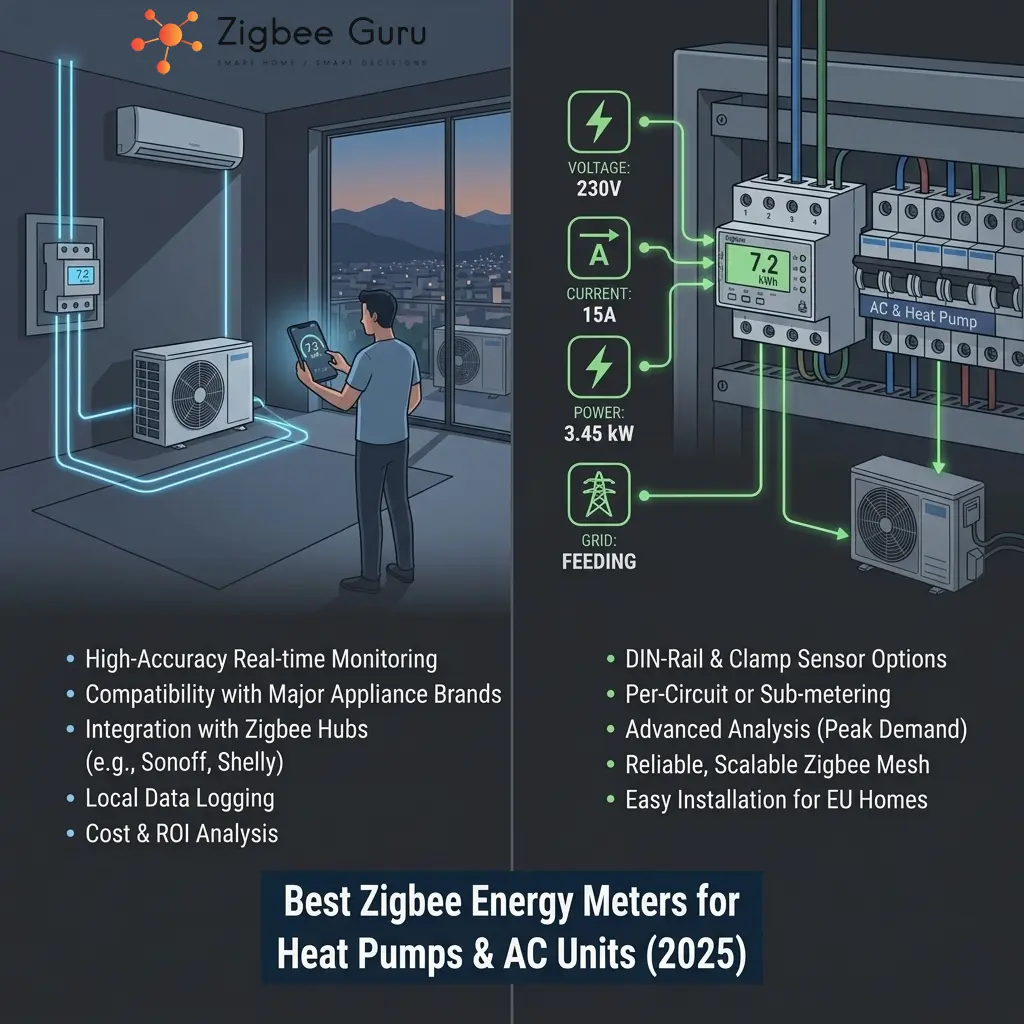
Heat pumps and air conditioners are among the largest electrical loads in an EU home. If you want meaningful energy management, you need metering that survives inverter ramps, compressor starts, and long duty cycles.
Zigbee energy meters can provide reliable telemetry (W and kWh) for HVAC circuits, but only when the measurement hardware, installation method, and reporting model match the load profile.
This guide explains what to measure, which Zigbee meter form factors work best for heat pumps and AC units, and what to expect from common Zigbee devices in 2026.
Table of Contents
- Overview: What “Good HVAC Metering” Looks Like
- Heat Pumps & AC Loads: Why They Break Cheap Meters
- DIN-Rail vs CT Clamp vs Smart Plug
- EU 230 V Sizing, Single-Phase vs Three-Phase
- Accuracy, Drift, and Calibration Basics
- Home Assistant Integration and Reporting Strategy
- Tuya Zigbee DIN-Rail Energy Meter (1P+N)
- Tuya Zigbee DIN-Rail Energy Meter (3-Phase)
- Tuya Zigbee CT Clamp Energy Monitor
- Aqara Smart Plug (EU) for Portable AC Loads
Overview: What “Good HVAC Metering” Looks Like
For HVAC, “good metering” means stable kWh over weeks and believable watts during ramps. Your goal is not lab-grade instrumentation, but repeatable numbers that track consumption and detect operating states.
Zigbee is an IEEE 802.15.4 mesh at 2.4 GHz. Metering devices use the mesh to report electrical measurements and energy counters to a coordinator and, optionally, to an IP system like Connectivity Standards Alliance ecosystems through bridges.
Because HVAC loads are large and safety-critical, the most useful Zigbee or Wifi energy meters are typically DIN-rail meters or CT-clamp monitors installed at the electrical panel, not plug-in adapters.
Heat Pumps & AC Loads: Why They Break Cheap Meters
Modern heat pumps and many split AC systems use inverter drives. The electrical signature includes non-sinusoidal current, changing power factor, and fast transitions as the compressor speed modulates.
Instantaneous power can be noisy during ramps, especially at low compressor speeds. A meter can still be useful if its energy counter (kWh) is stable and if its power readings correlate with “off / standby / running / defrost”.
Compressor inrush is typically lower on inverter systems than on legacy fixed-speed motors, but transients still exist (fans, crankcase heaters, defrost cycles). Automations should not trigger on single-sample spikes.
DIN-Rail vs CT Clamp vs Smart Plug
DIN-rail meters measure the circuit directly and usually provide the most consistent kWh tracking for HVAC. They are well suited when the heat pump/AC has a dedicated breaker or a clearly separated feed.
CT clamp monitors measure current through a clamp and infer power using voltage assumptions or a voltage reference. They can be easier to retrofit, but accuracy depends on calibration, phase alignment, and correct installation.
Smart plugs are limited to plug-in loads and current ratings. They can be appropriate for portable AC units or smaller window units, but they are rarely the right tool for hardwired HVAC circuits.
EU 230 V Sizing, Single-Phase vs Three-Phase
Most EU homes use 230 V / 50 Hz, with either single-phase (1P+N) or three-phase (3P+N) service. Heat pumps can be single-phase at lower capacities, while larger systems often use three-phase supplies.
Choose a meter that matches the circuit topology and current. For DIN-rail devices, confirm that the meter’s rated current and terminal design match your breaker and conductor sizes. For CT clamps, confirm the CT rating and whether the meter supports multiple clamps for three-phase.
Use CE-marked equipment intended for mains measurement and ensure the installation respects local electrical codes. For panel work, a licensed electrician is the correct path in most jurisdictions.
Accuracy, Drift, and Calibration Basics
Consumer Zigbee meters are typically “good enough” for optimization, not for billing. If you need regulated accuracy, look for MID-certified meters and treat Zigbee as telemetry rather than the authoritative record.
The most reliable validation method is to compare kWh over a multi-hour HVAC run against a trusted reference meter. Short tests are dominated by transients and reporting noise, especially on inverter systems.
Expect the biggest errors on low-power operation, distorted waveforms, and poorly calibrated CT installations. Prioritize stable energy counters over perfectly smooth watt readings.
Home Assistant Integration and Reporting Strategy
Home Assistant can ingest Zigbee metering via ZHA or Zigbee2MQTT. The key is correct scaling and stable “total increasing” handling for energy counters, so long-term statistics do not reset or mis-sum.
For EU apartments, remember Zigbee shares the 2.4 GHz band with Wi-Fi. A congested RF environment can cause missing reports, which affects graphs and any controller-side energy estimation based on power samples.
Use a reporting strategy that respects the mesh: moderate intervals (tens of seconds to minutes) and a meaningful reportable change threshold. For HVAC, kWh counters matter more than high-rate power telemetry.
Tuya Zigbee DIN-Rail Energy Meter (1P+N)
A Tuya Zigbee DIN-rail energy meter for 1P+N circuits is one of the most practical options for a dedicated single-phase heat pump or AC feed. It typically provides watts and a persistent kWh counter, which is what you need for seasonal consumption tracking. 👉 Check Price on Amazon
Accuracy depends on the specific model and installation quality. If the HVAC circuit includes an inverter drive, expect instantaneous power to fluctuate; validate kWh over longer runs rather than judging from minute-by-minute watts.
Use this form factor when the HVAC load is clearly separated at the panel. It is less suitable if the heat pump shares a mixed circuit with many unrelated loads.
Tuya Zigbee DIN-Rail Energy Meter (3-Phase)
A Tuya Zigbee DIN-rail energy meter designed for three-phase systems targets larger heat pumps and multi-phase HVAC installations common in bigger EU homes and light commercial settings. It can deliver per-phase and total values, depending on the model, which helps identify imbalance and abnormal behavior. 👉 Check Price on Amazon
Three-phase metering adds complexity: wiring must be correct per phase, and any CT-based variant must have correct orientation and consistent phase mapping. Small wiring mistakes can produce plausible-but-wrong totals.
Use this when the heat pump is truly three-phase and you want circuit-level totals. If your HVAC is single-phase, a simpler 1P+N meter is usually easier to validate and maintain.
Tuya Zigbee CT Clamp Energy Monitor
A Tuya Zigbee CT clamp monitor is useful when you cannot replace or re-route the HVAC feed through a DIN-rail meter, or when you want monitoring without modifying the conductor path. It can track current and estimate power and energy, often with one or more clamps depending on the model. 👉 Check Price on Amazon
CT solutions are more sensitive to calibration and phase error, especially on inverter-driven loads where waveform distortion is common. Validate kWh against a reference over a long HVAC run before relying on the totals.
CT clamps can be a strong choice for “trend and detection” use cases: confirming defrost cycles, spotting stuck auxiliary heaters, or detecting unexpected standby consumption.
Aqara Smart Plug (EU) for Portable AC Loads
The Aqara Smart Plug (EU) can be a practical meter when your air conditioner is a plug-in device (portable AC, smaller window unit) and the current draw is within the plug’s rated limits. It can provide fast “on/off + watts” visibility and a usable kWh trend line for day-to-day operation. 👉 Check Price on Amazon
For compressor-based loads, expect transient spikes and fluctuating watts as the unit cycles. Use filtered thresholds for automations and judge energy consumption using longer windows.
This approach is not suitable for hardwired splits or heat pumps. For those, prefer panel-level metering (DIN-rail or CT) that matches the circuit rating and installation constraints.
The table below summarizes which Zigbee meter form factors tend to work best for HVAC monitoring and what to watch for in EU 230 V installations.
| Meter type | Best for | Strength | Main limitation for HVAC |
|---|---|---|---|
| DIN-rail meter (1P+N) | Dedicated single-phase heat pump / split AC feed | Stable kWh totals, direct circuit measurement | Requires panel wiring; model accuracy varies |
| DIN-rail meter (3-phase) | Larger three-phase heat pumps | Total + per-phase visibility (model-dependent) | Wiring complexity; phase mapping errors |
| CT clamp monitor | Retrofit monitoring when re-wiring is hard | Non-invasive installation path | Calibration/phase error; waveform sensitivity |
| Smart plug with metering | Portable AC or smaller plug-in units | Easy deployment, quick state detection | Current limit and not for hardwired HVAC |
Use the lists below to choose a meter and to keep automations reliable when power readings fluctuate.
- Selection checklist: match topology (1P+N vs 3P+N), confirm current rating, and confirm the device is intended for EU 230 V mains use.
- Validation: compare kWh over a multi-hour HVAC run against a trusted reference meter; do not judge from short transients.
- Reporting: prefer an on-device kWh counter; avoid controller-side “energy by integrating power reports” when possible.
- RF stability: keep your Zigbee coordinator away from Wi-Fi APs and USB 3.0 noise sources; ensure enough mains-powered Zigbee routers.
- Safety: panel installations should follow local electrical code and are typically electrician work.
- Automation patterns that survive noisy watts: use time filters (e.g., “above threshold for 2–5 minutes”) and hysteresis bands.
- Detecting abnormal standby: alert when HVAC circuit draw stays above a baseline outside scheduled hours.
- Defrost and auxiliary heater detection: watch for characteristic step changes in watts and sustained high draw.
- Seasonal tracking: use kWh deltas per week/month to evaluate setpoints, schedules, and insulation changes.
For inverter HVAC, trust long-window kWh first. Treat instantaneous watts as a state signal, not as a precision instrument.
Zigbee energy metering can support HVAC energy management when you use the right form factor: panel-level DIN-rail meters for dedicated feeds, CT clamps for retrofit constraints, and smart plugs only for truly plug-in AC loads.
The practical path is simple: match the electrical topology, validate kWh over long runs, and design automations that tolerate transient noise and RF packet loss in dense EU 2.4 GHz environments.
See also: best zigbee thermostats for EU homes
FAQ
- Can a Zigbee smart plug meter a split AC or heat pump?
Usually no. Most splits and heat pumps are hardwired and exceed what a plug adapter is designed to handle. Use DIN-rail or CT metering at the panel. - Why does instantaneous power fluctuate so much on inverter HVAC?
Inverter drives modulate compressor speed and create non-linear current waveforms. Many consumer meters show noisy watts during ramps even if kWh totals remain usable. - Is Zigbee metering accurate enough for billing?
Generally not. For regulated sub-metering, look for MID-certified meters and use Zigbee for monitoring and automation inputs. - What matters more for HVAC: watts or kWh?
For cost and seasonal tracking, kWh is the primary value. Watts are mainly useful for detecting states (running, defrost, auxiliary heater, standby). - Will Wi-Fi interference change my meter’s measurement?
It does not change the internal measurement, but it can cause missed Zigbee reports. That affects graphs and any automation relying on real-time updates. - How should I validate a Zigbee HVAC meter?
Compare kWh over a multi-hour run against a trusted reference meter. Short comparisons are dominated by transients and reporting timing.



