
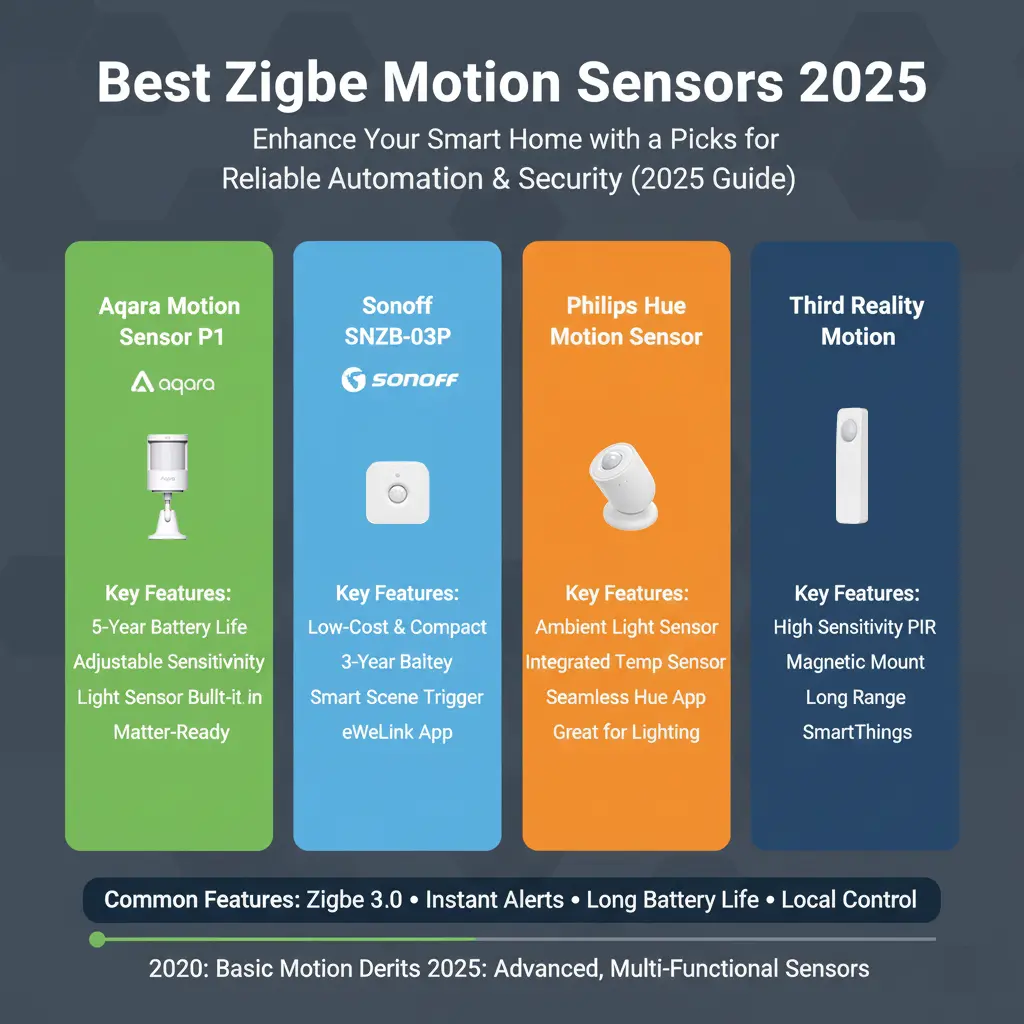
The best Zigbee motion sensor for most EU homes in 2026 is the Aqara Motion Sensor P1, because it combines Zigbee 3.0, a built-in lux sensor, an adjustable 1–200 s timeout and up to 5 years of battery life for around €17–25. For plug-and-play reliability choose the Philips Hue Indoor Motion Sensor, and for the lowest price the Sonoff SNZB-03P.
Quick Picks: Best Zigbee Motion Sensors at a Glance
| Sensor | Approx. EU Price | Best For | Key Specs |
|---|---|---|---|
| Aqara Motion Sensor P1 🏆 Best overall | ≈ €17–25 Check price: Amazon · AliExpress | All-round indoor security and lighting: living rooms, corridors, staircases. | Zigbee 3.0, lux sensor, 1–200 s timeout, up to 5-year battery (2×CR2450). |
| Philips Hue Indoor Motion Sensor Best premium / most reliable | from ≈ €37 Check price: Amazon | Hue-based homes that want instant response and zero debugging. | Zigbee, lux sensor, 100° / 5 m, ~2-year battery (2×AAA). |
| Sonoff SNZB-03P Best budget for DIY | from ≈ €15-21 Check price: Amazon · AliExpress | Home Assistant, Zigbee2MQTT and Sonoff hub setups where cost per sensor matters. | Zigbee 3.0, 110° / 6 m, ~3-year battery (1×CR2477). |
| IKEA VALLHORN Cheapest for IKEA homes | ≈ €10 IKEA stores / IKEA.com | Simple motion-to-light automation in IKEA-centric homes and rentals. | Zigbee, 120° / 5 m, indoor/outdoor use. |
Prices are approximate EU street prices as of September 2026 and change often; “Check price” links are affiliate links. Note: Aqara’s newer Motion and Light Sensor P2 is a Matter-over-Thread device, not Zigbee, and needs a Thread border router (such as the Aqara Hub M3), so it is not included in this Zigbee comparison.
Zigbee motion sensors are the backbone of any serious smart home security setup. They turn lights on as you walk into a room, trigger alarms when you’re away, and help drive intelligent energy-saving automations. But in 2026 the market is flooded: Aqara, Philips Hue, Sonoff, Tuya, IKEA and others all claim multi-year battery life, instant detection and “smart” features.
This guide focuses on the best Zigbee motion sensors for 2026, with a specific eye on EU homes. We’ll look at real engineering criteria (detection angle, range, battery chemistry, Zigbee 3.0 support, LQI and router density), not just marketing claims.
We’ll start with the key buying criteria, then compare Aqara, Philips Hue, Sonoff, Tuya/IKEA and advanced presence sensors so you can pick the right mix for corridors, living rooms, staircases and outdoor areas.
Table of Contents
- Quick Picks: Best Zigbee Motion Sensors at a Glance
- How to Choose a Zigbee Motion Sensor in 2026
- Full Comparison: Zigbee Motion Sensors 2026
- Aqara Motion Sensors (P1 & Classic): Best All-Rounders
- Philips Hue Motion Sensors: Premium but Rock-Solid
- Sonoff SNZB-03P and Friends: Budget for Power Users
- Tuya & IKEA VALLHORN: Ultra-Budget and Simple
- Placement, LQI & Router Density: Making Sensors Reliable
- Motion vs Presence Sensors (Aqara FP300/FP2 & Beyond)
- Conclusion
- FAQ About Zigbee Motion Sensors in 2026
How to Choose a Zigbee Motion Sensor in 2026
Not all Zigbee motion sensors are equal. Before looking at brands, it helps to understand the five technical parameters that truly matter.
- Detection Angle & Range
How wide the sensor can “see” (e.g. 100–170°) and at what distance (typically 5–7 m for indoor PIR). Narrow angles are fine for corridors; wide angles are better for open-plan rooms. - Battery Type & Life
Most Zigbee PIRs use CR2450/CR2477 coin cells or AAA batteries. Good designs achieve 2–5 years of life depending on traffic and timeout settings. - Built-in Light Sensor
Many modern units (e.g. Aqara P1, Hue) include a lux sensor. That allows “turn on lights only when it’s dark and motion is detected” instead of wasting energy during the day. - Zigbee Version & Ecosystem Support
Prefer Zigbee 3.0 for better interoperability and security. Check whether the sensor is tested with your hub (Home Assistant, Aqara, Hue Bridge, Sonoff, Tuya, SmartThings). - Configurable Timeouts & Sensitivity
Advanced models let you tune motion timeout (how long before “no motion”) and distance sensitivity. This is crucial for avoiding constant triggers in hallways or from pets.
If you’re still new to the protocol itself, read this first: What is Zigbee? A Complete 2026 Guide.
Full Comparison: Zigbee Motion Sensors 2026
Here is the full comparison of every Zigbee motion sensor covered in this guide, including the older Aqara Classic and generic Tuya options, and where each one shines.
| Sensor | Key Specs | Best Use-Case |
|---|---|---|
| Aqara Motion Sensor P1 | Zigbee 3.0, 170° FOV up to 4 m / 150° up to 7 m, built-in lux sensor, 5-year battery (2×CR2450), adjustable timeout (1–200 s), sensitivity modes. | All-round indoor sensor for security + lighting; ideal for living rooms, corridors, staircases. |
| Aqara Classic (RTCGQ11LM) | Zigbee 1.2, wide FOV, 2–3-year coin-cell battery, no configurable timeout, small housing. | Budget choice when you want many sensors at low cost and are OK with fewer tuning options. |
| Philips Hue Indoor Motion Sensor | Zigbee + Bluetooth, PIR + lux sensor, 100° FOV, up to 5 m range, 2×AAA with ~2-year battery life. | Premium, extremely reliable sensor for Hue Bridge and Hue-centric homes. |
| Sonoff SNZB-03P | Zigbee 3.0, 6 m range, 110° viewing angle, CR2477 battery (~3 years), designed to work with iHost, NSPanel Pro, ZBBridge, HA via ZBDongle. | Cheap and flexible for DIY/Home Assistant setups and Sonoff ecosystems. |
| IKEA VALLHORN | Zigbee-based wireless motion sensor, up to 5 m motion range, 120° angle, indoor/outdoor capable, works with IKEA smart lighting. | Simple motion-to-light automation, especially in IKEA-centric homes and rentals. |
| Tuya Zigbee PIR Sensors | Various OEMs; typically Zigbee 3.0, 110–120° FOV, 5–7 m range, CR2450/AAA battery, simple lux reporting. | Ultra-budget deployments where you need many sensors and are happy to live in Tuya/Smart Life. |
Key takeaway: For most users, Aqara P1 or Philips Hue Indoor Motion will cover 80% of use-cases. Sonoff, Tuya and IKEA are excellent for budget or specialist roles.
Aqara Motion Sensors (P1 & Classic): Best All-Rounders
Aqara has become the default choice for many EU smart home enthusiasts: good Zigbee radios, strong Home Assistant integration and native support in Aqara hubs (M2, M3, E1). For motion, the two main options are the Motion Sensor P1 and the older RTCGQ11LM.
- Motion Sensor P1
Uses Zigbee 3.0, supports three sensitivity levels (distance), configurable timeout from 1 s to 200 s, and a built-in light sensor. Aqara advertises up to 5 years battery life on 2×CR2450 cells with typical usage. 👉 Check price on Amazon | Check price on AliExpress (affiliate) - Aqara High Precision Motion Sensor (RTCGQ13LM, Zigbee 3.0)
Very popular thanks to its tiny size and excellent value for money. It works reliably with Aqara hubs. 👉 Check price on AliExpress (affiliate)
For new installations, the P1 is the obvious choice: Zigbee 3.0, extra-wide viewing angle (up to 170° close-range) and the lux sensor make it ideal for smart lighting that doesn’t waste energy.
If you’re deploying dozens of sensors and chasing cost savings, mixing a few P1 units in key rooms (living room, kitchen, stairs) with cheaper classic Aqara sensors in low-priority zones is a very efficient strategy.
Philips Hue Motion Sensors: Premium but Rock-Solid
Philips Hue motion sensors are not the cheapest, but they’re widely considered the most reliable “it just works” option when paired with a Hue Bridge or compatible Zigbee hub.
- Hue Indoor Motion Sensor
Passive infrared + daylight sensor (lux), 100° detection angle, up to 5 m range, powered by 2×AAA batteries with about 2 years typical life. Uses Zigbee for mesh connectivity and Bluetooth for initial pairing in some setups. 👉 Check Price on Amazon - Hue Outdoor Motion Sensor
Larger housing, weatherproof, ideal for driveways and gardens when combined with Hue or Matter-exposed outdoor lighting. 👉 Check Price on Amazon
Community feedback consistently highlights their instant local response and low false-trigger rate. Many advanced users end up replacing cheaper sensors with Hue after fighting random misses or delays.
If your lighting is already Hue-based, using Hue motion sensors + Hue Bridge gives you a robust, low-maintenance foundation that can still be integrated into Home Assistant or Matter ecosystems later.
Key takeaway: Hue motion sensors cost more, but you’re paying for time saved debugging: they pair easily, trigger fast and generally “just work” for years.
Sonoff SNZB-03P and Friends: Budget for Power Users
Sonoff targets the DIY and Home Assistant crowd. The SNZB series of Zigbee sensors are aggressively priced and designed to integrate with Sonoff hubs (iHost, NSPanel Pro, ZBBridge-P) and open ecosystems via Zigbee2MQTT or ZHA.
- SNZB-03P (newer model)
Zigbee 3.0 PIR, detection within 6 m and 110° viewing angle, powered by a single CR2477 coin cell with up to 3 years expected battery life. Works with Sonoff hubs and generic Zigbee 3.0 coordinators (e.g. ZBDongle-E/P). 👉 Check Price on Amazon | Check Price on AliExpress (affiliate) - SNZB-03 (older model)
Slightly smaller and cheaper, but with less refined hardware and typically shorter battery life than the 03P revision. 👉 Check Price on Amazon
Combined with a Sonoff ZBDongle-P/E and Home Assistant, SNZB-03P sensors form a very cost-effective mesh for whole-house coverage. The trade-off vs Aqara/Hue is a bit more tinkering with firmware updates and device configuration.
For a deeper dive into Sonoff devices and hub options, see: Sonoff Zigbee Ecosystem Explained and Best Zigbee Hubs for EU Homes (2026): Aqara vs Sonoff vs Tuya vs SmartThings
Tuya & IKEA VALLHORN: Ultra-Budget and Simple
Tuya-based Zigbee sensors are sold under dozens of brands (MOES, Gosund, no-name Amazon sellers). Meanwhile, IKEA’s VALLHORN brings a very affordable motion sensor tightly integrated with the IKEA ecosystem.
- Generic Tuya Zigbee PIR Sensors
Most offer a 110–120° detection angle, 5–7 m range, basic lux reporting and either CR2450 or AAA power. They pair with Tuya/Smart Life gateways and can often be exposed to Home Assistant via local integrations. 👉 Check Price on Amazon - IKEA VALLHORN
Wireless motion sensor designed for indoor and outdoor use, with up to 5 m motion detection range, 120° angle and up to 10 m link range to the controlled light when line-of-sight. It integrates with IKEA’s own smart lighting gateway and app.
For renters or small apartments, a Tuya gateway + 3–5 Zigbee motion sensors can automate hallway and bathroom lights at extremely low cost. Just keep in mind that Tuya is primarily a cloud-first platform; if you want long-term local control, Aqara, Sonoff or Hue are safer foundations.
Key takeaway: Tuya and IKEA offer unbeatable price-per-sensor. Use them where absolute reliability is less critical (guest rooms, storage, secondary corridors).
Placement, LQI & Router Density: Making Sensors Reliable
Even the best Zigbee motion sensor will disappoint if your mesh network is weak. Motion sensors are typically sleepy end devices powered by batteries; they rely heavily on nearby mains-powered routers (plugs, switches, bulbs) to reach the coordinator.
- Aim for strong LQI
LQI (Link Quality Indicator) is usually reported on a 0–255 scale. For security-critical sensors (entrances, staircases), aim for LQI > 150 to minimize packet loss and battery-draining retries. - Router every 7–8 meters
In a typical EU apartment (brick walls, reinforced concrete), place a Zigbee router device every 7–8 m and within 10 m of the coordinator for a strong backbone. - Avoid Wi-Fi channel overlap
Both Zigbee and Wi-Fi operate at 2.4 GHz. If your Wi-Fi router is on channel 1 or 6 and your Zigbee network uses channel 11, you may see interference. Move Wi-Fi to channel 1 and Zigbee to 20/25, or vice versa, to reduce overlap. - Mounting height matters
Most PIR sensors are calibrated for ~2–2.5 m height. Too high or too low and you’ll either miss motion (walking across the beam) or get false triggers (heat sources, pets).
Spend time designing the mesh and placement first; only then worry about swapping brands. In many “bad sensor” stories, the real culprit is a weak Zigbee backbone, not the PIR itself.
Motion vs Presence Sensors (Aqara FP300/FP2 & Beyond)
Zigbee motion sensors (PIR) are great at detecting movement, but they struggle when you’re still – reading on the sofa or working at a desk. This is where new mmWave presence sensors come in.
In late 2025, Aqara launched the Presence Multi-Sensor FP300, a battery-powered device that combines PIR + 60 GHz mmWave radar with Zigbee and Matter over Thread support. It can detect stationary people up to 6 m away and includes temperature, humidity and light sensors for advanced automations.
- Classic PIR (Aqara P1, Hue, Sonoff)
Best for corridors, staircases, entrances and bathrooms where people are usually moving. - Presence mmWave (Aqara FP300 / FP2)
Best for living rooms, offices and bedrooms where you want lights and HVAC to stay on while someone is sitting still.
While mmWave sensors like FP300/FP2 are not purely “Zigbee motion sensors”, it’s important to understand them as the next step in room awareness. In a 2026-ready home you’ll often mix:
- Cheap Zigbee PIR sensors for basic on/off triggers.
- 1–2 mmWave presence sensors per floor for high-value zones (living room, main office).
Key takeaway: PIR is still king for cost-effective coverage, but mmWave presence sensors are increasingly the “brain” that refine when lights and HVAC stay on.
Conclusion
In 2026, there is no single “best Zigbee motion sensor” for every home. Instead, you should build a portfolio of sensors that match room function, ecosystem and budget.
Aqara P1 and Philips Hue Indoor are the safest all-round choices for most EU homes, combining strong Zigbee radios, good battery life and lux-aware lighting. Sonoff SNZB-03P is excellent for DIYers who use Home Assistant and want low cost plus flexibility. Tuya sensors and IKEA VALLHORN are perfect when you just need “something cheap that works” in non-critical zones.
The real “Guru move” is to focus on mesh quality (routers, channels, LQI) and supplement PIR with mmWave presence sensors in key rooms. That’s how you get a home that feels responsive, efficient and genuinely smart – not just full of gadgets.
See also: Best Zigbee Sensors for Home Security
FAQ About Zigbee Motion Sensors in 2026
Below are the most common questions people ask when selecting Zigbee motion sensors for home security and automation in 2026.
- How many Zigbee motion sensors can my hub support?
Most consumer hubs (Aqara, Hue, Tuya, Sonoff) support dozens of devices without issue. The practical limit is usually around 50–100 devices per coordinator, assuming you have enough routers. - Which Zigbee motion sensor has the best battery life?
On paper, Aqara P1 advertises up to 5 years of battery life, while Sonoff SNZB-03P targets ~3 years and Hue around 2 years. Real-world life depends heavily on traffic and timeout settings. - Are Hue motion sensors worth the extra cost?
If you value reliability and minimal debugging, yes. Hue motion sensors, especially with a Hue Bridge, have an excellent reputation for low latency and long-term stability, which can justify the higher upfront price. - Can Zigbee motion sensors work without internet?
Yes. As long as your hub (Aqara, Hue, Sonoff iHost, Home Assistant, SmartThings) supports local scenes, motion-based automations will continue to work even when your WAN connection is down. Cloud is only needed for remote access and voice assistants. - Should I skip PIR and go straight to mmWave presence sensors?
No. mmWave sensors are great but more expensive and complex. For most homes, a mix of cheap Zigbee PIRs for basic triggers and a few mmWave presence sensors in high-value rooms is the most cost-effective combination.



