
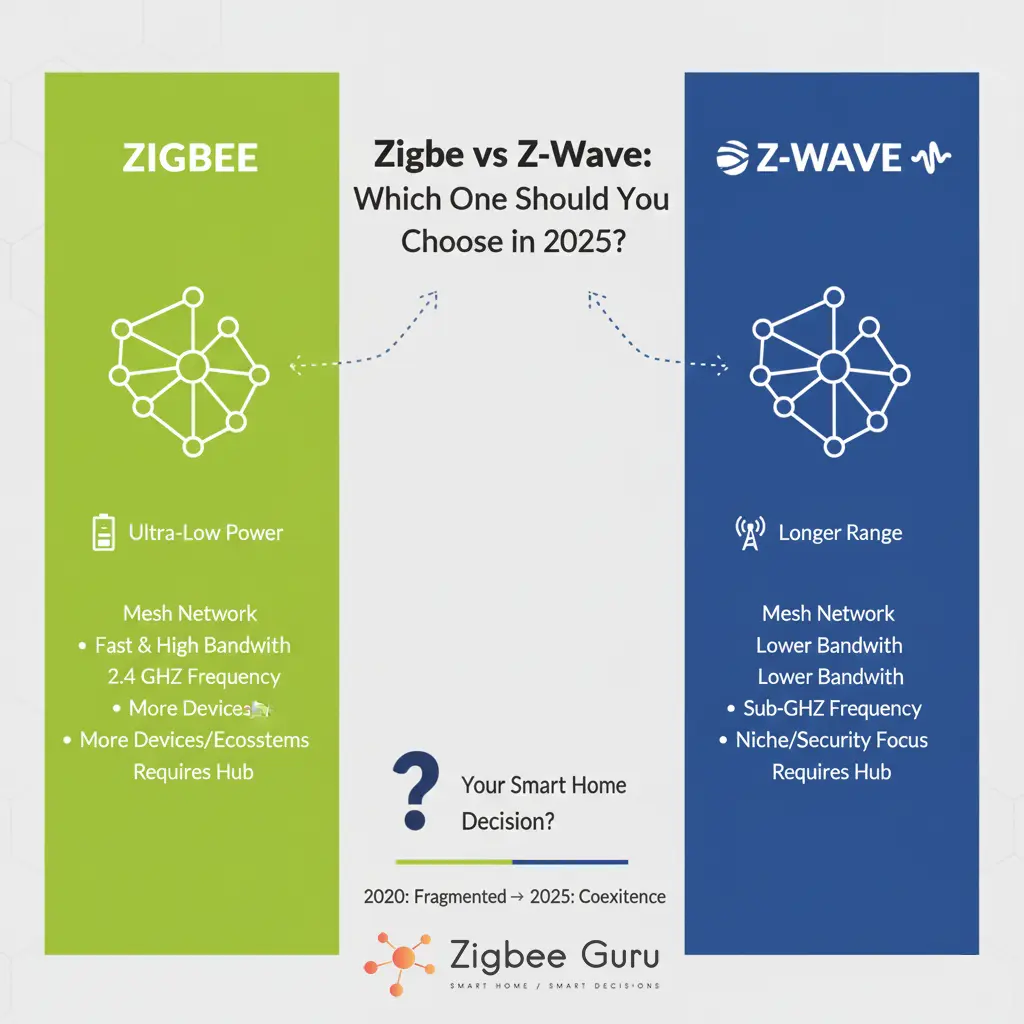
Zigbee and Z-Wave are the two classic low-power mesh protocols that powered the first generation of serious smart homes. Both connect lights, sensors and switches without flooding your Wi-Fi, both promise strong range and low energy usage — and both are still very much alive in 2026.
At the same time, the landscape has changed. Matter and Thread are arriving, Zigbee just introduced Zigbee 4.0 with sub-GHz options, and Z-Wave Long Range promises kilometer-scale links and thousands of nodes on a single network.
This guide cuts through the noise. We’ll compare Zigbee and Z-Wave at the radio and network layers, look at range, reliability, battery life and ecosystem support, and finish with clear recommendations for which one to choose in 2026 — especially for EU homes.
Table of Contents
- Zigbee vs Z-Wave: High-Level Overview
- Frequency Bands, Range & Regulations
- Network Topology & Node Limits
- Ecosystem, Interoperability & Device Availability
- Latency, Reliability & RF Interference
- Power Consumption & Battery Life
- Future Roadmaps: Zigbee 4.0 & Z-Wave Long Range
- Zigbee vs Z-Wave: 2026 Comparison Table & Recommendations
- Conclusion
- FAQ About Zigbee vs Z-Wave
Zigbee vs Z-Wave: High-Level Overview
Zigbee is a low-power wireless mesh standard based on IEEE 802.15.4, designed for personal area networks and home automation. It typically operates in the 2.4 GHz ISM band worldwide (with some sub-GHz variants), and is widely used in sensors, switches, smart lighting and energy monitoring.
Z-Wave is also a low-power wireless protocol for home and building automation, but it uses sub-GHz frequencies and is tightly controlled by the Z-Wave Alliance and Silicon Labs. It started as a classic mesh network and now also includes Z-Wave Long Range (LR) for star-topology, kilometer-scale links.
Both are designed specifically for smart homes — not for high-bandwidth tasks like streaming. They prioritize reliability, modest data rates and low energy consumption over raw speed.
If you want a deep dive into Zigbee fundamentals (Coordinator / Router / End Device roles, mesh design, etc.), you can read the dedicated guide: What is Zigbee? A Complete Guide
Frequency Bands, Range & Regulations
The most fundamental difference between Zigbee and Z-Wave is the radio band they use.
- Zigbee: Commonly uses the 2.4 GHz ISM band worldwide, with 16 channels defined between 2.405–2.480 GHz. Some Zigbee variants also operate in 868 MHz (EU) and 915 MHz (US), but consumer smart-home devices are overwhelmingly 2.4 GHz today.
- Z-Wave: Uses sub-GHz bands that vary by region. In Europe, the primary frequency is 868.4 MHz, while in North America it’s typically 908.4 MHz. Devices are region-locked and not cross-compatible between frequency regions.
Sub-GHz signals used by Z-Wave tend to offer better wall penetration and longer range at the same transmit power than 2.4 GHz, which is helpful in thick-walled EU homes. Zigbee’s 2.4 GHz band is more crowded (Wi-Fi, Bluetooth, microwave ovens), but it is globally harmonized and supported by a huge range of chipsets.
For large properties or challenging RF conditions, the lower frequency of Z-Wave (and future Zigbee 4.0 sub-GHz options) can be a practical advantage.
Network Topology & Node Limits
Both Zigbee and classic Z-Wave use mesh networking — devices relay messages for each other so the network can cover larger areas and route around failures.
- Zigbee Mesh: Zigbee supports mesh routing with a theoretical maximum of up to 65,000 devices per network (practically, the limit is much lower and depends on the coordinator and implementation). Typical indoor range per hop is 10–20 m at 2.4 GHz, but walls and interference can reduce this.
- Z-Wave Mesh: Traditional Z-Wave networks support up to 232 nodes and use up to 4 hops between devices and the controller. This is usually enough for a single-family home but can be restrictive in very large installations.
Z-Wave Long Range (LR) changes things: instead of mesh, it uses a star topology where all devices connect directly to the hub. Z-Wave LR supports up to 4,000 nodes and line-of-sight ranges of up to several miles at higher power levels, while remaining backward compatible with classic mesh nodes.
For typical EU homes and apartments, both protocols have sufficient node capacity. Mesh quality (number and placement of powered repeaters) usually matters more than the theoretical node limit.
Ecosystem, Interoperability & Device Availability
Zigbee is managed by the Connectivity Standards Alliance (CSA) — the same body behind Matter. It has a massive installed base in consumer lighting, sensors and energy products: Philips Hue (internally), IKEA, Aqara, many Tuya-based devices and countless OEM brands.
Z-Wave is governed by the Z-Wave Alliance and Silicon Labs. Its ecosystem is smaller in sheer device count but very strong in professional security panels, locks and certified smart-home systems, especially in North America and parts of Europe.
- Zigbee strength: Huge variety of low-cost devices; lots of choice for sensors and lighting; strong support in DIY platforms like Home Assistant via USB coordinators.
- Z-Wave strength: Stricter certification; region-specific RF reduces interference; many devices targeted at alarm installers and pros, often with a “just works” reputation once configured correctly.
Both worlds are now being pulled toward Matter. Many Zigbee and Z-Wave hubs (Hue, Aqara, SmartThings, etc.) will increasingly act as bridges, exposing their internal Zigbee/Z-Wave devices as Matter accessories to Apple/Google/Amazon ecosystems. That means the protocol choice is gradually moving “under the hood”, while the user sees a unified Matter layer.
For a deeper dive into Matter and Thread and how they impact Zigbee, see: What Is Matter & Thread? Will Matter Kill Zigbee?
Latency, Reliability & RF Interference
Both Zigbee and Z-Wave are designed for low-latency control (think lights turning on in under 200 ms) rather than high throughput. In practice, most differences users notice are due to RF environment and network design, not the raw protocol spec.
- Zigbee & Interference: At 2.4 GHz, Zigbee shares spectrum with Wi-Fi and Bluetooth. Poor channel planning (e.g. Zigbee on a channel overlapping Wi-Fi channel 1 or 6) can cause retries and latency spikes. The upside: 2.4 GHz radios are cheap, and there are many channels to choose from.
- Z-Wave & Interference: Operating in sub-GHz bands (868.4 MHz EU), Z-Wave typically avoids Wi-Fi interference but may overlap with some cordless phones or legacy systems. Fewer nearby interferers can mean more consistent performance in dense apartment blocks.
In a well-designed network (good router placement, sensible channels, strong coordinator), both protocols can deliver near-instant automations. In badly planned networks, both can misbehave. There is no magic — radio physics still wins.
Key takeaway: In real homes, reliability is decided more by router density, placement and channel selection than by “Zigbee vs Z-Wave” on its own.
Power Consumption & Battery Life
Both Zigbee and Z-Wave were designed around low-power radios. In practice, battery life is dominated by how often the device wakes up, sends packets, and how good the firmware is — not only by the protocol label on the box.
- Zigbee: Mature implementations routinely deliver multi-year battery life for contact sensors and motion sensors in typical homes, thanks to very short radio-on times and simple payloads.
- Z-Wave: Z-Wave Plus and Z-Wave LR further improve energy efficiency. Z-Wave Long Range marketing claims up to 10 years on a coin cell for some devices, depending on usage and reporting intervals.
In 2026, the safest assumption is that well-designed devices from reputable vendors in either protocol can achieve multiple years of battery life. Zigbee still has a slight advantage in sheer maturity and tuning, while Z-Wave LR is catching up with more aggressive low-power modes.
Future Roadmaps: Zigbee 4.0 & Z-Wave Long Range
The “2026 and beyond” story is important, because it tells you whether investing in Zigbee or Z-Wave today is still wise.
- Zigbee 4.0: Recently announced by the CSA, Zigbee 4.0 adds support for European 800 MHz and North American 900 MHz PHYs (the “Suzi” branding), extending range and penetration while remaining backward-compatible with Zigbee 3.0. It also improves security, introduces scheduled communication for better battery life, and standardizes features like Zigbee Direct (Bluetooth commissioning) and batch device setup.
- Z-Wave Long Range (LR): Z-Wave LR extends range to several miles line-of-sight, supports up to 4,000 devices per network and uses a star topology. It’s backward compatible with classic Z-Wave but requires LR-capable hubs to exploit the new capabilities.
Both ecosystems clearly have a roadmap. Zigbee is doubling down on mesh plus optional sub-GHz and easier commissioning. Z-Wave is doubling down on long-range, high-node-count star networks while keeping its mesh roots.
Crucially, both are also positioning themselves as field buses behind Matter — used internally in bridges and hubs even when the user-visible layer is all IP and Matter clusters.
Zigbee vs Z-Wave: Comparison Table & Recommendations
The table below summarizes the main technical and practical differences between Zigbee and Z-Wave in 2026.
| Aspect | Zigbee (3.0 / 4.0) | Z-Wave (Plus / LR) |
|---|---|---|
| Typical Frequency | 2.4 GHz worldwide; Zigbee 4.0 adds EU 800 MHz & US 900 MHz options | Sub-GHz (868.4 MHz EU, 908.4 MHz US), region-specific |
| Network Topology | Mesh (Coordinator + Routers + End Devices) | Mesh (classic) + Star for Z-Wave LR |
| Node Capacity | Theoretical >65k; practical limit depends on coordinator | Classic ~232 nodes; Z-Wave LR up to 4,000 nodes |
| Interference Profile | Shares 2.4 GHz band with Wi-Fi/Bluetooth | Below Wi-Fi band, less crowded RF but region-locked |
| Ecosystem Size | Very large (Hue internal, IKEA, Aqara, Tuya, many DIY options) | Smaller but strong in locks, security and pro systems |
| Battery Life (Real World) | Excellent, multi-year on mature sensors | Very good; LR claims up to ~10 years in some cases |
| Future Path | Zigbee 4.0, Suzi sub-GHz, Zigbee Direct, better integration with Matter bridges | Z-Wave LR rollout, higher node counts and long-range outdoor/industrial use |
| Best Fit (2026) | EU homes wanting low-cost sensors, strong DIY ecosystem and Matter bridges | Homes prioritizing sub-GHz range, security devices and pro-grade certified systems |
So, which should you choose?
- Choose Zigbee if… you want a large variety of affordable sensors and lighting, plan to integrate with DIY platforms (e.g. Home Assistant via USB coordinator) and like the idea of future Zigbee 4.0 upgrades and Matter bridges.
- Choose Z-Wave if… you prioritize sub-GHz range and wall penetration, want strong support for certified locks and security products, or are working with an installer who already uses Z-Wave as their standard.
- Choose “both behind Matter” if… you’re building a long-term system. Let Zigbee and Z-Wave handle the field layer, and expose everything through modern hubs that can bridge to Matter and Thread where it makes sense.
Guru verdict: In 2026, the real question isn’t “Zigbee or Z-Wave?” but “Which protocol handles which job best in a hybrid, Matter-ready home?”
Conclusion
Zigbee and Z-Wave were both designed for exactly the same problem: reliable, low-power control of smart devices without overloading Wi-Fi. In 2026, both still solve that problem extremely well — just with different trade-offs in frequency, ecosystem and roadmap.
Zigbee offers an enormous, low-cost ecosystem and is evolving with Zigbee 4.0, sub-GHz options and better commissioning. Z-Wave provides quieter sub-GHz RF, strong presence in locks and security, and a powerful Z-Wave Long Range extension for very large or spread-out deployments.
For most EU homes, the most robust strategy is hybrid: use Zigbee where the ecosystem is strongest (sensors, lighting, energy) and Z-Wave where it adds clear value (locks, specialist modules, long-range links) — and connect both to modern hubs that can bridge into Matter and Thread over time. That way, whatever wins the standards war at the application layer, your devices remain useful.
FAQ About Zigbee vs Z-Wave
Below are the most common questions people ask when deciding between Zigbee and Z-Wave for a 2026 smart home.
- Which is better for EU homes, Zigbee or Z-Wave?
There’s no single winner. Zigbee gives you a huge ecosystem of affordable devices and strong support in DIY platforms. Z-Wave’s sub-GHz band can offer better penetration through thick walls and less interference. In many EU homes, the best choice is to mix them: Zigbee for sensors and lights, Z-Wave for locks and selected modules. - Are Zigbee and Z-Wave compatible with Matter?
Not directly. Matter is an IP-based application layer, while Zigbee and classic Z-Wave are non-IP mesh protocols. However, many hubs and bridges will expose their Zigbee/Z-Wave devices as Matter accessories, allowing them to appear in Apple/Google/Amazon apps even though the underlying radio is Zigbee or Z-Wave. - Can Zigbee and Z-Wave coexist in the same house?
Yes. They use different frequency bands (2.4 GHz vs sub-GHz), so they do not interfere with each other. You can run both protocols simultaneously and control them through one or more hubs or a central platform like Home Assistant. - Is Z-Wave more secure than Zigbee?
Both protocols support modern, strong encryption and secure key exchange when implemented correctly. Z-Wave has historically marketed its mandatory certification and security profiles strongly; Zigbee 3.0 and 4.0 significantly improved Zigbee’s security model compared to early versions. In 2026, device-level security and vendor implementation matter more than choosing “Zigbee vs Z-Wave” alone. - Does Z-Wave Long Range make Z-Wave the default choice?
Z-Wave LR is excellent for long-range or campus-style deployments and very large node counts, but it requires LR-capable hubs and devices. For typical apartments or standard EU homes, classic Zigbee or Z-Wave mesh is usually enough. Z-Wave LR is best seen as an additional tool, not a universal replacement. - If I’m starting from zero in 2026, what should I pick?
If you like DIY and want maximum choice, start with a solid Zigbee coordinator and add devices from reputable brands. If you’re working with a professional installer or want strong lock/security integration, expect Z-Wave to play a bigger role. In both cases, choose hubs that are Matter-aware so you can integrate with future Matter/Thread devices without rebuilding everything.



