
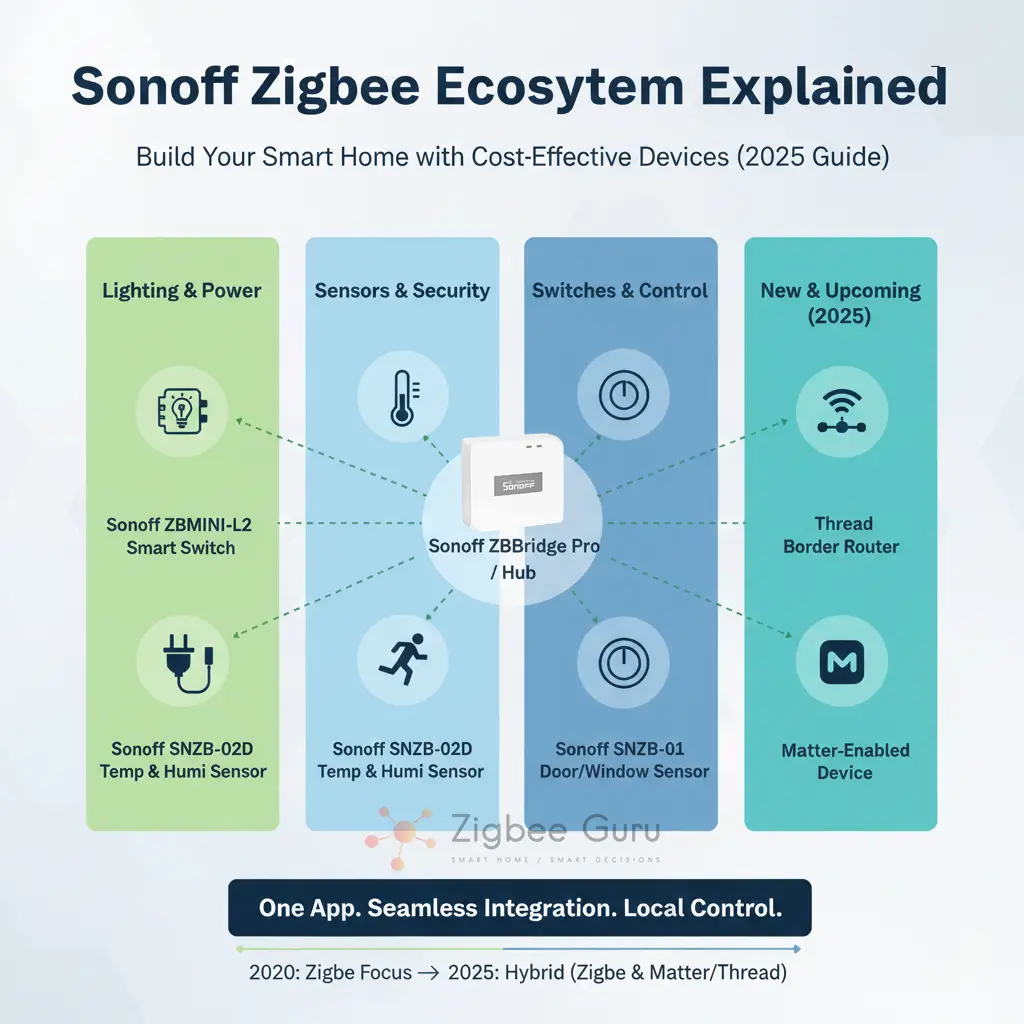
SONOFF has become one of the most popular brands for budget-friendly smart home gear — especially in the Zigbee world. But once you start looking at bridges, USB dongles, iHost, NSPanel Pro, ZBMINI switches, and a dozen different SNZB sensors, the ecosystem can quickly feel confusing.
This guide explains the Sonoff Zigbee ecosystem as a whole: how the bridges and USB dongles differ, where iHost and NSPanel Pro fit in, how the SNZB sensors behave in a real Zigbee mesh, and what to choose if you’re building a local-first, EU-friendly smart home in 2026.
We’ll also look at network capacity, router density, local vs cloud control, and how Sonoff’s Zigbee lineup fits into a future that includes Matter and Thread.
Table of Contents
- What Is the Sonoff Zigbee Ecosystem?
- Core Building Blocks: Bridges, Dongles & Hubs
- Sonoff Zigbee Sensors & Remotes (SNZB Series)
- Switches, Plugs & In-Wall Modules
- Local vs Cloud: eWeLink, iHost & Open Platforms
- Mesh Capacity, Range & Network Design
- Matter, Thread & the Long-Term Future of Sonoff Zigbee
- Sonoff Zigbee Gateways: Comparison Table
- Conclusion
- FAQ About the Sonoff Zigbee Ecosystem
What Is the Sonoff Zigbee Ecosystem?
The Sonoff Zigbee ecosystem is a family of devices built around Zigbee 3.0 — including bridges, USB coordinators, sensors, switches, and Zigbee-enabled control panels. The goal is simple: provide an affordable, flexible way to add low-power mesh automation to homes that already rely on Wi-Fi, Alexa, Google Home, or Home Assistant.
At the center of this ecosystem are Zigbee gateways such as the ZBBridge-P (Zigbee–Wi-Fi bridge), the ZBDongle-P/E USB coordinators for open-source platforms, and the iHost and NSPanel Pro hubs with built-in Zigbee 3.0 radios. These gateways can typically handle dozens to over 100 Zigbee devices each, forming a self-healing mesh (depending on platform and firmware).
Around them you’ll find Sonoff’s SNZB sensors (door, motion, temperature, button), ZBMINI-L2 in-wall switches, and S26R2ZB smart plugs acting as both automation endpoints and Zigbee routers. The result is a complete toolkit that can cover lighting, heating, presence, and basic security in a typical EU apartment or house.
If you’re new to Zigbee itself, you may want to start with the full protocol overview here: What is Zigbee? A Complete Guide (2026 updated).
Core Building Blocks: Bridges, Dongles & Hubs
Sonoff exposes Zigbee in three main ways:
- Zigbee Bridges – Wi-Fi connected boxes that link Zigbee devices to the eWeLink cloud and app.
- USB Dongles – Universal Zigbee 3.0 coordinators for Home Assistant, openHAB and Zigbee2MQTT.
- Integrated Hubs – Devices like iHost and NSPanel Pro with built-in Zigbee and local automation capabilities.
Here’s how the most important products fit together.
1. SONOFF ZBBridge-P (Zigbee Bridge Pro)
The ZBBridge-P is a Zigbee 3.0 bridge that connects up to 128 Zigbee sub-devices (sensors, plugs, switches) and exposes them to the eWeLink app over Wi-Fi. Plug-in devices can act as Zigbee routers to extend coverage, and the bridge supports local smart scenes and security modes, so some automations continue to run even if the internet is down.
Where to Buy:
👉 Amazon — Best Current Price (affiliate)
👉 AliExpress — Alternative Seller (affiliate)
2. SONOFF ZBDongle-P & ZBDongle-E (USB Coordinators)
The ZBDongle-P and ZBDongle-E are USB Zigbee 3.0 coordinators designed for local-first platforms like Home Assistant, openHAB, and Zigbee2MQTT.
ZBDongle-P – Based on TI CC2652P, pre-flashed with Z-Stack coordinator firmware, external SMA antenna, up to roughly 50 direct children and ~200 devices with routers (depending on platform and config).
Where to Buy:
👉 Amazon — Best Current Price (affiliate)
👉 AliExpress — Alternative Seller (affiliate)
ZBDongle-E – Based on Silicon Labs EFR32MG21 with EZNet coordinator firmware, typically ~30 direct children plus additional devices via routers.
Where to Buy:
👉 Amazon — Best Current Price (affiliate)
👉 AliExpress — Alternative Seller (affiliate)
Both are ideal if you want full control over your Zigbee mesh and prefer local dashboards (Home Assistant, Node-RED) instead of the eWeLink cloud.
3. SONOFF iHost & NSPanel Pro (Integrated Zigbee Hubs)
The iHost Smart Home Hub is a local control center with a built-in Zigbee hub that can manage up to 128 Zigbee devices, expose a Zigbee map, and run scenes completely without cloud dependency.
👉 Best Price on Amazon (affiliate)
👉 Alternative Seller — AliExpress (affiliate)
The NSPanel Pro is a wall-mounted control panel with a built-in Zigbee 3.0 hub, Wi-Fi, Bluetooth and Matter support, designed to manage lights, temperature and security from a single touchscreen.
👉 Best Price on Amazon (affiliate)
👉 Alternative Seller — AliExpress (affiliate)
Key takeaway: Bridges (ZBBridge-P/U) are best for eWeLink users, USB dongles (ZBDongle-P/E) are best for Home Assistant and Zigbee2MQTT, while iHost and NSPanel Pro suit users who want built-in Zigbee hubs with local scenes and dashboards.
Sonoff Zigbee Sensors & Remotes (SNZB Series)
The SNZB series is the backbone of the Sonoff Zigbee ecosystem. These are usually battery-powered end devices designed for very low energy usage and multi-year battery life.

| Model | Function | Key Specs / Highlights |
|---|---|---|
| SNZB-01P | Wireless button / remote | Zigbee 3.0, single/double/long press, CR2477 battery with up to ~5-year life, compact 45×45×17.7 mm design. |
| SNZB-02P | Temperature & humidity | ±0.2 °C / ±2% RH accuracy, 5-second refresh rate, up to ~4-year battery, supports iHost, NSPanel Pro, ZBBridge-P, ZBDongle-E and third-party hubs. |
| SNZB-03P | Motion sensor | Detects motion in under ~5 s, CR2477 battery with ~3-year life, can trigger lights, alarms and cameras; supports local scenes if hub allows. |
| SNZB-04P | Door / window contact | Zigbee 3.0, tamper alert, >5-year battery, integrates with NSPanel Pro, iHost, ZBBridge-P, ZBDongle-E and Echo/SmartThings hubs. |
These sensors are excellent for home security, presence detection, and energy-aware automation. For example:
-
- SNZB-04P on doors/windows → triggers lights and security alerts.
-
- SNZB-03P in hallways → motion-based night lighting with minimal standby power.
-
- SNZB-02P in living room and bedrooms → drives climate automation and radiator/AC control.
-
- SNZB-01P as a wireless wall switch → scene recall and manual overrides.
Most SNZB devices are Zigbee end devices (they do not route traffic), so they depend on a healthy mesh of mains-powered routers such as plugs and in-wall switches. For a deeper dive into practical sensor use cases, see also: Best Zigbee Sensors for Home Security.
Switches, Plugs & In-Wall Modules
Sonoff’s Zigbee switches and plugs are important because they act as both controllable loads and Zigbee routers (except a few end-device-only models), helping to extend and stabilize the mesh.
-
- S26R2ZB Smart Plug – A Zigbee 3.0 smart Schuko plug that can be remote-controlled via eWeLink, scheduled, and used in smart scenes. It’s compatible with the ZBBridge-P and other Zigbee 3.0 hubs and can be integrated with Zigbee2MQTT for vendor-independent control.
-
- ZBMINI-L2 (ZBMINI Extreme) – An ultra-compact in-wall Zigbee 3.0 switch that does not need neutral, making it ideal for older EU homes. It fits inside EU/86/120 wall boxes and supports external rocker or push-button switches. Note that ZBMINI-L2 is a Zigbee end device, not a router, so it does not extend the mesh.
In a typical Sonoff setup, you’ll combine:
-
- 1× Zigbee gateway (ZBBridge-P, ZBDongle-P/E, iHost, NSPanel Pro)
-
- Several Zigbee plugs/switches as routers (S26R2ZB, some in-wall modules)
-
- Many Zigbee end devices (SNZB sensors, ZBMINI-L2, buttons)
This combination gives you both coverage and functionality: routers spread the mesh, while end devices capture environmental data and trigger your automations.
Local vs Cloud: eWeLink, iHost & Open Platforms
One of the key decisions in the Sonoff ecosystem is where your Zigbee logic runs — entirely local, partly cloud-dependent, or fully open-source.
-
- eWeLink Cloud (ZBBridge-P, S26R2ZB, SNZB series)
With devices paired via a Zigbee bridge to the eWeLink app, automations are created in the cloud but many local scenes (for ZBBridge-P) can still run even if the internet is down. Voice assistants (Alexa, Google, SmartThings) are easily integrated.
- eWeLink Cloud (ZBBridge-P, S26R2ZB, SNZB series)
-
- Local Controller – iHost
The iHost hub acts as a local server with built-in Zigbee, local security modes and smart scenes, and support for up to 128 Zigbee devices. Sonoff also offers a Matter Bridge for Home Assistant over iHost, allowing you to expose local devices to Matter-compatible platforms.
- Local Controller – iHost
-
- Open Platforms – ZBDongle-P/E
With ZBDongle-P/E, all Zigbee devices are managed directly by Home Assistant, openHAB or Zigbee2MQTT. This gives maximum flexibility, vendor-independent device support and fully local automation – at the cost of more configuration.
- Open Platforms – ZBDongle-P/E
Key takeaway: If you want the easiest experience, choose ZBBridge-P + eWeLink. If you want a local, vendor-neutral lab, use ZBDongle-P/E + Home Assistant. If you want a Sonoff-centric but local hub, choose iHost or NSPanel Pro.
Mesh Capacity, Range & Network Design
From a Zigbee Guru perspective, the Sonoff ecosystem matters less than how you design the mesh. The good news: Sonoff’s gateways are capable enough for most EU homes.
-
- ZBBridge-P & iHost – Can typically connect up to 128 Zigbee devices, assuming sufficient router density.
-
- ZBDongle-P – Roughly 50 direct children and up to ~200 devices with routers, depending on platform/firmware.
-
- ZBDongle-E – Around 30 direct children plus more via routers; platforms usually become the limiting factor before the radio itself.
For a stable Sonoff Zigbee mesh in a typical European apartment or house:
-
- Place the gateway (bridge/dongle/hub) roughly central in the floor plan.
-
- Use at least 3–5 mains-powered routers per 100 m² (e.g. S26R2ZB plugs), especially along corridors and near staircases.
-
- Keep SNZB sensors within one or two hops of a router and away from metal cabinets or reinforced concrete when possible.
-
- If you use ZBMINI-L2 heavily (end devices), do not rely on them as routers – add dedicated router-capable plugs/switches.
This design ensures that Sonoff’s low-power sensors have strong LQI to at least one nearby router and your automations remain fast and reliable.
Matter, Thread & the Long-Term Future of Sonoff Zigbee
As of 2026, the smart home world is shifting towards Matter and Thread, but that doesn’t make Sonoff’s Zigbee ecosystem obsolete. Instead, Sonoff is positioning its hardware as a bridge between legacy Zigbee and the new multi-admin ecosystem.
-
- NSPanel Pro combines Zigbee 3.0, Wi-Fi, Bluetooth and Matter, acting as both Zigbee hub and Matter controller for multi-vendor devices.
-
- iHost offers a Matter bridge for Home Assistant devices, so your local HA-managed devices can be exposed to Matter-compatible platforms.
-
- Zigbee devices (SNZB sensors, S26R2ZB plugs, ZBMINI-L2 switches) remain cost-effective and low-power, and can be mapped into Matter ecosystems via bridges and gateways for many years.
In other words, Sonoff’s Zigbee lineup is likely to coexist with Matter/Thread for a long time: Zigbee handles cheap sensors and actuators, while Matter/Thread focuses on cross-ecosystem compatibility and newer device classes.
Sonoff Zigbee Gateways: Comparison Table
The table below summarizes how Sonoff’s main Zigbee gateways differ. Exact limits depend on firmware and platform, but the relative positioning is accurate for 2026.
| Gateway | Type | Typical Zigbee Scale | Primary Platform | Best For |
|---|---|---|---|---|
| ZBBridge-P | Zigbee–Wi-Fi bridge | Up to ~128 devices | eWeLink Cloud + local scenes | Easy setup, mixed Wi-Fi/Zigbee Sonoff homes |
| ZBDongle-P | USB Zigbee coordinator (CC2652P) | ~50 direct children, ~200+ with routers | Home Assistant (ZHA), Zigbee2MQTT, openHAB | Power users building large, fully local meshes |
| ZBDongle-E | USB Zigbee coordinator (EFR32MG21) | ~30 direct children + extra via routers | Home Assistant, Zigbee2MQTT, openHAB | Users preferring Silicon Labs-based stacks |
| iHost | Local hub with built-in Zigbee | Up to ~128 devices | Sonoff local platform + Matter bridge | Local-first Sonoff homes with dashboards |
| NSPanel Pro | Wall panel with Zigbee hub & Matter | Household-scale Zigbee network | eWeLink + Matter, voice assistants | In-wall control center for lights/comfort/security |
For a deeper protocol-level comparison between Zigbee and other options, you can also see: Zigbee vs Z-Wave: Which One Should You Choose in 2026?
Conclusion
The Sonoff Zigbee ecosystem offers a complete, affordable toolkit for building a modern smart home: gateways for both cloud and local control, well-priced sensors and plugs, and integrated hubs like iHost and NSPanel Pro that bridge classic Zigbee into the Matter era.
If you want a plug-and-play experience, start with a ZBBridge-P and a handful of SNZB sensors + S26R2ZB plugs. If you’re an advanced user or engineer, consider a ZBDongle-P/E with Home Assistant and treat Sonoff’s Zigbee lineup as a flexible, low-cost hardware layer underneath your own automations.
Either way, with good router density and a sensible choice of gateway, the Sonoff Zigbee ecosystem can easily serve as the backbone of a stable, energy-aware EU smart home for many years.
FAQ About the Sonoff Zigbee Ecosystem
Below are the most common practical questions about Sonoff’s Zigbee ecosystem, especially from users deciding between bridges, dongles and integrated hubs.
-
- Can I mix Sonoff Zigbee devices with other brands?
Yes. Sonoff Zigbee devices follow the Zigbee 3.0 standard, so they can usually join any compatible Zigbee 3.0 hub (e.g. Echo 4th Gen, SmartThings, Home Assistant + ZBDongle-P/E). Always check device support lists for your chosen platform.
- Can I mix Sonoff Zigbee devices with other brands?
-
- Which Sonoff Zigbee gateway should I pick?
Use ZBBridge-P if you want the eWeLink app and easy cloud integration, ZBDongle-P/E if you want full local control with Home Assistant or Zigbee2MQTT, and iHost / NSPanel Pro if you prefer an integrated local hub with dashboards or wall-mounted control.
- Which Sonoff Zigbee gateway should I pick?
-
- Do Sonoff Zigbee devices work offline?
Yes, as long as they remain connected to a local Zigbee hub. ZBBridge-P supports local scenes, iHost is explicitly designed for local automation, and ZBDongle-P/E with Home Assistant or Zigbee2MQTT are fully local by design.
- Do Sonoff Zigbee devices work offline?
-
- Can I use Sonoff Zigbee with Home Assistant?
Yes. Sonoff’s ZBDongle-P/E are popular Zigbee coordinators for Home Assistant (via ZHA or Zigbee2MQTT). Many Sonoff Zigbee end devices (SNZB sensors, S26R2ZB, ZBMINI-L2) are supported out of the box.
- Can I use Sonoff Zigbee with Home Assistant?
-
- Is Sonoff Zigbee compatible with Matter?
Indirectly. NSPanel Pro and iHost can act as Matter controllers/bridges, allowing you to expose Zigbee devices and Home Assistant entities to Matter ecosystems. The Zigbee devices themselves remain Zigbee; Matter runs on top via bridging.
- Is Sonoff Zigbee compatible with Matter?



