
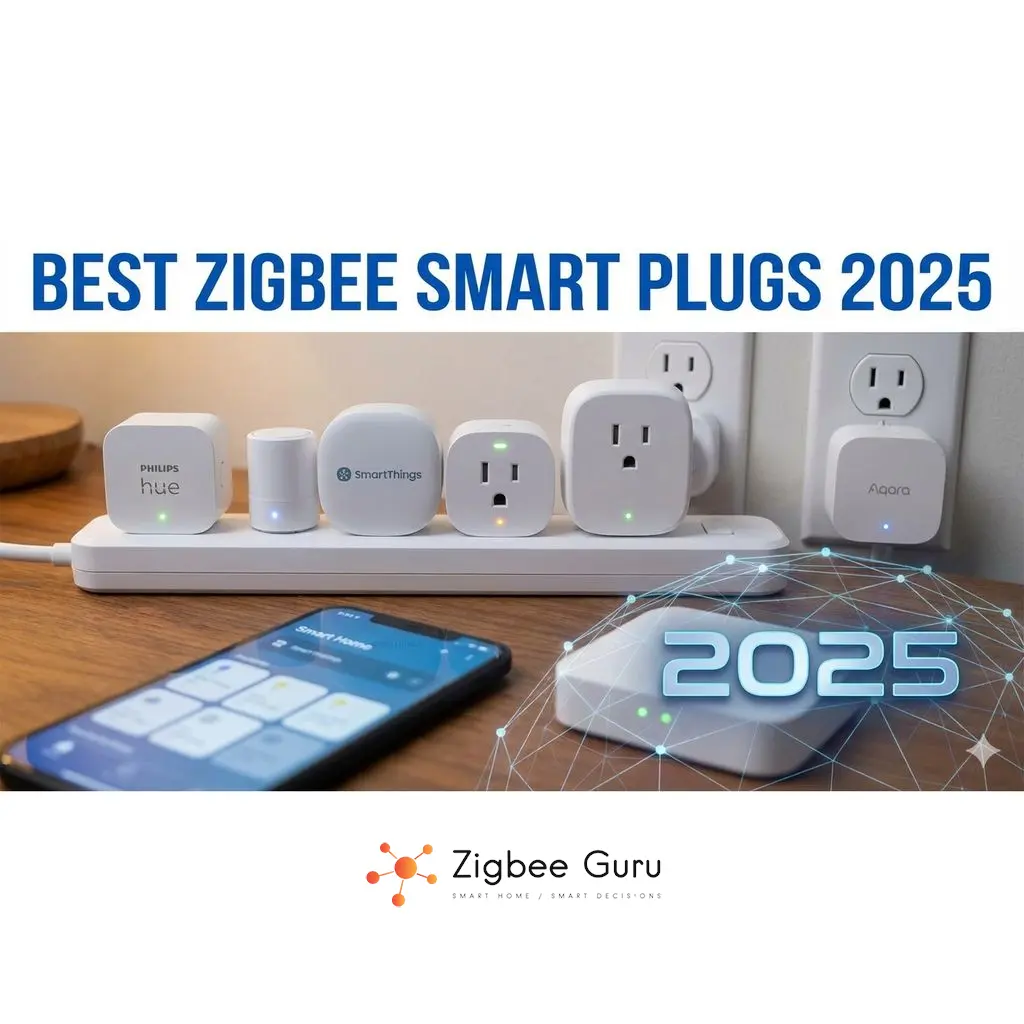
Zigbee smart plugs are one of the fastest ways to add real intelligence to an existing home. They sit between the wall socket and your appliance, giving you remote control, schedules, energy monitoring, and protection features without rewiring or replacing devices.
In 2026, the “best” Zigbee smart plug is not just the cheapest one. You need safe switching at EU mains, strong Zigbee 3.0 radio performance, correct handling of heavy loads, and good integration with your chosen ecosystem (Home Assistant, Aqara, Tuya, SmartThings, etc.).
This guide focuses on the best Zigbee smart plugs for 2026, how they differ, and how to choose the right mix for energy monitoring, automation and safety in a typical European home.
Table of Contents
- Overview: What a Zigbee Smart Plug Actually Does
- Key Benefits vs Wi-Fi and Z-Wave Plugs
- Best Overall: Aqara Smart Plug (EU)
- Best for Home Assistant: SONOFF Zigbee Smart Plug
- Best Budget: Tuya Zigbee Smart Plugs
- Energy Monitoring and Load Management
- Comparison Table: Best Zigbee Smart Plugs 2026
- Setup Tips, Safety and EU Considerations
- Conclusion
- FAQ: Zigbee Smart Plugs
Overview: What a Zigbee Smart Plug Actually Does
A Zigbee smart plug is a small adapter that plugs into a wall socket and exposes the connected appliance to your Zigbee network. It turns a “dumb” heater, lamp, fan or charger into a controllable load that your hub can switch, schedule and monitor.
Technically, the plug contains a relay rated for EU mains (usually 230 V AC at 10–16 A), a Zigbee radio based on IEEE 802.15.4 at 2.4 GHz, and often a metering chip for real-time power and energy measurements. Most plugs act as Zigbee routers, extending your mesh while also controlling the load.
Because they are mains powered and always on, Zigbee plugs are ideal for strengthening network coverage, especially in homes where battery sensors alone would create a weak mesh.
Key Benefits vs Wi-Fi and Z-Wave Plugs
Smart plugs exist in all major protocols: Wi-Fi, Z-Wave, Zigbee and even Thread. Zigbee remains a strong choice in 2026 because it balances low power consumption, mesh coverage and mature hub support across many brands.
| Aspect | Zigbee Smart Plug | Wi-Fi Smart Plug | Z-Wave Smart Plug |
|---|---|---|---|
| Network type | IEEE 802.15.4 mesh at 2.4 GHz | 802.11 Wi-Fi, star topology | Sub-GHz mesh (EU: ~868 MHz) |
| Impact on router | Low (uses hub/coordinator) | High if you have many plugs | Low (uses Z-Wave controller) |
| Range in EU buildings | Good with enough routers | Good, but can be noisy | Very good wall penetration |
| Ecosystem diversity | Strong (Aqara, Tuya, SONOFF, etc.) | Strong but fragmented | More niche, fewer brands |
| Typical use case | Whole-home automation + sensors | Simple app or cloud control | High-end automation installs |
For most European apartments and houses, Zigbee smart plugs are a practical default: they play nicely with other Zigbee sensors, reduce Wi-Fi congestion, and still offer enough range when you deploy them as part of a well-designed mesh.
Best Overall: Aqara Smart Plug (EU)
The Aqara Smart Plug (EU) is a compact Zigbee plug with solid build quality, support for up to 230 V / 10 A loads, and tight integration with Aqara hubs and Apple Home. It combines reliable switching, basic overload protection and decent energy reporting for most household appliances.👉 Check Price on Amazon
- Ecosystem: works best with Aqara hubs, with exposure to Apple Home, Google Home and other ecosystems via supported bridges.
- Load rating: typically suitable for lamps, routers, small heaters and media equipment; always check the label before using with high-wattage devices.
- Features: on/off control, power monitoring in supporting apps, and use as a stable Zigbee router in your mesh.
This plug is a strong general-purpose choice if you are already invested in Aqara sensors or want a clean, vendor-supported experience that still uses standard Zigbee under the hood.
Best for Home Assistant: SONOFF Zigbee Smart Plug
The SONOFF Zigbee Smart Plug (such as the S26 Zigbee EU variant) targets power users who prefer flexible hubs like Home Assistant, Zigbee2MQTT or ZHA. It is usually Zigbee 3.0 certified, exposes energy metering, and behaves as a strong router in medium-sized meshes.👉 Check Price on Amazon
- Integration: well-supported by most open Zigbee stacks, often with easy pairing and full access to power, voltage and current entities.
- Use cases: monitoring IT gear, network equipment, entertainment systems and small heaters, while reinforcing the Zigbee mesh.
- Firmware and community: commonly used by enthusiasts, which helps with long-term compatibility and troubleshooting guides.
If your primary hub is Home Assistant running on a dedicated coordinator, a SONOFF Zigbee plug is a practical default, balancing cost, Zigbee routing quality and energy telemetry.
Best Budget: Tuya Zigbee Smart Plugs
Tuya Zigbee smart plugs are sold under many brand names but usually share similar electronics: Zigbee 3.0 radio, 10–16 A relay, and optional energy metering, all configured through the Tuya or Smart Life app. They are often the most economical way to deploy many plugs across a home.👉 Check Price on Amazon
- Cost: frequently the lowest price per plug, especially in multipacks, making them ideal for non-critical loads and coverage-building routers.
- App ecosystem: native control via Tuya/Smart Life, with cloud-to-cloud links to Alexa and Google Assistant, and local control possible through compatible gateways.
- Variations: many models offer energy metering, child lock, scheduling and overload protection; always confirm the exact spec of the variant you buy.
For renters and budget-conscious users, Tuya-based Zigbee plugs provide a flexible entry point, as long as you verify correct EU certification and load ratings for your country.
Energy Monitoring and Load Management
Many modern Zigbee smart plugs include an internal metering chip that measures real-time power (W), energy (kWh), voltage (V) and current (A). Exposed through your hub, these values allow you to build accurate dashboards and automation rules for energy savings.
- Baselining devices: log typical power draw of fridges, boilers, routers and TVs to understand their real consumption.
- Detecting anomalies: trigger alerts when a device draws zero power unexpectedly (e.g. freezer failure) or far more than expected (possible fault).
- Peak shaving: stagger heavy loads, such as heaters or dryers, so they do not all run at the same time during expensive tariff windows.
Key point: a Zigbee smart plug with good metering turns “guessing” about energy use into measurable data, which is essential for serious efficiency work in 2026.
Comparison Table: Best Zigbee Smart Plugs 2026
This table summarizes the main differences between the three core plug families discussed above, focusing on EU usage.
| Aspect | Aqara Smart Plug (EU) | SONOFF Zigbee Plug | Tuya Zigbee Plugs |
|---|---|---|---|
| Best for | Aqara / Apple-centric homes | Home Assistant and power users | Budget and wide deployment |
| Typical load rating | Up to ~10 A @ 230 V | Up to ~10–16 A @ 230 V (model-dependent) | Up to ~10–16 A @ 230 V (model-dependent) |
| Energy monitoring | Yes, in supporting apps | Yes, often with detailed entities | Common, but varies by model |
| Zigbee role | Router | Router | Router |
| Hub dependency | Aqara hub recommended | Works well with open Zigbee stacks | Tuya/Smart Life gateway or compatible hub |
| Typical price tier | Mid | Mid | Low to mid |
In practice, many homes use a mix: Aqara or SONOFF plugs for critical or high-value loads, and Tuya-based plugs for secondary circuits where low cost and mesh coverage matter most.
Setup Tips, Safety and EU Considerations
Smart plugs deal directly with mains voltage, so basic electrical safety and EU regulatory awareness are essential. Always stay within rated current, and never use a plug outside its specified environment or temperature range.
- Check CE marking and documentation: confirm the plug is intended for 230 V AC in your region and has appropriate certification and enclosure category.
- Respect maximum current: do not run high-power resistive loads (e.g. large heaters) on 10 A plugs; in doubt, measure actual current or choose a higher-rated model.
- Use indoors unless specified: most Zigbee plugs are for indoor dry locations only; for outdoor use, look for IP-rated models with Schuko outlets designed for that purpose.
- Plan the mesh deliberately: distribute plugs so that they both control loads and act as reliable Zigbee routers, especially along corridors and between floors.
Following these guidelines keeps both your automation logic and your electrical installation within sensible engineering boundaries, which matters just as much as protocol choice.
Conclusion
Zigbee smart plugs in 2026 are mature, widely available and technically robust. When chosen carefully, they provide reliable switching, useful energy insight and stronger mesh coverage, without adding unnecessary load to your Wi-Fi network.
In most European homes, an Aqara Smart Plug (EU) or SONOFF Zigbee plug can cover the majority of important loads, while Tuya Zigbee plugs fill in budget-friendly roles and help densify the mesh. Prioritise correct load ratings, ecosystem compatibility and deliberate placement, and your smart plugs will behave like stable infrastructure rather than gadgets.
Combined with well-placed Zigbee sensors and a reliable coordinator, these plugs form a key part of a low-power, standards-based smart home that remains flexible as Matter and Thread continue to evolve on top of existing installations.
FAQ: Zigbee Smart Plugs
This section answers common questions about selecting and deploying Zigbee smart plugs in 2026, especially in European homes.
- Can I mix Zigbee smart plugs from different brands on the same network?
Yes, as long as your coordinator and software stack support them. It is common to mix Aqara, SONOFF, Tuya and other brands on one Zigbee 3.0 network, especially when using Home Assistant, Zigbee2MQTT or ZHA. - Are Zigbee smart plugs safe for high-power heaters?
Only if the plug’s rated current and power clearly cover the load. Many EU plugs are rated at 10 A; a 2 kW heater at 230 V draws around 8.7 A, which is close to the limit. In such cases, ensure good ventilation, avoid daisy-chaining adapters, and consider a higher-rated device if available. - Do Zigbee smart plugs work without an internet connection?
Yes. Zigbee is a local mesh protocol. As long as your hub or coordinator is running locally and your automation platform does not depend on cloud services for rules, smart plugs will continue to operate even if your internet is down. - Will Zigbee smart plugs still be relevant in a Matter/Thread future?
Yes. Existing Zigbee smart plugs will continue to work with their hubs, and many ecosystems offer bridges that expose Zigbee devices to Matter. Thread-based Matter plugs will grow, but there is no requirement to replace a functioning Zigbee installation. - How many Zigbee smart plugs can I safely add to one home?
From a network perspective, dozens of plugs are usually fine, and they actually strengthen the mesh. Practical limits are set by your coordinator firmware and hub software. From an electrical perspective, you must also respect circuit ratings and avoid overloading wall outlets or extension strips.



