
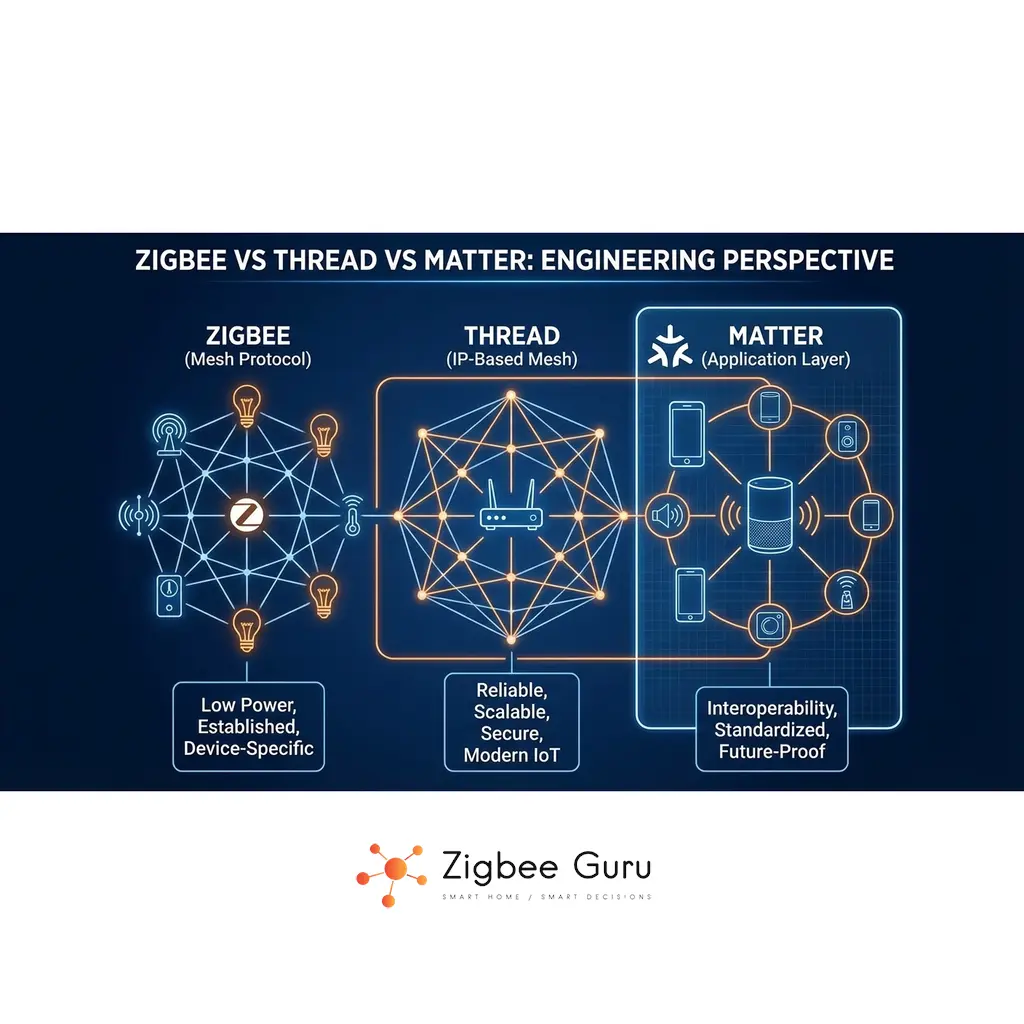
Zigbee, Thread and Matter are often mentioned together, but they solve different layers of the smart home stack. Zigbee and Thread are low-power mesh networking technologies, while Matter is an application layer that runs on top of IP networks such as Wi-Fi and Thread.
From an engineering perspective, choosing the right technology for each part of a home means understanding radio behaviour, power budgets, latency, and how controllers and bridges interact. The goal is not to pick a single winner, but to design a system where each protocol is used where it is strongest.
Most real EU homes in 2025–2030 will be hybrid — a mix of Matter, Thread and Zigbee devices. That is not a failure of standards. It is normal engineering: legacy gear stays, budgets matter, and ecosystems evolve at different speeds. The aim is a system that stays stable, debuggable, and upgrade-friendly — without turning your living room into a firmware support ticket.
This article explains how Zigbee, Thread and Matter work together, where they differ, and how to combine them in real European homes. It moves from engineering analysis to practical decisions and concrete product picks, so you can design a setup that survives the next few years of ecosystem churn.
Table of Contents
- Overview: Zigbee vs Thread vs Matter
- Zigbee: Engineering Basics and Strengths
- Thread: Engineering Basics and Strengths
- Matter: Application Layer and Ecosystem Role
- Design Patterns for Hybrid Smart Homes
- Latency, Reliability and Failure Modes
- Energy Use and 2.4 GHz Spectrum in Europe
- Choose Your Primary Ecosystem and Controllers
- Recommended Matter Controllers and Thread Border Routers (EU)
- Recommended Zigbee Hubs and Matter Bridges
- Reference Architecture: A Layered Model
- What to Use Where: Practical Recommendations
- Setup Checklist
- Comparison Table: Zigbee vs Thread vs Matter
- Conclusion
- FAQ
Overview: Zigbee vs Thread vs Matter
Zigbee and Thread both use IEEE 802.15.4 radios, typically at 2.4 GHz, to create low power mesh networks of devices. They differ mainly in the network and transport layers: Zigbee uses its own stack, while Thread is built on IPv6 with 6LoWPAN, allowing direct IP routing inside the mesh.
Matter is different: it is an application layer and data model that runs over IP. Matter devices can use Wi-Fi, Ethernet or Thread as transport, but they share a common commissioning flow and standardised clusters for lighting, sensors, climate and more. Controllers from multiple vendors can, in principle, talk to the same Matter device.
- Zigbee: non IP mesh over 802.15.4, mature and widely deployed.
- Thread: IP mesh over 802.15.4, designed for low power and interoperability.
- Matter: application layer over IP, unifying control and commissioning.
In a modern installation you are likely to use all three: Zigbee for low cost devices, Thread as a transport for some Matter nodes, and Matter itself as the unifying layer across ecosystems and vendor apps.
Zigbee: Engineering Basics and Strengths
Zigbee is built on IEEE 802.15.4 at 2.4 GHz, with optional sub-GHz variants in some regions. It uses a coordinator, routers and end devices to form a mesh, with routing tables and link quality metrics that determine how messages hop through the network. In practice, routers such as smart plugs and in wall modules are critical for stability.
On the application side, Zigbee profiles such as Home Automation and Zigbee 3.0 define clusters for lighting, sensors, metering and other functions. These clusters are well understood by open source stacks such as ZHA, Zigbee2MQTT and deCONZ, which translate them into entities for home automation platforms.
- Very low power for battery devices.
- Large existing ecosystem of sensors, switches and modules.
- Mature tooling and community knowledge for troubleshooting.
The main limitations are that Zigbee is not IP native and that vendor specific attributes can reduce interoperability. Bridges and coordinators remain a permanent part of the architecture, even if higher level control later moves to Matter or other IP based protocols.
Thread: Engineering Basics and Strengths
Thread also uses IEEE 802.15.4 at 2.4 GHz, but builds an IPv6 mesh on top using 6LoWPAN, UDP and standard routing. Every Thread node has an IP address, and roles such as routers, leaders and border routers are defined to keep the mesh stable while allowing communication with the wider network.
This IP native design means that application protocols such as Matter can run end to end without translation at the network layer. Border routers bridge between the Thread mesh and the home IPv6 network, often co located with smart speakers, TVs or dedicated hubs.
- IP based, making integration with existing networks straightforward.
- Low power mesh similar to Zigbee but with standardised routing.
- Designed from the start with security and commissioning in mind.
Thread adoption is still ramping up compared with Zigbee, but for new product designs and for installations where deep IP integration is desired, it offers a cleaner long term path while keeping the same radio characteristics as Zigbee. Keep an eye on Thread 1.4 adoption as the expected baseline for border routers in the next wave (2026+).
Matter: Application Layer and Ecosystem Role
Matter is defined by the Connectivity Standards Alliance as an application layer and device data model that runs over IP. It does not replace Zigbee or Thread at the radio level; instead it standardises how devices are commissioned, described and controlled over transports such as Wi-Fi, Ethernet and Thread.
A Matter controller, implemented in devices such as smart speakers or dedicated hubs, handles onboarding, fabric management and access control. Matter nodes expose clusters for functions like on or off, level control or temperature setpoints, and these are accessible to any authorised controller on the fabric, independent of vendor apps.
- Runs over existing IP transports rather than defining a new radio.
- Provides a common language for devices across ecosystems.
- Reduces the need for cloud to cloud integrations for basic control.
In homes that already have Zigbee installations, Matter will often be introduced via bridges, where a hub exposes legacy Zigbee devices as Matter endpoints. This preserves existing hardware while making it visible to newer controllers from multiple ecosystems.
Design Patterns for Hybrid Smart Homes
Most real European homes in the 2025–2030 window will be hybrid. Retrofitted apartments may keep Zigbee as a field bus for affordable sensors and in wall relays, add Thread for some newer devices, and use Matter as the common language for controllers and automations.
Hybrid works when each protocol has a clearly defined job. The biggest mistake is letting “whatever pairs fastest today” define your long-term architecture. A clean assignment of roles looks like this:
- Matter is your interoperability layer — what your main ecosystem sees.
- Thread is your modern low-power mesh for new Matter-native devices.
- Zigbee is your cost-effective device bus — sensors, stable lighting, legacy relays.
- One primary controller keeps the user experience consistent (voice, app, automations).
At a higher level, one practical pattern is to choose a primary ecosystem controller (for example a Home Assistant instance or a major vendor hub), then attach Zigbee and Thread networks as radio domains. Matter controllers sit above this, discovering devices natively when possible and through bridges when needed. For a concrete example of that pattern, see Home Assistant as the Matter controller over a Zigbee and Thread stack.
- Keep Zigbee for wide sensor coverage and low cost retrofits.
- Introduce Thread gradually with devices that benefit from IP.
- Use Matter to unify control across phone apps and ecosystems.
- Place border routers and coordinators carefully for good RF coverage.
Engineering rule: treat Zigbee and Thread as radio tools, and Matter as the language that your controllers and automations speak. Matter unifies, Zigbee stabilises, Thread future-proofs.
This layered approach keeps the architecture understandable and makes it easier to reason about failure modes: if a Thread border router fails, Thread based devices are affected, but Zigbee sensors and purely Wi-Fi Matter devices may continue working normally.
Latency, Reliability and Failure Modes
Latency in Zigbee and Thread is typically dominated by mesh hops and radio conditions, not by raw protocol overhead. Both can deliver sub second responses for lighting and sensors when the mesh is well designed and interference is controlled. Matter adds some processing overhead at the controller but remains suitable for real time user interactions.
Reliability is more sensitive to topology. Long chains of routers, battery devices placed at the edge of coverage and overloaded coordinators can all contribute to dropped commands or delayed updates. IP based Thread meshes can sometimes recover paths more flexibly, but they share the same radio constraints as Zigbee.
- Zigbee: proven behaviour under load, but coordinator limits matter.
- Thread: robust mesh with standard IP routing and diagnostics.
- Matter: depends heavily on controller quality and fabric design.
In engineering terms, it is helpful to design for graceful degradation. Local automations close to the edge devices, especially for lighting and safety, should not depend on remote clouds or on a single controller process that can be rebooted accidentally.
Energy Use and 2.4 GHz Spectrum in Europe
Both Zigbee and Thread assume low power operation on constrained devices. Typical sensor nodes are designed for multi year battery life by sleeping between short transmissions. The energy used by a smart bulb or plug is dominated by its load, not by the radio itself, but idle standby draw still matters at scale.
In the 2.4 GHz band, Zigbee and Thread share spectrum with Wi-Fi and Bluetooth. In European apartments with dense Wi-Fi deployments, careful channel planning is essential. Zigbee or Thread channels should ideally be placed between strong Wi-Fi channels, and coordinators kept away from noisy USB 3.0 devices and metal enclosures.
- Minimise redundant broadcasts and high reporting frequencies.
- Prefer mains powered routers for mesh stability.
- Consider sub-GHz options where allowed and appropriate.
Matter itself does not change the radio behaviour, but it may increase the number of IP capable devices in a home. For this reason, good Wi-Fi design and IPv6 support on the main LAN are increasingly important in mixed Matter, Thread and Zigbee environments. Check also How Much Energy Zigbee Uses vs Wi-Fi (Surprising Results).
Choose Your Primary Ecosystem and Controllers
Once the engineering principles are clear, the next decision is which ecosystem will be your front end. Pick one as the default user experience, then connect everything else to it via Matter — directly where possible, through bridges where needed. Mixing two front-ends rarely ends well: features diverge, automations duplicate, and troubleshooting doubles.
Apple-first homes
Use HomePod mini or Apple TV 4K as your primary Matter controller and Thread Border Router. The Apple TV 4K Ethernet model is preferable because a wired uplink eliminates a class of intermittent latency issues that affect mesh diagnostics.
- HomePod mini — Check price on Amazon
- Apple TV 4K (Ethernet model preferred) — Check price on Amazon
Google-first homes
Use Nest Hub devices and/or a compatible Nest Wi-Fi as the core experience. Keep firmware updated, because Thread behaviour varies significantly by version and region. A wired Nest Hub Max placed centrally is a strong baseline; adding a second border router only helps if coverage actually demands it.
- Nest Hub (2nd gen) — Check price on Amazon
- Nest Hub Max — Check price on Amazon
- Nest Wifi Pro — Check price on Amazon
Amazon / Alexa-first homes
Recent Echo devices and some Eero setups can deliver Matter controller and Thread Border Router capabilities, and certain Echo models also include a Zigbee radio — which can simplify small Zigbee deployments by removing the need for a separate hub. For larger Zigbee networks a dedicated coordinator is still the better choice.
- Echo (4th gen) — Check price on Amazon
- Echo Hub / Echo Show (latest models) — Check price on Amazon
- Eero (Thread-capable models) — Check price on Amazon
DIY / Home Assistant homes
Home Assistant shines when you want visibility, diagnostics, and long-term independence. Pair it with a strong Zigbee coordinator and a Thread solution — preferably an OpenThread Border Router approach you can monitor and update on your own schedule. For a step-by-step walkthrough see Home Assistant + Zigbee: A Step-by-Step Setup.
- Home Assistant Green — Check price on Amazon
- Multiprotocol Zigbee + Thread USB (where supported) — Check price on Amazon
Recommended Matter Controllers and Thread Border Routers (EU)
The picks above are grouped by ecosystem. For a deeper buyer’s guide focused on EU availability, voltage, and real-world Thread border router behaviour, see our dedicated comparison: Best Matter Controllers & Thread Border Routers for EU Homes.
A few practical notes that apply regardless of ecosystem:
- Prefer wired uplinks (Ethernet) for any device acting as a border router or primary controller.
- One central, reliable Thread border router beats three weak ones at the edges of coverage.
- Avoid placing the controller inside a metal cabinet, behind a TV, or directly next to USB 3.0 hubs.
- Check that the device explicitly advertises both Matter controller and Thread border router roles — not all do.
Recommended Zigbee Hubs and Matter Bridges
The best hybrid setups keep Zigbee devices behind a strong hub — then bridge upward to your main ecosystem so everything looks consistent in one app. This is what turns a pile of multi-vendor Zigbee gear into a single, manageable surface inside Apple Home, Google Home, Alexa, or Home Assistant.
- Aqara Hub M2 / M3 — solid Matter bridge behaviour for an affordable Zigbee deployment. The M3 also includes Thread border router functionality. Full breakdown in our Aqara Hub M3 Review. Check price on Amazon
- Philips Hue Bridge — the most mature Zigbee lighting controller in the EU market, with strong Matter export. Check price on Amazon
- Sonoff Zigbee Bridge Pro — good value for broader device coverage, especially in mixed Tuya/Aqara/Sonoff homes. See Sonoff Zigbee Ecosystem Explained. Check price on Amazon
For a side-by-side comparison across the major EU hub options including SmartThings, see Best Zigbee Hubs for EU Homes: Aqara vs Sonoff vs Tuya vs SmartThings.
Reference Architecture: A Layered Model
Use a layered model to prevent ecosystem spaghetti. The voice/app experience lives at the top; radios and device meshes live at the bottom. Each layer has one job and a clear interface to the one above and below it.
| Layer | Technology | Role | Typical devices |
|---|---|---|---|
| User experience | Primary ecosystem | Apps, voice, scenes | Apple Home / Google Home / Alexa / Home Assistant |
| Interoperability | Matter | Common device model and commissioning | Matter lights, plugs, switches, bridges |
| Modern low-power mesh | Thread | IP-based mesh for Matter-native low-power devices | New sensors and switches (Matter-over-Thread) |
| Device bus | Zigbee | Cost-effective, stable devices | Sensors, legacy relays, mature lighting |
The benefit of designing around this model is that any one layer can be replaced or upgraded without rebuilding the rest. A new primary ecosystem? Re-pair Matter devices to the new controller and rebuild automations — but the Zigbee mesh underneath does not move. A new Thread 1.4 border router? Drops in without touching the Zigbee side. This is the architecture that keeps a smart home maintainable over the lifetime of the building.
What to Use Where: Practical Recommendations
For door and window contacts, simple motion sensors and low cost environment sensing, Zigbee remains an excellent choice. The hardware is inexpensive, easy to find and integrates well with platforms that can bridge it later into Matter or other ecosystems through a hub.
For new build or major renovations where you control more of the infrastructure, adding Thread capable devices for lighting, plugs and some sensors can make sense. They will participate directly in IP routing and are ready for native Matter control without additional translation at the network layer.
- Use Zigbee where device cost and battery life dominate.
- Use Thread where future proof IP integration is important.
- Use Matter as the application layer to unify control and automation.
- Keep critical safety and lighting automations as local as possible.
If you already have a large Zigbee deployment, there is usually no reason to replace it reactively. Instead, treat Matter and Thread as extensions: new devices can be Matter native, while bridges make legacy Zigbee nodes visible in newer ecosystems when needed.
Setup Checklist
Use this checklist before you spend money or reset devices for the third time. It distils the engineering principles above into the order they actually need to happen on the ground.
- Pick one primary ecosystem (Apple / Google / Alexa / Home Assistant) and stick with it for at least 12 months.
- Place your Thread Border Router centrally — avoid corners, metal enclosures, and the cavity behind a TV.
- Keep Zigbee on a solid hub or coordinator, and plan mains-powered router devices for stable coverage.
- Bridge Zigbee upward via a Matter bridge where possible, so your main ecosystem sees devices consistently.
- Document what pairs where — which app, which hub, which room, which firmware version.
- Onboard in layers: primary controller → Thread → Zigbee → automations. Do not mix everything on day one.
- Run a local backup of your controller configuration before each major firmware update.
Comparison Table: Zigbee vs Thread vs Matter
The following table summarises key technical differences between Zigbee, Thread and Matter from an engineering perspective. It focuses on radio layer, network stack, role in the architecture and typical use cases in European homes.
| Aspect | Zigbee | Thread | Matter |
|---|---|---|---|
| Radio layer | IEEE 802.15.4, mainly 2.4 GHz | IEEE 802.15.4, 2.4 GHz | Uses Wi-Fi, Ethernet or Thread |
| Network stack | Non IP Zigbee stack | IPv6, 6LoWPAN, UDP | Application layer over IP |
| Topology | Mesh with coordinator and routers | Mesh with routers and border routers | Depends on underlying transport |
| Interoperability scope | Within Zigbee profiles and vendor hubs | Within Thread mesh and IP domain | Across ecosystems and vendors |
| Typical devices | Sensors, switches, bulbs, relays | Sensors, locks, plugs, some bulbs | Controllers, bridges, end devices |
| Strengths | Mature, low cost, wide device choice | IP native, secure, efficient mesh | Unified commissioning and control |
| Main limitations | Non IP, relies on bridges to join IP world | Newer ecosystem, fewer devices so far | Depends on quality of controllers and stacks |
| Best use in home | Field bus for cheap, dense sensing | Transport for low power IP endpoints | Top layer for scenes, automations and apps |
This comparison highlights that there is no single winner. Each technology has a clear role, and the most robust homes are usually those that use Zigbee, Thread and Matter in a complementary way rather than trying to force one protocol everywhere. 👉 See our picks: Best Matter Controllers & Thread Border Routers for EU. You can also check why not Z-Wave.
Conclusion
From an engineering standpoint, Zigbee, Thread and Matter address different layers of the smart home problem. Zigbee and Thread define how low power devices talk over the air, while Matter standardises how devices describe themselves and are controlled over IP.
The most practical strategy for European homes is usually incremental. Keep using Zigbee where it already works well and remains cost effective, add Thread where IP connectivity adds value, and deploy Matter capable controllers and bridges to tie everything together into a coherent automation fabric.
By treating each technology as a tool in a layered architecture — and by picking one primary ecosystem to own the user experience — you can design a smart home that is resilient to vendor changes, efficient in its use of radio spectrum and power, and easier to maintain over the lifetime of the building. Stick to the layered model and use bridges strategically, and your smart home stops feeling like a permanent beta.
FAQ: Zigbee vs Thread vs Matter
This FAQ addresses common questions about how Zigbee, Thread and Matter fit together and how to choose technologies for specific projects.
- Do I need Matter if my home already uses Zigbee?
If your current Zigbee installation is stable, you do not need Matter to keep it working. Matter becomes interesting when you want easier multi ecosystem control or when buying new IP based devices. Bridges from hubs can expose existing Zigbee nodes into Matter later without replacing hardware. - Is Thread a replacement for Zigbee?
Thread is not a drop in replacement for Zigbee, but another option for low power mesh with an IP based stack. In practice, many homes will keep Zigbee for legacy and low cost devices, while adding Thread for newer Matter endpoints and more integrated networking. - Can a single hub manage Zigbee, Thread and Matter?
Some platforms combine multiple radios and protocol stacks in one device or software instance, but internally they still treat Zigbee and Thread as separate networks with their own coordinators or border routers. Matter then runs above them as the application layer. - Which protocol is best for battery powered sensors?
Both Zigbee and Thread can support multi year battery life when devices are designed correctly. In practice, Zigbee currently has a wider choice of low cost sensors, while Thread based options are growing as more Matter devices arrive. - How should I plan for future compatibility?
A good approach is to choose platforms that support multiple radios and offer clear migration paths, such as bridging Zigbee into Matter. Documenting device locations, firmware versions and network topology also makes it easier to evolve the installation over time. - How many Thread Border Routers do I need?
Start with one centrally located, reliable border router. Add more only if coverage demands it — too many weak routers at the edge can create inconsistent behaviour and make troubleshooting harder, not easier. - What is the safest hybrid strategy for beginners?
Pick one ecosystem as your front-end, keep Zigbee behind one solid hub or coordinator, and add Thread/Matter devices gradually — one device category at a time. This keeps each onboarding step debuggable in isolation. - Can Home Assistant be my main controller in a hybrid home?
Yes, especially if you value diagnostics, local control and long-term independence from vendor clouds. Pair it with a strong Zigbee coordinator and a proper Thread border router approach, and it will sit comfortably at the top of the layered architecture.



