
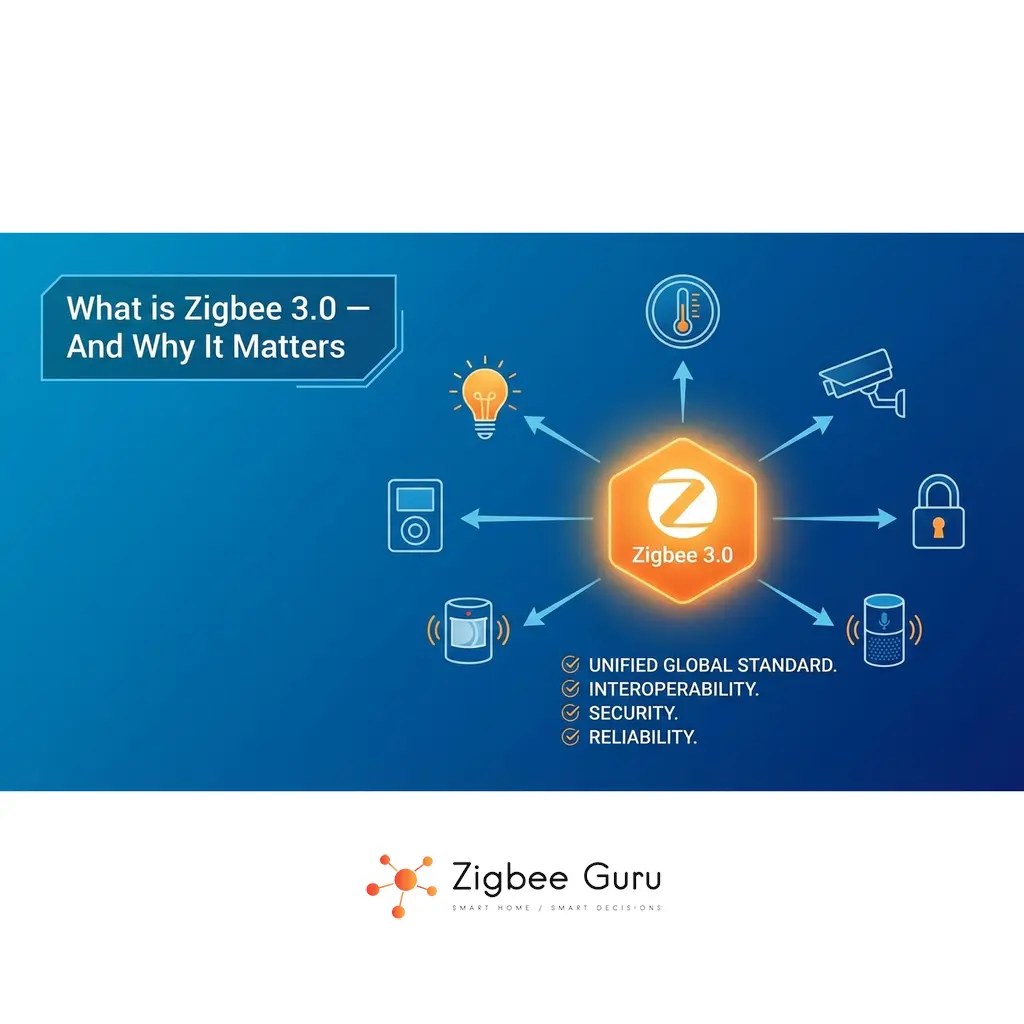
Zigbee 3.0 is the unified version of the Zigbee standard, designed to bring all previous profiles under one umbrella and make low-power smart home devices behave more predictably on the same network. It still runs on IEEE 802.15.4 at 2.4 GHz, but introduces a cleaner, more interoperable way for sensors, switches and lighting products to talk to each other.
For European homes, Zigbee 3.0 matters because it reduces vendor lock-in and makes it easier to mix devices from different brands on the same coordinator without running into obscure compatibility issues. It also tightens security, improves commissioning and gives installers a clearer baseline for planning large meshes.
This guide explains what Zigbee 3.0 is, how it differs from older Zigbee profiles, what it changes for security and network design, and how it fits into a world that now also includes Thread and Matter.
Table of Contents
- What Is Zigbee 3.0?
- Key Features of Zigbee 3.0
- Zigbee 3.0 vs Older Zigbee Profiles
- Security and Encryption in Zigbee 3.0
- Interoperability and Ecosystem Support
- Network Size, Range and Reliability
- Zigbee 3.0, Thread and Matter
- Migrating to Zigbee 3.0 in Existing Homes
- Conclusion
- FAQ: Zigbee 3.0
What Is Zigbee 3.0?
Zigbee 3.0 is the consolidated version of the Zigbee specification that merges previous application profiles (such as Home Automation and Light Link) into a single, interoperable standard. The goal is simple: any Zigbee 3.0-certified device should be able to join a compliant network and expose its functions in a predictable way.
At the physical and MAC layers, Zigbee 3.0 still uses IEEE 802.15.4 radios, typically at 2.4 GHz in Europe, forming a low-power mesh network. The major changes are above the radio: unified commissioning, improved security and a common application layer that reduces the risk of two Zigbee products “speaking different dialects”.
If you are new to the general concept of Zigbee, you may want to read the broader introduction first: What Is Zigbee? Zigbee 3.0 builds on those fundamentals and tightens the rules so that mixed-brand installations behave more consistently.
Key Features of Zigbee 3.0
The Zigbee 3.0 specification introduces several key features that directly impact how real-world smart homes are designed and maintained. These changes focus on interoperability, security, commissioning and power efficiency, while remaining compatible with earlier generations of hardware in many cases.
| Feature | Description | Practical Impact |
|---|---|---|
| Unified application layer | Single profile instead of many separate ones | Mixed-brand devices are more likely to work together |
| Enhanced commissioning | Standardised join, rejoin and binding procedures | Devices join networks more reliably and stay joined |
| Improved security model | Updated key handling and secure re-join options | Reduces risk from eavesdropping and weak default keys |
| Green Power support | Support for ultra-low-power “energy harvesting” devices | Battery-free switches and sensors become practical |
| Backward compatibility focus | Many older devices can coexist with Zigbee 3.0 | Simplifies upgrades and gradual migrations |
Key point: Zigbee 3.0 does not change what Zigbee is at the radio level; it standardises how devices behave above the radio so that multi-vendor smart homes are more predictable.
For installers and advanced users, this means less time spent diagnosing “profile mismatch” problems and more freedom to choose devices based on function and build quality instead of staying within a single brand family.
Zigbee 3.0 vs Older Zigbee Profiles
Before Zigbee 3.0, the Zigbee ecosystem was split into multiple application profiles. A light bulb designed for one profile might not fully interoperate with a switch designed for another, even though both were technically “Zigbee” devices using the same 802.15.4 radio.
Zigbee 3.0 consolidates these into a single profile that covers lighting, sensors, metering, HVAC and more. The aim is to ensure that a compliant coordinator can understand and manage all supported device types with fewer special cases or vendor-specific workarounds.
In practice, many modern hubs translate older profiles into Zigbee 3.0-style entities internally. However, when you choose Zigbee 3.0-certified devices, you reduce the risk of missing features, incomplete clusters or unexpected behaviour when mixing brands in one European home.
Security and Encryption in Zigbee 3.0
Zigbee 3.0 continues to rely on AES-128 encryption at the link layer, using network keys and optional link keys to protect traffic between nodes. The specification refines how keys are distributed, stored and rotated, making it harder for an attacker to join or observe a network without authorisation.
One important improvement is the handling of secure re-join. Older devices could sometimes rejoin in ways that exposed them to downgrade or spoofing attacks; Zigbee 3.0 gives coordinators clearer rules to decide which rejoin attempts are acceptable and when additional authentication is required.
For residential EU installations, the practical recommendation is to use a coordinator and hub software that fully implement the Zigbee 3.0 security model, disable legacy insecure join modes where possible, and keep your hub firmware updated so that future patches can be applied promptly.
Interoperability and Ecosystem Support
Zigbee 3.0 was designed to improve interoperability across brands and hubs. In the field, this translates to better behaviour when combining lighting, sensors and plugs from different vendors on the same coordinator or bridge, especially when the coordinator implements the full Zigbee 3.0 stack.
Many commercially available hubs and open-source stacks work with Zigbee 3.0 devices while still accepting older Zigbee products. In practice, a mixed network will often run both types, but Zigbee 3.0-certified devices give you the highest chance that advanced features such as reporting, binding and group control behave consistently.
When planning a new installation in Europe, it is sensible to prioritise Zigbee 3.0 devices for new purchases while keeping older, reliable Zigbee hardware in service where it already works well. This balances cost control with better long-term interoperability.
Network Size, Range and Reliability
Zigbee 3.0 retains the same basic mesh architecture as earlier Zigbee versions: a coordinator manages the network, mains-powered routers extend coverage, and battery-powered end devices connect through routers or directly to the coordinator. The theoretical limit is still tens of thousands of nodes, but practical limits depend on firmware and hardware.
What changes with Zigbee 3.0 is primarily predictability. With more consistent behaviour across profiles and device types, it becomes easier to design a mesh where link quality (LQI) stays high, rejoin behaviour is stable, and devices do not silently fall off the network in complex EU buildings with reinforced concrete and metal frames.
| Node Type | Role | Impact on Zigbee 3.0 Network |
|---|---|---|
| Coordinator | Single central controller | Stores network keys and tables; defines overall capacity |
| Router | Mains-powered repeater | Extends range and increases reliability; density is critical |
| End device | Battery-powered sensor or switch | Low traffic, relies on routers; battery life depends on link quality |
In European 2.4 GHz environments with dense Wi-Fi, paying attention to channel planning and router placement is still essential. Zigbee 3.0 does not remove interference, but it gives you clearer, more consistent behaviour when the mesh is designed carefully.
Zigbee 3.0, Thread and Matter
Matter is an application-layer standard designed to unify smart home communication over IP-based transports such as Wi-Fi, Ethernet and Thread. Thread, like Zigbee, uses IEEE 802.15.4 radios at 2.4 GHz, but adds IPv6 via 6LoWPAN instead of Zigbee’s non-IP mesh networking.
Zigbee 3.0 devices do not speak Matter natively, but many ecosystems use bridges or hubs that expose Zigbee devices as Matter endpoints. In this model, Zigbee 3.0 continues to act as a field bus for low-power sensors and actuators, while Matter provides a common application language to higher-level controllers.
For most homes, the realistic medium-term scenario is coexistence: a robust Zigbee 3.0 mesh for inexpensive, battery-powered devices and retrofits, and a growing set of Thread and Wi-Fi Matter devices for newer product categories. Planning with this hybrid future in mind avoids unnecessary replacements.
Migrating to Zigbee 3.0 in Existing Homes
Many installations in 2025 are not greenfield; they contain a mix of early Zigbee devices, vendor-specific hubs and newer Zigbee 3.0-certified hardware. Migrating to a more modern setup is usually a gradual process rather than a full reset.
A typical strategy is to adopt a coordinator or hub that supports Zigbee 3.0 while still accepting older devices, then replace legacy hardware over time as it fails or when new functionality is needed. Critical infrastructure devices, such as always-on routers and in-wall relays, are good candidates for early replacement.
- Start with a Zigbee 3.0-capable coordinator or hub.
- Keep stable older devices online but prefer Zigbee 3.0 for new purchases.
- Upgrade routing devices first to improve mesh quality for the entire network.
- Document which devices are still legacy so you can phase them out over time.
This approach aligns with long product lifecycles in buildings and avoids unnecessary electronic waste while still moving the installation towards a more interoperable and secure baseline.
Conclusion
Zigbee 3.0 is less about changing the radio and more about standardising behaviour. By unifying application profiles, tightening security and clarifying commissioning and rejoin rules, it makes multi-vendor Zigbee networks more robust and predictable for both installers and advanced users.
In practical terms, choosing Zigbee 3.0-certified devices for new installations, combined with careful mesh design and channel planning, gives European homes a stable low-power backbone for sensors, lighting and control. This backbone can coexist with, and even feed into, newer IP-based standards such as Thread and Matter.
For most users, the right question is not “Zigbee or Matter?” but how to design a layered system where Zigbee 3.0 continues to deliver reliable, efficient device-level connectivity while higher layers evolve over time.
FAQ: Zigbee 3.0
This FAQ addresses common questions about Zigbee 3.0, its compatibility with older devices and its role alongside newer standards like Matter and Thread.
- Is Zigbee 3.0 a different radio from older Zigbee versions?
No. Zigbee 3.0 still uses IEEE 802.15.4 radios, typically at 2.4 GHz. The main changes are in the higher layers: unified application profile, commissioning and security. - Will my older Zigbee devices work on a Zigbee 3.0 network?
In many cases, yes. A Zigbee 3.0 coordinator can usually accept older Zigbee devices, although feature support may vary by hub and device. Checking your hub’s compatibility documentation remains important. - Do I need to replace all my devices to benefit from Zigbee 3.0?
No. You can start by using a Zigbee 3.0-capable coordinator or hub, then introduce Zigbee 3.0 devices over time. The benefits accumulate as more of your network follows the newer standard. - Is Zigbee 3.0 more secure than older Zigbee versions?
Yes. It refines key management and rejoin procedures to reduce attack surfaces. Security also depends on implementation, so using up-to-date hub firmware and disabling legacy insecure join modes where possible remains important. - How does Zigbee 3.0 compare to Thread and Matter?
Zigbee 3.0 is a non-IP mesh standard optimised for low-power devices, while Thread uses 802.15.4 with IPv6 and Matter operates at the application layer over IP. In many homes, Zigbee 3.0 continues as a field bus, with bridges exposing devices to Matter-enabled ecosystems.



