
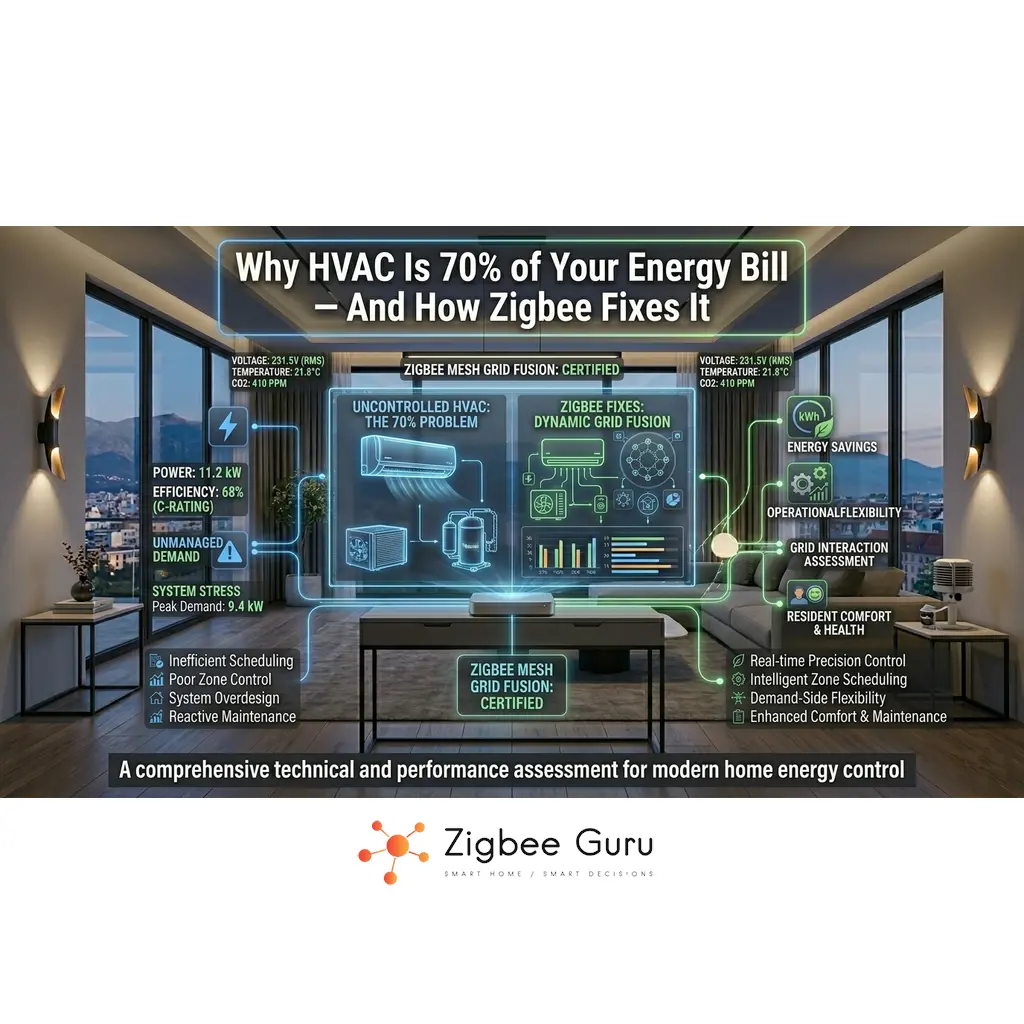
In many European homes, heating and cooling costs dominate the total energy spend. Once you include space heating, cooling, ventilation, and often domestic hot water, it can feel like “HVAC is 70% of the bill” for a large part of the year.
The reason is simple physics: maintaining indoor comfort against outdoor conditions requires continuous energy. Small changes in setpoints, schedules, and control stability can shift annual consumption more than most people expect.
Zigbee does not change thermodynamics, but it can change control quality. It enables low-power sensors and reliable actuators on a local mesh, which makes measurement-driven HVAC automation practical in real EU apartments — and increasingly relevant as EU EPBD smart-readiness rules push existing homes toward measurable, room-level heating control.
Table of Contents
- What “HVAC” Means in EU Homes
- Why HVAC Can Reach ~70% of Energy Spend
- Where HVAC Waste Actually Happens
- How Zigbee Helps: Sensing, Actuation, and Local Control
- Control Strategies That Reduce Consumption Without Chaos
- Zoning, TRVs and Sensor Placement for Real Buildings
- RF Reliability in EU Apartments: Wi-Fi, Channels, and Placement
- Implementation Options: Hubs, Home Assistant, and Data
- EPBD and Smart-Readiness: Where Regulation Meets HVAC Control
- Conclusion
What “HVAC” Means in EU Homes
In EU contexts, “HVAC” often includes more than a single air-conditioning unit. Many homes have radiator heating (gas, oil, heat pump), optional cooling, mechanical ventilation in newer buildings, and domestic hot water that can be tightly linked to the heating system.
This matters because “the bill” is usually mixed-fuel: electricity for appliances and cooling, plus gas or other fuels for space heating and hot water. The dominant share depends on climate, insulation, and how the home is operated day to day.
From a control perspective, the biggest opportunities come from reducing unnecessary runtime while keeping comfort within defined limits.
Why HVAC Can Reach ~70% of Energy Spend
Space conditioning is a continuous load driven by temperature difference. When outdoor air is far from your setpoint, the building loses (or gains) heat through walls, windows, ventilation, and infiltration, and HVAC must compensate.
In winter-dominant regions, space heating plus hot water often becomes the largest annual energy component. In summer-heavy regions, cooling can spike electricity bills, especially in dense apartments with high internal gains and limited cross-ventilation.
“70%” is not universal, but it is a plausible outcome when heating and hot water are fuel-based and the remaining electrical loads are modest. The key is that HVAC is both large and controllable.
- Climate load: degree days and humidity drive runtime.
- Building envelope: insulation, glazing, air leakage, and thermal bridges.
- Behavior: setpoints, schedules, window habits, and zoning.
Where HVAC Waste Actually Happens
Most waste is not “a bad boiler” or “an inefficient AC.” It is uncontrolled runtime: heating empty rooms, cooling while windows are open, or maintaining a tight setpoint when a wider comfort band would be acceptable.
Control instability is another silent cost. Short cycling, overshoot, and frequent on/off switching reduce efficiency and can increase wear on compressors, valves, and circulation pumps.
The practical goal is to convert HVAC from a manual, always-on behavior into a measured system with explicit constraints and predictable transitions.
- Heating or cooling based on a single sensor in the wrong location.
- Schedules that ignore occupancy and building thermal inertia.
- No window/door state awareness for ventilation events.
- Setpoints that are too tight, forcing frequent corrections.
How Zigbee Helps: Sensing, Actuation, and Local Control
Zigbee runs on IEEE 802.15.4 at 2.4 GHz and supports mesh networking via a coordinator and routers. In practice, this enables a dense layer of battery sensors and mains-powered actuators that can run reliably without depending on Wi-Fi client capacity.
For HVAC, Zigbee is valuable because it can deliver frequent, low-power telemetry (temperature, humidity, contact state) and stable local actuation (relays, valves, thermostatic control). This makes closed-loop control achievable, not just “scene triggering.”
Protocol details still matter. If you need a refresher on Zigbee fundamentals and roles, see What Is Zigbee? and the technical references at Zigbee at the Connectivity Standards Alliance (CSA).
- Sensing layer: battery devices (see Best Zigbee Temperature & Humidity Sensors and Door/Window Sensors) report state without constant Wi-Fi association.
- Actuation layer: mains devices (smart plugs, in-wall relays, Zigbee smart plugs) can act as mesh routers, improving coverage.
- Local logic: a local controller can keep HVAC behavior consistent during internet outages.
Control Strategies That Reduce Consumption Without Chaos
Energy savings come from changing the control objective. Instead of “hold 21.0°C always,” use comfort bands, occupancy-aware schedules, and constraints that prevent waste while keeping the system stable.
Good strategies account for thermal inertia. Radiators and building mass respond slowly, so abrupt setpoint changes can create overshoot. The simplest fix is hysteresis and time-based limits on how often you allow state changes.
Start with one controllable zone and validate outcomes. Expanding a stable control pattern is safer than building a complex rule graph that becomes un-debuggable.
- Comfort bands: e.g., heat between 20–21°C instead of chasing 20.5°C precisely.
- Occupancy windows: reduce setpoints when a room is unused for a defined time.
- Window-aware pauses: suspend heating/cooling when ventilation is detected.
- Anti-short-cycling: minimum on/off times for compressors and boiler calls.
Zoning, TRVs and Sensor Placement for Real Buildings
Zoning is the most direct lever for reducing HVAC waste: do not condition the entire home as if every room has the same occupancy and thermal behavior. In EU radiator homes, room-level control often matters more than central scheduling.
Sensor placement determines whether your control loop “sees” reality. A sensor too close to a radiator or in direct sun will report biased temperatures, causing the system to underheat or overcool the occupied zone. A reliable Zigbee temperature/humidity sensor in the correct location is typically the highest-leverage starting point for any HVAC automation. 👉 Recommended Zigbee Temperature & Humidity Sensor on Amazon
Design zones around usage and thermal coupling: bedrooms, living areas, and office spaces often require different profiles, especially in apartments with uneven exposure.
Zigbee TRVs: The Highest-Leverage Device for EU Radiator Homes
For the millions of European homes still heated by water radiators, Zigbee Thermostatic Radiator Valves (TRVs) are the single most cost-effective upgrade you can make. A Zigbee TRV replaces the mechanical knob on each radiator with a motorised valve that takes temperature commands from your controller — so each room becomes its own zone, controlled by its own sensor and its own schedule.
Compared with a single central thermostat, room-level TRV control routinely cuts space-heating runtime in shoulder seasons (autumn, spring) and lets you keep unused rooms at a lower setback temperature without freezing them. Critically for EU buildings, this avoids the classic “heat the whole apartment to keep one cold room warm” pattern that wastes large amounts of fuel every winter.
From an engineering perspective, the most important features to check are: compatibility with your hub or stack (Zigbee 3.0 + ZHA/Zigbee2MQTT support), battery life under realistic schedules, noise level (motor sounds matter in bedrooms), and valve adapter compatibility with common EU radiator threads (M30×1.5 is the most common, but variations exist). 👉 Recommended Zigbee TRV for EU Radiators on Amazon
- Place temperature sensors away from heat sources, sunlight, and exterior drafts.
- Use contact sensors on frequently opened windows to avoid heating during ventilation.
- In radiator rooms, measure near occupant height, not directly at the valve — TRVs use their internal sensor by default, which sits near the floor and reads warmer than the room.
- Use humidity data to prevent condensation risk when doing aggressive setbacks.
RF Reliability in EU Apartments: Wi-Fi, Channels, and Placement
EU apartments are RF-dense at 2.4 GHz. Zigbee shares the band with Wi-Fi and Bluetooth, so interference management is part of HVAC reliability—especially if you depend on timely sensor reports and stable actuation.
Practical channel planning helps. Many deployments favor Zigbee channels that reduce overlap with the busiest Wi-Fi segments, but results depend on local conditions and router settings. Coordinator placement also matters: keep it away from Wi-Fi access points, USB 3.0 noise sources, and metal enclosures. For deeper troubleshooting of mesh instability, see Why Zigbee Devices Lose Connection and Zigbee Range Problems: Easy Solutions.
Mesh health is not optional. Mains-powered routers strengthen routes and reduce retries, which improves latency and battery life for sensors used in HVAC logic — TRVs in particular are sensitive to retries because every missed valve command can mean a missed heating cycle.
- Keep the coordinator central and elevated, not next to the Wi-Fi router.
- Increase router density with mains devices to avoid single-hop bottlenecks.
- Expect seasonal RF changes (neighbors, new routers, channel auto-selection).
- For 230V devices, treat electrical safety and local installation rules as constraints, not “optional.”
Implementation Options: Hubs, Home Assistant, and Data
A Zigbee HVAC layer needs three things: a coordinator, an automation engine, and a way to observe outcomes. Vendor hubs (see Best Zigbee Hubs) can be simple for onboarding, while platforms like Home Assistant can provide deeper control and logging.
On Home Assistant, common Zigbee stacks include ZHA and Zigbee2MQTT, which expose device telemetry and mesh diagnostics. Observability is a core requirement for energy work: without history, you cannot prove whether a change helped or hurt.
For hybrid homes, you can keep Zigbee as the sensor/actuation layer while using IP-based ecosystems for dashboards and voice control. The design principle is separation: critical HVAC control should remain stable even if the “convenience layer” changes. If you’re still choosing between vendor ecosystems, the Aqara vs Tuya comparison covers the practical differences for HVAC-relevant device categories.
- Controller stability: prefer local execution for heating/cooling decisions.
- Logging: track temperature, humidity, HVAC runtime, and power where possible.
- Change control: adjust one variable at a time and re-measure for at least a week.
| Lever | What Zigbee Enables | Main Risk if Done Wrong | How to Mitigate |
|---|---|---|---|
| Setbacks / schedules | Occupancy + time-based control per zone | Comfort complaints, overshoot | Use comfort bands, ramp changes, validate per room |
| Window-aware pauses | Contact sensors tied to HVAC state | False positives stop heating/cooling | Debounce, require sustained open state, add manual override |
| Room-level heating (TRVs) | Per-room valves controlled by per-room sensors | Cold rooms, condensation, valve noise in bedrooms | External sensors for control, minimum-temperature floor, model selection |
| Hot water scheduling | Cylinder relay / boiler call control | Legionella risk, cold morning showers | Minimum weekly high-temp cycle, schedule aligned with use |
| RF/mesh stability | Mains routers improve routing and latency | Packet loss breaks control assumptions | Coordinator placement, router density, monitor LQI/RSSI |
- Step 1: Measure one zone (temperature, humidity, and HVAC runtime if available).
- Step 2: Add window/door state for that zone and implement a conservative pause rule.
- Step 3: Introduce a comfort band and a simple schedule with hysteresis.
- Step 4: Validate for 1–2 weeks, then expand to the next zone — TRVs make this incremental rollout cleaner than ducted systems.
- Step 5: Review mesh health (routing, LQI/RSSI) before adding more devices.
If you cannot measure runtime and comfort, you are not managing energy—you are guessing with extra steps.
EPBD and Smart-Readiness: Where Regulation Meets HVAC Control
Across the EU, the revised Energy Performance of Buildings Directive (EPBD) is steadily raising the bar on heating control. Member states are transposing rules that push toward measurable, room-level heating control, smart-readiness indicators (SRI) and zero-emission building targets — and these requirements are increasingly checked at sale, rental, or major renovation events, not just at new construction.
For most existing EU homes, the practical implication is that the gap between “mechanical TRV + central thermostat” and “Zigbee TRV per room + measured automation” is becoming smaller in cost and larger in compliance value. A modest Zigbee deployment focused on heating control is one of the cheapest ways to move a home toward the smart-readiness profile that future EPBD assessments will reward.
For the full regulatory context — what EPBD changes between 2024 and 2030, and how Zigbee, Thread and Matter fit an EPBD-ready home — see the dedicated guide: EPBD Smart Home Requirements (EU).
Conclusion
HVAC can dominate energy spend because it is a continuous physical load driven by climate and building losses. In many EU homes, heating and hot water alone can outweigh all other household loads, and cooling can add significant seasonal peaks.
Zigbee helps when it improves control quality: more accurate sensing, stable actuation, and local automation that survives everyday network and internet variability. The savings come from reducing unnecessary runtime, not from the protocol itself.
The engineering approach is consistent: measure first, control with constraints, validate outcomes, and expand only after stability is proven. In practical order for a typical EU radiator home, that means starting with one good temperature/humidity sensor and one window contact sensor in your largest room, layering a comfort band and a window-aware pause, and only then expanding to Zigbee TRVs as room-level zones — with the larger EU regulatory picture (EPBD, SRI) as the long-term backdrop that makes this investment durable rather than throwaway.
FAQ
- Is HVAC really 70% of my energy bill?
It can be, especially when space heating and domestic hot water are fuel-based and the rest of your loads are modest. The actual share depends on climate, insulation, and setpoints. - Does Zigbee itself save energy?
No. Zigbee is a communication layer that enables sensors and actuators. Savings come from better control strategies that reduce unnecessary HVAC runtime. - What is the first Zigbee sensor that helps with HVAC efficiency?
A reliable temperature sensor in the right location, followed by a window/door contact sensor for ventilation-aware pauses. Measurement accuracy matters more than feature count. - Are Zigbee TRVs worth it in a typical EU radiator home?
In most EU homes with water-radiator heating, Zigbee TRVs are one of the best-performing investments you can make in heating control: they let you keep unused rooms at setback temperatures and stop heating the whole apartment to compensate for a single cold room. Budget for one valve per radiator you actually want to schedule independently, verify thread compatibility (commonly M30×1.5), and start with the rooms where occupancy varies most across the day. - Will Wi-Fi interference break HVAC automations?
It can cause delays or missed updates at 2.4 GHz in dense apartments. Good coordinator placement, mesh routing, and conservative control logic reduce the risk. Missed packets matter more for TRVs and boiler relays than for sensor reports, because a dropped command can mean an unintended heating cycle. - How do I avoid short cycling when automating heating or cooling?
Use hysteresis and minimum on/off times. Do not change setpoints too frequently, and treat compressors and boilers as equipment with operational constraints. - Do I need Home Assistant for Zigbee HVAC control?
Not strictly. A vendor hub can work for simple control, but platforms like Home Assistant provide better observability, logging, and diagnostics, which are important for energy-focused tuning. - How does EPBD smart-readiness affect home HVAC control in 2026?
The revised EU Energy Performance of Buildings Directive (EPBD) is pushing existing housing toward measurable, room-level heating control, and member states are aligning their certification regimes with smart-readiness indicators. A Zigbee deployment focused on per-room temperature sensing and TRV-based heating control is one of the most direct ways to move an existing home in the direction the regulation rewards — without waiting for a major renovation.



