
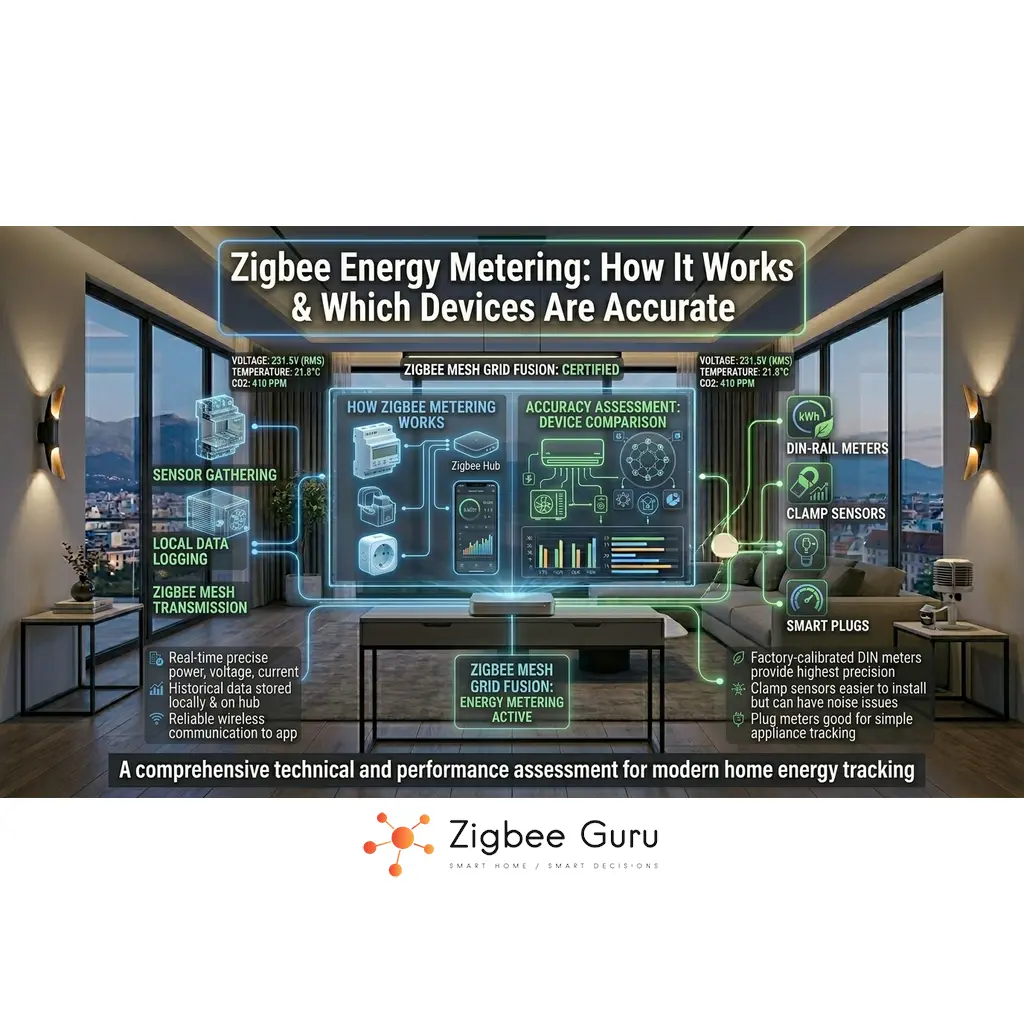
Zigbee energy metering is a practical way to measure power (W), voltage (V), current (A), and energy (kWh) on appliances and circuits without running new wires to every sensor.
The hard part is not “does it report numbers”, but whether those numbers are accurate across real household loads: LED drivers, laptop chargers, heat pumps, and variable-speed motors.
This guide explains how Zigbee metering works at the measurement and protocol level, what affects accuracy in EU 230 V homes, and which Zigbee device types are typically the most reliable — with a clear view of how this fits the broader EU regulatory picture for energy monitoring under EPBD and smart-readiness rules.
Table of Contents
- What Zigbee Energy Metering Really Is
- How Power and Energy Are Calculated
- Which Zigbee Clusters Carry Metering Data
- Reporting Intervals vs True Sampling
- Accuracy Limits in Real EU Loads
- Home Assistant: ZHA vs Zigbee2MQTT for Metering
- Aqara Smart Plug (EU): Typical Use Case and Accuracy
- IKEA INSPELNING: Energy Monitoring in a Zigbee Ecosystem
- SONOFF Zigbee Smart Plug: What to Expect
- Tuya Zigbee DIN-Rail Meter and CT-Clamp Alternatives
- Energy Metering and EU Regulation: MID, EPBD and Sub-Metering
- Conclusion
- FAQ
What Zigbee Energy Metering Really Is
Zigbee is an IEEE 802.15.4 low-power mesh network. Energy metering devices use that mesh to report electrical measurements and accumulated energy values to your controller.
Metering is not “a Zigbee feature” by itself. It depends on the device’s measurement hardware, its firmware math, and how it exposes attributes over standard Zigbee clusters.
If you need a Zigbee baseline first, see What Is Zigbee?. Metering reliability is strongly linked to mesh quality: missed reports look like “wrong energy”, even when the meter itself is fine — so getting the underlying mesh right (see Why Zigbee Devices Lose Connection) is the foundation for any metering project.
How Power and Energy Are Calculated
Real power (W) is the average of instantaneous voltage multiplied by instantaneous current over time. Energy (Wh or kWh) is the integral of power over time.
Many consumer meters also compute apparent power (VA) and power factor (PF). These become unreliable when the current waveform is distorted, which is common with switch-mode power supplies and LED drivers.
In EU 230 V / 50 Hz systems, accuracy depends on correct RMS voltage/current estimation, phase alignment, and sufficient sampling. Low-cost designs may under-sample or use simplified assumptions that fail on non-linear loads.
Which Zigbee Clusters Carry Metering Data
Zigbee devices usually expose metering through standard Zigbee Cluster Library (ZCL) clusters. Two common ones are “Simple Metering” (for accumulated energy and demand) and “Electrical Measurement” (for voltage/current/power-related attributes).
In practice, different vendors expose different subsets of attributes. One device may report only instantaneous power, while another reports voltage, current, frequency, reactive power, and energy counters.
The key engineering point is consistency: you want stable units, predictable update behavior, and an energy counter that survives reboots, so long-term kWh totals remain meaningful.
Reporting Intervals vs True Sampling
Zigbee reporting defines how often a device sends updates, not how it measures internally. A plug can sample many times per second but report every 30–60 seconds, or it can sample poorly and still report frequently.
For energy (kWh), the most robust method is an on-device accumulator that continuously integrates power and reports a counter value. If your system estimates energy by integrating sporadic power reports, accuracy depends on reporting regularity and load stability.
In dense EU apartments, packet loss from 2.4 GHz congestion can cause missing reports. That is a network problem, not a metering problem, but it affects dashboards and automations that depend on timely values. For practical mesh design that minimises this kind of loss, see Zigbee Range Problems: Easy Solutions.
Accuracy Limits in Real EU Loads
Resistive loads (kettles, heaters) are the easiest: current waveform is clean and PF is near 1. These usually match a reference meter closely for power and energy.
Non-linear loads (LEDs, phone chargers, many electronics) distort the current waveform and can confuse low-cost measurement ICs. Results often drift more on low power levels (single-digit watts) than on high loads.
Motor and compressor loads (fridges, HVAC indoor units) add inrush current, varying PF, and harmonics. A meter can be “accurate on average” for kWh but noisy for instantaneous W, which matters if you trigger automations from power thresholds — particularly relevant if you are building measurement-driven HVAC control on top of these readings.
Home Assistant: ZHA vs Zigbee2MQTT for Metering
Home Assistant can read Zigbee metering via ZHA or Zigbee2MQTT. Both can expose the same underlying ZCL attributes, but they differ in device converters, scaling, and how they handle odd vendor implementations.
For accuracy, your priority is correct unit scaling and stable state class handling (power vs energy). If the integration treats an energy counter as a “measurement” instead of a “total increasing” value, dashboards and statistics can become misleading.
A practical approach is to validate each meter once against a known reference (a plug-in reference meter or a DIN-rail reference meter) and then lock the device’s reporting intervals to stable values that do not overload your Zigbee mesh.
Aqara Smart Plug (EU): Typical Use Case and Accuracy
The Aqara Smart Plug (EU) is typically used for appliance-level monitoring where you care about trends and relative consumption: dehumidifiers, heaters, servers, and “always-on” electronics. It is usually most consistent on mid-to-high loads and less trustworthy at very low wattage values where many consumer plugs quantize or drift. 👉 Check Price on Amazon -> (EU version) or (US)
In EU homes, verify that the plug is rated for 230 V and the expected current (often up to 16 A for Schuko). Treat it as a monitoring device, not a billing instrument, and validate once against a reference meter if you will base automations on power thresholds. For broader plug comparisons across vendors, see Best Zigbee Smart Plugs and the Aqara vs Tuya ecosystem comparison.
For best reliability, keep the plug within a healthy Zigbee mesh (mains-powered routers nearby) so reports arrive on time. A stable mesh makes “energy graphs” look accurate because the data stream is continuous.
IKEA INSPELNING: Energy Monitoring in a Zigbee Ecosystem
IKEA INSPELNING is a Zigbee smart plug designed to provide power and energy monitoring inside an IKEA hub ecosystem, with integration options through compatible controllers. As with most consumer plugs, expect “household-grade” accuracy: good for comparing devices and tracking kWh over weeks, not for compliance-level submetering.
Its strengths are typically in ecosystem stability and consistent reporting when paired with a supported hub. The main limitation is that detailed electrical parameters (reactive power, harmonics) are not the goal, so complex loads may show more variance in instantaneous watts.
If you are in a Wi-Fi-crowded apartment block, treat reporting stability as part of “accuracy”. A device that measures fine but reports intermittently can distort short time-window statistics and automations.
SONOFF Zigbee Smart Plug: What to Expect
A SONOFF Zigbee smart plug with power monitoring is a common choice for cost-effective appliance metering, especially when you need several measurement points in the same home. In most setups it is accurate enough for identifying major consumers and for detecting state changes (device on/off), but it should still be validated for low-power electronics and PF-heavy loads. 👉 Check Price on Amazon
Engineering reality: “instantaneous power” is where plugs disagree the most across vendors. “Accumulated energy” can be more stable if the device keeps a real internal counter rather than relying on the controller to integrate power samples.
For automation triggers, add hysteresis and time filtering. Do not fire logic from single-sample spikes, because compressor inrush and switching supplies can create short transients that are not meaningful energy events.
Tuya Zigbee DIN-Rail Meter and CT-Clamp Alternatives
A Tuya Zigbee DIN-rail energy meter targets circuit-level monitoring (for example: heat pump feed, water heater, or a lighting circuit) rather than a single plug. This form factor is typically better for consistent long-term kWh tracking, but accuracy varies widely by model and installation quality, so the key is selecting a device with clear specs and proper current/voltage sensing design. 👉 Check Price on Amazon
For EU 230 V panels, installation should follow local electrical code and is usually electrician work. Poor wiring, loose terminals, or wrong CT orientation (for CT-based designs) can introduce systematic errors that look like “bad Zigbee”.
If you need legally recognized billing accuracy, look for MID-certified meters and treat Zigbee reporting as a telemetry layer. Consumer Zigbee DIN-rail meters are mainly for optimization, alerting, and comparative analysis.
CT-Clamp Alternatives for Whole-Home Monitoring
When a plug is too narrow (single appliance) and a DIN-rail meter is too invasive (requires panel work), CT-clamp based Zigbee monitors are a useful middle ground. A CT clamp wraps around the live conductor of a circuit — or the main feed — and measures current without breaking the wiring. The Zigbee device combines that current reading with a voltage reference to compute power, then transmits it like any other Zigbee meter.
The main use cases in EU homes are whole-home consumption monitoring, solar PV self-consumption tracking, and EV charger circuit monitoring without modifying the panel. The engineering caveats are well documented: CT clamps are sensitive to phase shift on reactive loads, to CT orientation (an upside-down clamp inverts the sign), and to low-current accuracy (most consumer CTs lose linearity below a few amps). Calibration is usually required for trustworthy whole-home numbers.
Treat CT clamp data the same way you treat plug data: validate once against a reference, lock the reporting intervals, and use the accumulated kWh counter rather than integrating instantaneous power on the controller side.
The table below summarizes which Zigbee metering device types are usually the most reliable, and where accuracy breaks down in typical EU homes.
| Metering device type | Typical accuracy behavior | Best use | Common failure mode |
|---|---|---|---|
| Zigbee smart plug (Schuko) | Best on resistive and mid/high loads; weaker at low watts and distorted waveforms | Appliance monitoring, on/off detection, daily kWh trends | Wrong watts on LED/SMPS, noisy readings, missing reports in weak mesh |
| Zigbee DIN-rail meter | More stable kWh over time when well installed; model-dependent specs | Dedicated circuit monitoring (HVAC, water heater, EV line) | Installation errors, scaling issues, unclear sensor design |
| CT clamp-based energy monitor | Potentially good after calibration; sensitive to phase shift and placement | Main feed, solar PV self-consumption, EV chargers where plug/DIN are impractical | Phase error on reactive loads, CT orientation mistakes, low-current inaccuracy |
| “Energy by integrating reported power” (controller-side) | Depends on report regularity and load stability; weakest for fast-changing loads | Rough estimates when no energy counter exists | Packet loss, long report intervals, spikes distort totals |
Use the following lists as a practical checklist to evaluate accuracy and to avoid common mistakes that look like “bad metering”.
- Accuracy checklist: validate once against a trusted reference meter on (a) a resistive load ~1000–2000 W, (b) a low-power load ~5–20 W, and (c) an inductive load (fridge or fan).
- Look for energy counters: prefer devices that expose an accumulated energy value on-device, not only instantaneous power.
- Watch unit scaling: confirm that watts, volts, amps, and kWh are scaled correctly in your integration (no hidden multipliers).
- Control reporting load: avoid extremely frequent reporting in dense apartment meshes; use sensible min/max intervals and reportable change. A stable Zigbee hub and coordinator setup matters more here than people expect.
- Safety and compliance: use CE-marked devices rated for EU 230 V, with correct plug type and current rating for the appliance.
- Calibration workflow: measure real power with a reference meter, compare to Zigbee reading, and note error at multiple loads.
- Automation hygiene: add hysteresis (e.g., 10–30 W band) and time filters (e.g., 10–60 seconds) to avoid false triggers.
- Mesh placement: keep the Zigbee coordinator away from Wi-Fi access points and USB 3.0 devices; avoid placing it behind metal panels.
- Interpret PF carefully: if PF and reactive values look unstable on electronics, trust kWh trends more than instantaneous PF.
Most “bad energy metering” in Zigbee is either waveform reality (non-linear loads) or integration reality (scaling, reporting, and missing packets), not a broken sensor.
Energy Metering and EU Regulation: MID, EPBD and Sub-Metering
European energy regulation pushes consumers and prosumers toward measurable consumption — for time-of-use tariffs, heat pump subsidies, solar PV self-consumption reporting, and increasingly for building-level compliance under the revised Energy Performance of Buildings Directive (EPBD). Understanding which category your Zigbee meter belongs in avoids both wasted spend and unmet expectations.
- MID-certified meters (Measuring Instruments Directive, EU Directive 2014/32/EU) are required when a measurement is used for commercial billing — for example a landlord billing tenants for heating, an EV charging point billing the driver, or a heat pump subsidy that requires certified kWh reporting. Consumer Zigbee meters are not MID-certified and cannot substitute for these.
- EPBD smart-readiness monitoring sits one layer above billing. It is about whether a home can measure and respond to its own consumption — which is exactly what a properly designed Zigbee energy stack delivers, without needing legal-grade accuracy. Per-circuit Zigbee monitoring of heating, water heating and EV charging counts toward the “smart-readable” profile.
- Time-of-use and dynamic tariffs reward visibility into when consumption happens, not legally certified totals. Zigbee plug-level and CT-clamp data is well suited to identifying shiftable loads (dishwasher, washing machine, EV charging) for cheaper hours, which is increasingly relevant as more EU markets roll out hourly pricing.
- Solar PV self-consumption reporting to the DSO (distribution system operator) is typically done through certified meters at the inverter or main feed. Zigbee data is supplementary — useful for routing surplus to the heat pump or EV charger, not for the official self-consumption figure submitted to the network operator.
The practical rule of thumb: use Zigbee meters for optimisation and intelligence; use MID-certified meters where money or compliance changes hands. The two are complementary, not competing.
Conclusion
Zigbee energy metering works well when you separate three things: measurement quality, reporting stability, and correct interpretation in your controller. In EU homes, the best results come from validating once against a reference meter, choosing sensible reporting settings, and designing automations that tolerate noise and transients.
For appliance-level monitoring, Zigbee smart plugs are usually sufficient and easy. For energy management decisions (HVAC circuits, water heaters, EV chargers), circuit-level metering with a DIN-rail device or a CT-clamp monitor is typically more consistent, provided installation and scaling are correct. For anything where money changes hands — billing, subsidy reporting, regulated submetering — fall back on MID-certified meters and treat Zigbee as the telemetry layer beside them.
The simplest path forward is incremental: start with one Zigbee plug on your largest appliance, validate it against a reference, then expand to circuit-level monitoring where the energy spend is highest — typically heating and hot water, the same circuits where Zigbee-driven HVAC control already delivers the largest savings.
FAQ
- Is Zigbee energy metering accurate enough for billing in the EU?
Usually no. For billing or regulated sub-metering, you typically need MID-certified meters; Zigbee devices are mainly for monitoring and optimization. - Which Zigbee clusters are commonly used for metering?
Many devices use ZCL clusters such as Simple Metering for energy/demand and Electrical Measurement for voltage/current/power-related attributes. - Why do LED lights and chargers show “wrong” watts or power factor?
They are non-linear loads with distorted current waveforms. Low-cost meters can mis-estimate RMS and phase relationships, especially at low power. - How often should a Zigbee meter report power and energy?
Use moderate intervals that keep the mesh stable (tens of seconds to minutes), and rely on an on-device energy counter for kWh whenever possible. - Can Wi-Fi interference change my energy readings?
Wi-Fi does not change the meter’s internal measurement, but it can cause missing Zigbee reports, which affects graphs, statistics, and controller-side energy estimation. - What is the minimum setup for reliable kWh per appliance?
A stable Zigbee mesh, a plug or meter that exposes an accumulated energy counter, and one validation test against a reference meter to confirm scaling and drift. - Can Zigbee metering be used for solar PV self-consumption and time-of-use tariffs?
Yes for optimisation, no for official reporting. Zigbee CT clamps or DIN-rail meters can give you per-circuit visibility into when self-generated solar energy is being consumed, which is exactly what you need to route surplus to your heat pump, EV charger or hot water cylinder for maximum self-consumption. The figure your DSO sees, however, comes from certified meters at the inverter or main feed — Zigbee data complements those, it does not replace them. - How does EPBD smart-readiness affect home energy metering choices?
The revised EU EPBD rewards homes that can measure and respond to their own energy consumption. Per-circuit Zigbee monitoring of heating, water heating and EV charging is exactly the kind of capability that improves a home’s smart-readiness profile, even though Zigbee meters themselves are not legally certified. The combination — Zigbee for visibility, MID-certified meters where money is involved — is the practical EU-compliant pattern.



