
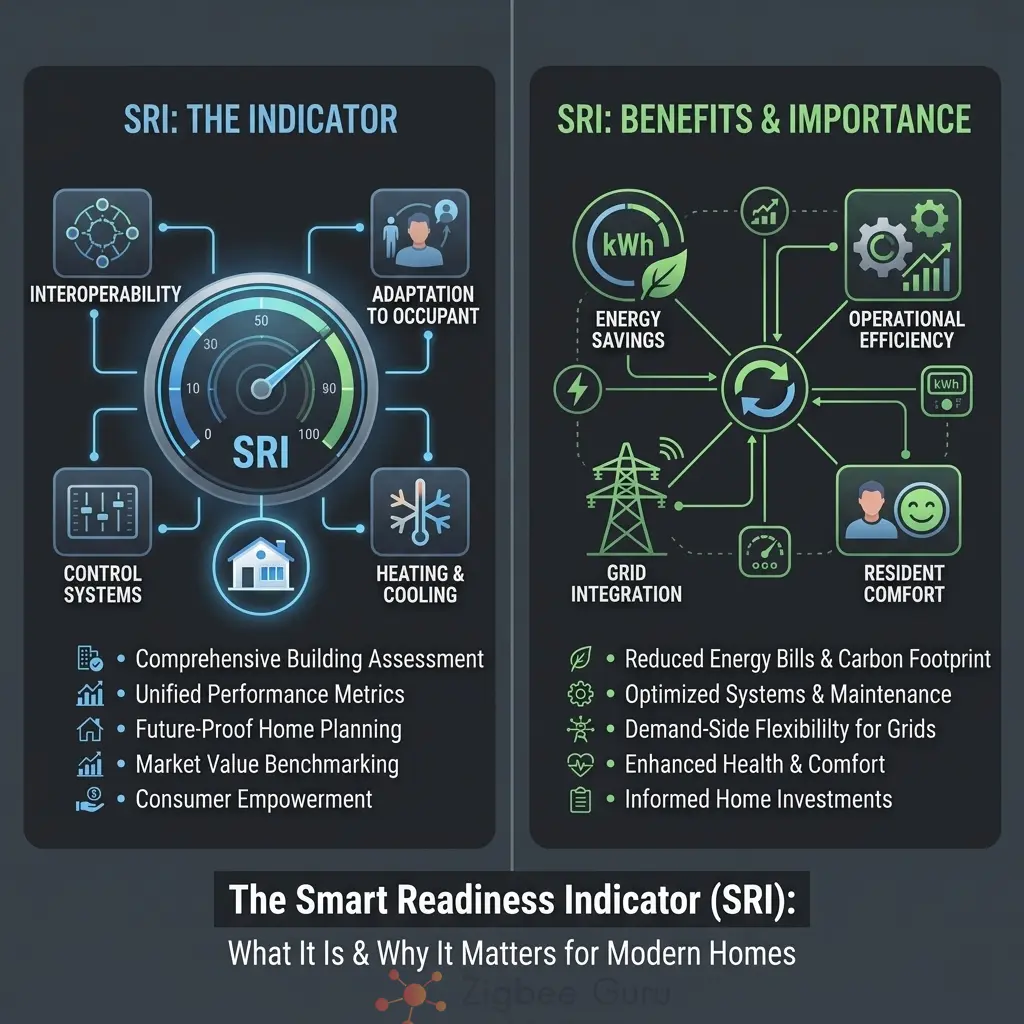
The Smart Readiness Indicator (SRI) is an EU framework that aims to describe how “smart-ready” a building is. It focuses on whether building systems can monitor, adapt, and support energy efficiency, comfort, and interaction with the grid.
SRI is not a gadget score. It is a structured way to translate capabilities—automation, control, feedback, and interoperability—into a comparable result that can guide renovations, upgrades, and procurement.
For modern homes, SRI matters because the highest-value smart functions are measurable: reduced heating/cooling runtime, better indoor air quality control, and better demand flexibility when tariffs or grid conditions change.
Table of Contents
- What the SRI Measures
- Where SRI Fits in EU Building Policy
- How SRI Scoring Works (High Level)
- Core Domains: Energy, Comfort, Health, and Information
- Demand Response and Grid Interaction
- Data, Cybersecurity, and GDPR Reality
- Mapping SRI to Zigbee, Thread, and Matter
- A Practical Roadmap for Existing Homes
- Conclusion
What the SRI Measures
SRI evaluates whether a building can sense conditions, make control decisions, and support occupants with clear information. The target is building performance, not the number of devices installed.
In practice, this means assessing automation and controllability across systems like heating, cooling, ventilation, domestic hot water, lighting, and sometimes on-site generation and storage.
A “smart-ready” home is one where controls are stable, measurable, and maintainable, rather than a collection of isolated apps.
Where SRI Fits in EU Building Policy
SRI was introduced as part of the EU’s policy direction for smarter, more energy-flexible buildings. It sits alongside energy performance concepts, but it is not the same as an EPC energy class.
The framework is designed so Member States can adopt and implement it, typically with local adaptation and methodology details. This means real-world availability and use can vary by country and market maturity.
For homeowners, the practical value is guidance: which upgrades improve controllability and energy outcomes, and which upgrades mainly add convenience.
How SRI Scoring Works (High Level)
SRI scoring is based on defined “services” that represent useful building functions. Each service has capability levels, typically moving from manual control to automated control and then to optimized, feedback-driven operation.
The core engineering idea is maturity: do you have sensing, do you have reliable actuation, and do you have logic that maintains comfort and efficiency without constant user intervention?
The outcome is intended to be comparable and actionable, but it depends on honest input data and on whether systems are integrated rather than fragmented. More info at EU SRI webpage.
Core Domains: Energy, Comfort, Health, and Information
Modern homes need to balance energy efficiency with comfort and indoor environmental quality. SRI tries to capture this balance by looking at how systems work together, not just how efficient a single device is.
Comfort is about stable temperature control and sensible zoning. Health includes ventilation and humidity management, which matters for mold risk and perceived air quality in airtight renovations.
Information is the visibility layer: if the home cannot report meaningful status and consumption patterns, optimization becomes guesswork.
Demand Response and Grid Interaction
One SRI motivation is demand flexibility: shifting or shaping consumption when it benefits the grid or the household. This is increasingly relevant with heat pumps, EV charging, and variable electricity tariffs.
Engineering-wise, demand response requires predictable control and well-defined constraints. A home should reduce load without breaking comfort boundaries or creating equipment stress from excessive cycling.
The “smart” part is not remote control. It is coordinated control that respects priorities: safety, comfort, cost, and grid signals.
Data, Cybersecurity, and GDPR Reality
SRI-aligned systems often collect occupancy-adjacent data: schedules, presence patterns, temperature history, and device states. In the EU, this intersects directly with GDPR expectations around purpose limitation, minimization, and security.
From a design standpoint, local processing reduces exposure. Keeping control logic on-premises and sending only aggregated insights to cloud services is usually easier to justify than streaming granular data continuously.
Cybersecurity is also operational: updates, device lifecycle, and clear ownership of accounts and credentials are part of “smart readiness,” even if they are not visible in a quick demo.
Mapping SRI to Zigbee, Thread, and Matter
SRI does not require a specific protocol, but it benefits from reliable sensing, stable mesh coverage, and interoperable control. Zigbee and Thread run on IEEE 802.15.4, while Matter is an application layer over IP that improves interoperability across ecosystems.
In practical homes, Zigbee often fits the sensor layer (battery devices, dense deployment), Thread fits IP-native low-power devices, and Matter helps unify control and reduce vendor lock-in. For Zigbee basics, see What Is Zigbee? and Zigbee.org.
For Matter context and ecosystem alignment, the primary reference is the Connectivity Standards Alliance at CSA. The protocol stack matters less than whether the system is measurable, maintainable, and secure.
A Practical Roadmap for Existing Homes
Most EU housing stock is existing, not new-build. SRI-relevant improvements should be staged: start with measurement and control stability, then expand into optimization and grid-aware behavior.
The first win is usually HVAC control quality: zoning, sensible setpoint bands, and ventilation awareness. After that, energy monitoring and automation can connect actions to outcomes. Must see: Best Zigbee Thermostats for EU Homes (2026)
A good retrofit plan avoids fragile dependency chains. The system should keep basic heating and safety behavior stable even if a voice assistant, app, or cloud service changes.
| SRI capability area | What it looks like in a home | Typical enabling layer | Engineering note |
|---|---|---|---|
| Monitoring & feedback | Room temperature/humidity history, energy visibility | Sensors + local logging | Without data, you cannot validate savings or comfort. |
| Automatic control | Stable HVAC control with hysteresis and minimum runtimes | Local automation engine | Controls must respect equipment constraints to avoid short cycling. |
| Zoning | Different profiles for bedrooms vs living spaces | Distributed sensors + actuators | Sensor placement is a primary accuracy risk. |
| Interoperability | Devices from different vendors under one control model | Matter over IP; bridges where needed | Interoperability helps lifecycle management, not only convenience. |
| Demand flexibility | Load shaping for heat pumps, water heating, EV charging | Tariff/grid signals + constraints | Flexibility must preserve comfort and safety boundaries. |
| Security & privacy | Least-privilege accounts, updates, minimized data sharing | Local-first design + hardened network | GDPR compliance is easier with minimization and transparency. |
- Start with measurement: temperature, humidity, and basic runtime or energy indicators.
- Stabilize control: hysteresis, minimum on/off times, and clear zoning boundaries.
- Add context signals: window/door state, occupancy patterns, and ventilation events.
- Introduce optimization: schedules that match building thermal inertia, not just clock time.
- Plan interoperability: reduce single-vendor coupling where possible, keep critical control local.
- Avoid “app islands”: isolated subsystems rarely score well in real-world outcomes.
- Avoid over-tight setpoints: narrow targets increase cycling and reduce efficiency.
- Avoid cloud-only control: basic comfort should survive internet outages.
- Avoid ignoring security: weak credential practices are a long-term operational cost.
SRI is useful when it turns “smart” into measurable capability: stable control, verified outcomes, and predictable operation under constraints.
Conclusion
The Smart Readiness Indicator is a structured attempt to describe what smart building capability actually means. It prioritizes automation maturity, feedback, and interaction over novelty features.
For modern homes, SRI is most relevant when it drives practical decisions: better HVAC control, meaningful monitoring, and interoperability that survives vendor and ecosystem changes. The technical layers—Zigbee, Thread, and Matter—are tools to achieve reliable sensing and control, not the goal by themselves.
Used correctly, SRI frames smart home design as engineering: define objectives, enforce constraints, measure outcomes, and iterate.
FAQ
- Is SRI the same as an EPC energy rating?
No. EPCs focus on energy performance classification, while SRI focuses on the capability of building systems to monitor, control, and support efficient operation. - Is SRI mandatory across Europe?
SRI is a framework designed for adoption by Member States. Availability, methodology details, and market use can vary by country. - Does a higher SRI guarantee lower bills?
Not automatically. Capability enables savings, but results depend on correct setup, stable control logic, and occupant behavior. - What is the most SRI-relevant upgrade for typical homes?
Improving HVAC control quality and zoning usually delivers the most measurable impact, especially when paired with reliable sensing and logging. - How do Matter and SRI relate?
Matter can support interoperability across ecosystems, which helps long-term maintainability. SRI values integrated, measurable control more than vendor-specific features. - Does SRI raise privacy concerns?
It can, because smart control often implies behavioral data. Local-first processing, data minimization, and clear user control align better with GDPR expectations.



