
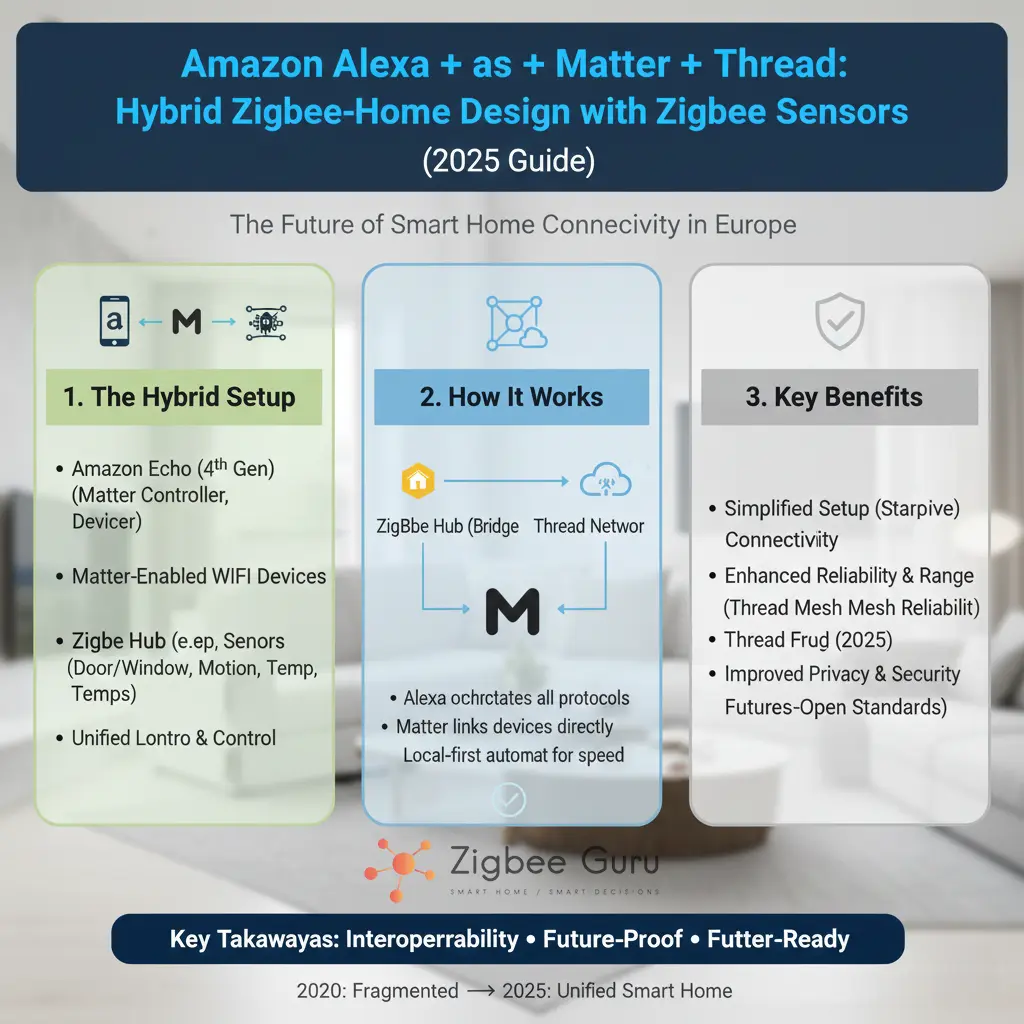
Amazon Alexa has evolved from a simple voice assistant into a full smart home platform that understands Matter, Thread and, uniquely among the major ecosystems, Zigbee directly through certain Echo devices. For many homes in Europe, the challenge is not “which protocol is best?” but how to combine them into a stable, low-latency and future-proof design.
At the same time, countless reliable and inexpensive Zigbee sensors are already deployed in motion, contact, temperature and energy-monitoring roles. Replacing them all with Matter devices rarely makes economic sense. The right strategy is to let Zigbee continue doing what it does best, while using Alexa, Matter and Thread for new devices and user-facing experiences — the layered pattern also explored in Zigbee vs Thread vs Matter.
This guide walks through how Alexa fits into a hybrid architecture, where Matter and Thread handle new endpoints and Zigbee remains the backbone for sensors. We focus on European homes, RF realities and concrete patterns you can apply when planning or upgrading your own hybrid system. For the sibling guides in other ecosystems, see Apple Home Hybrid and Google Home Hybrid.
Table of Contents
- Alexa + Matter + Thread: High-Level Overview
- How Alexa Handles Matter and Thread
- The Ongoing Role of Zigbee Sensors
- Recommended Hybrid Architecture with Alexa
- Network and RF Planning for EU Homes
- Onboarding Devices: Matter, Thread and Zigbee
- Automation Design: Voice, Cloud and Local Logic
- Security, Privacy and Cloud Dependence
- Troubleshooting Common Hybrid Issues
- Comparison Table: Architecture Options
- Conclusion
- FAQ
Alexa + Matter + Thread: High-Level Overview
Alexa’s smart home platform now speaks multiple “languages”: classic cloud APIs, Zigbee (on certain Echo models), Matter over Wi-Fi and, with compatible hardware, Matter over Thread. This multi-protocol capability allows one voice assistant to orchestrate several underlying networks in parallel — and in 2026, Amazon actually leads the major ecosystems in Thread Border Router coverage, with more Echo models supporting Thread than either Apple or Google.
Matter provides a common application layer over IP, so lights, plugs and sensors can be described in a unified way and shared between ecosystems. Thread offers a low-power IPv6 mesh for these Matter devices, while Zigbee remains a mature 802.15.4 mesh with its own application stack and thousands of compatible products.
In a well-designed hybrid system, Alexa focuses on user interaction, scenes and voice, while Thread and Zigbee handle the low-level RF work. Zigbee sensors continue providing fast, robust triggers, and Matter devices expose state and control in a vendor-neutral way across ecosystems.
- Alexa: voice, routines, cloud integration
- Matter: interoperable application layer over IP
- Thread: low-power IPv6 mesh transport
- Zigbee: proven mesh for cheap, reliable sensors and actuators
How Alexa Handles Matter and Thread
Alexa acts as a Matter controller when supported Echo or Fire TV devices are present on the network. These devices can onboard Matter endpoints using setup codes, maintain secure sessions and expose the resulting accessories to the Alexa app, voice routines and skills environment.
For Thread-based Matter devices, Alexa also needs at least one Thread Border Router in the home. As of 2026, Thread-capable Alexa devices include the Echo (4th generation), Echo Plus (2nd generation), Echo Studio, Echo Dot Max, Echo Hub, Echo Show 8 (3rd gen), Echo Show 15, and several eero mesh Wi-Fi routers (see FAQ for the full list). Older Echo Dots (1st–5th gen) and the original Echo speakers cannot act as Thread Border Routers. For a broader hardware comparison, see Best Matter Controllers and Thread Border Routers for EU Homes.
Zigbee support is a distinctive Alexa capability: certain Echo models include a built-in Zigbee radio and act as Zigbee coordinators, allowing Alexa to pair Zigbee devices directly without any additional hub. The current models with Zigbee radios include the Echo (4th gen), Echo Studio, Echo Dot Max, Echo Hub, and Echo Show 8 (3rd gen). In practice, many users combine this with third-party Zigbee hubs from Philips Hue, IKEA DIRIGERA, Aqara or Home Assistant deployments, particularly for larger installations or specialised sensor lines.
- Echo devices as Matter controllers on the IP network
- Thread Border Routers to connect Matter-over-Thread endpoints
- Zigbee support via built-in radios or external hubs
- Unified Alexa app view for multi-protocol devices
The Ongoing Role of Zigbee Sensors
Zigbee remains extremely attractive for sensors and low-cost actuators. Motion, contact, temperature, humidity and power-monitoring devices are widely available, energy-efficient and well understood by integrators. Many of these sensors have years of real-world performance data, which is not yet the case for all Matter products.
In a hybrid Alexa setup, Zigbee sensors can either connect directly to an Echo with Zigbee support, or to dedicated hubs — see Best Zigbee Hubs for EU Homes for a full comparison. These hubs then expose aggregate device information to Alexa via cloud APIs or, in newer designs, via Matter bridge functionality.
This approach lets you keep existing Zigbee deployments in place while gradually introducing Matter devices for visible elements like switches and plugs. If you later migrate away from Alexa or add another ecosystem, Zigbee infrastructure can remain usable through different bridges or controllers. For a deeper overview of Zigbee itself, you can refer to What Is Zigbee?.
- Low power, long battery life for sensors
- Large variety of devices at budget-friendly prices
- Works well as a dedicated “field bus” under Alexa
- Can be bridged into Matter ecosystems via compatible hubs
Recommended Hybrid Architecture with Alexa
A robust hybrid design starts by clearly separating roles. Matter and Thread handle new devices that benefit from ecosystem interoperability, while Zigbee remains responsible for cost-sensitive, widely distributed sensors. Alexa serves as the main user interface, voice layer and routine engine that connects both sides.
At the centre sits your IP network: a router, one or more Wi-Fi access points and, ideally, a wired backbone. Echo devices with Matter and Thread support connect here, as do Thread Border Routers and cloud-connected Zigbee hubs. Zigbee radio coverage is provided either by an Echo with a Zigbee radio or by dedicated Zigbee hubs placed strategically in the home.
Within this topology, you can decide where “truth” lives. Some homes treat Alexa as the single source of truth for devices and scenes, while others maintain a more advanced local controller (such as a dedicated Home Assistant instance) and simply expose selected devices to Alexa. The important point is that Zigbee sensors, Matter devices and Wi-Fi endpoints are all represented consistently in the Alexa graph. This local-vs-cloud tradeoff is explored in depth in Local vs Cloud Smart Home Automations.
- Central IP network with stable Wi-Fi and wired backhaul
- Echo devices as Matter controllers and optional Zigbee coordinators
- Zigbee hubs providing sensor meshes and, where available, Matter bridges
- Thread Border Routers extending coverage for low-power Matter devices
Think of Alexa as the conductor of an orchestra: Zigbee, Thread and Wi-Fi are different instrument sections that must be tuned and balanced, not forced to play the same notes.
Network and RF Planning for EU Homes
In Europe, both Zigbee and Thread typically operate in the 2.4 GHz band using IEEE 802.15.4, while Wi-Fi uses 2.4 GHz (channels 1–13) and higher bands such as 5 GHz and 6 GHz. Concrete and brick walls, metal shutters and reinforced floors all attenuate 2.4 GHz signals strongly, which has direct impact on mesh stability. For the full channel-selection framework, see Zigbee Channels in EU Homes; for diagnosing Wi-Fi crowding symptoms, see Zigbee + Wi-Fi Interference in EU Apartments.
A practical rule is to centralise Matter controllers, Zigbee coordinators and Thread Border Routers on middle floors or central rooms, away from metal cabinets and not directly behind TVs or refrigerators. Whenever possible, place Wi-Fi-heavy devices on 5 GHz or 6 GHz channels to reduce congestion in the 2.4 GHz band used by Zigbee and Thread.
Mains-powered devices such as smart plugs, in-wall switches and lamps should be used strategically as routers for both Zigbee and Thread meshes. In multi-storey houses, a few well-placed mains-powered devices per floor can significantly improve link quality and reduce retries, which leads to more responsive Alexa routines and fewer “device did not respond” messages. For the underlying range and coverage principles, see Zigbee Range Problems: Easy Solutions.
- Map Wi-Fi access points, Zigbee hubs and Thread Border Routers on a floor plan
- Avoid stacking radios together; allow some physical separation
- Use wired Ethernet where possible for backhaul
- Leverage mains-powered nodes as mesh routers, not only as endpoints
Onboarding Devices: Matter, Thread and Zigbee
Matter devices are typically onboarded by scanning a setup QR code or entering a numeric code into the Alexa app. Once commissioned, the device joins the appropriate IP network (Wi-Fi or Thread) and becomes visible as a Matter accessory with a standardised feature set.
Thread-based Matter devices first join the Thread mesh through a Border Router, which then makes them reachable by Alexa’s Matter controller. Correct IPv6 routing and multicast support are important here; misconfigured guest networks or isolated VLANs can prevent discovery even if RF links are healthy.
Zigbee devices connect either directly to Echo devices with Zigbee radios or to third-party Zigbee hubs (such as Philips Hue Bridge, IKEA DIRIGERA, or Aqara Hub M3), which in turn integrate with Alexa via skills or bridge functionality. Pairing Zigbee devices close to the coordinator or hub, then moving them to their final position, helps the mesh establish good routes before encountering challenging RF environments.
- Commission Matter devices in the same room as the controller when possible
- Verify that Thread Border Routers appear correctly in Alexa’s device list
- For Zigbee, allow time after pairing for routing tables to stabilise
- Apply clear, room-based naming to simplify voice interactions
Automation Design: Voice, Cloud and Local Logic
Alexa routines have historically depended more on cloud processing than either Apple Home or Google Home, though the 2026 introduction of Matter has begun to shift some device commands to local execution. When designing a hybrid system, it helps to divide automations into categories: those that can safely rely on the cloud (such as announcement-style routines and cross-service integrations) and those that should remain as local as possible, especially for lighting and security-related responses.
Zigbee sensors are well suited for latency-sensitive triggers, thanks to low-power mesh behaviour and tight local coordination. Matter devices, especially when running over Thread, can provide equally fast responses when controlled by nearby Border Routers. The combination allows most everyday automations to feel immediate even though Alexa itself operates partly via cloud services. Energy-critical flows such as Zigbee HVAC control especially benefit from keeping the trigger-to-action chain local.
A best practice is to build simple, robust chains: “Zigbee motion sensor → Matter or Zigbee light → Alexa routine for override or announcements”. Voice is then an additional interface layered on top of solid, protocol-level behaviour rather than the only way devices interact.
- Reserve cloud-heavy routines for non-critical convenience features
- Use Zigbee and Thread sensors as primary triggers for lights and alerts
- Design routines so they fail gracefully if the internet is unavailable
- Keep naming and grouping consistent between Alexa and physical rooms
Design your hybrid Alexa home so that comfort and safety work even when nobody speaks a word and the internet connection is having a bad day.
Security, Privacy and Cloud Dependence
Every additional protocol and hub in your system introduces new trust relationships. Alexa, vendor clouds, Zigbee hubs and Thread Border Routers all handle device identifiers, state and sometimes user behaviour data. Understanding this landscape is essential when deciding where to terminate encryption and which services need internet access — a topic covered in detail in Local vs Cloud Automations.
Matter is designed with strong, end-to-end secure sessions between controllers and devices, with setup codes and certificates controlling who can join a fabric. Zigbee also supports link-layer security with network keys and device-specific keys, though implementations differ between vendors. Thread, as an IPv6 mesh, inherits many security practices from traditional IP networking.
From a practical perspective, regular software updates for Echo devices, Zigbee hubs and Border Routers are non-negotiable. Network segmentation (for example, placing IoT devices on a separate VLAN or SSID) can limit the impact of any compromise. Logging and notification settings in the Alexa app and vendor accounts should also be reviewed periodically. For energy-consumption data specifically, EU regulation is increasingly relevant: see EPBD Smart Home Requirements for the emerging compliance picture.
- Keep firmware updated for Echo devices, hubs and routers
- Use strong, unique passwords and multi-factor authentication where available
- Segment IoT networks from personal computing devices
- Review voice history and data-sharing settings regularly
Troubleshooting Common Hybrid Issues
Common issues in Alexa-centric hybrid homes include devices not responding, inconsistent status reporting and automations triggering with noticeable delay. Diagnosing these problems requires separating RF issues, IP routing problems and cloud-related delays. For symptom-driven diagnostics on the Zigbee side, see Why Zigbee Devices Lose Connection.
Start with physical checks: confirm that Zigbee devices still have good link quality to their coordinator or hub, and that Thread Border Routers are powered and visible. Next, verify your IP network: ensure that the Echo devices, hubs and Border Routers share the same logical network and that guest or isolation modes are not blocking required traffic.
If voice commands work but automations fail, review your Alexa routines and any cross-account linking between vendor clouds. When devices respond only when moved closer to hubs or Echos, this usually points to mesh coverage gaps or interference in the 2.4 GHz band, not to protocol bugs. Incremental relocation of routers and repeaters often solves more issues than extensive reconfiguration.
- Check power, connectivity and recent changes before deeper debugging
- Use vendor tools and Alexa diagnostics to inspect signal quality and errors
- Temporarily disable non-essential routines to isolate timing issues
- Add or reposition mains-powered devices to strengthen mesh paths
Comparison Table: Architecture Options
The table below compares several common ways to structure an Alexa-based hybrid smart home using Matter, Thread and Zigbee sensors.
| Architecture | Description | Strengths | Vendor lock-in risk | Trade-Offs |
|---|---|---|---|---|
| Alexa + Matter over Wi-Fi only | Alexa controls Matter devices that connect via Wi-Fi, no Thread or Zigbee. | Simple setup, no extra radios or hubs needed. | Low — Matter is portable across ecosystems | No low-power mesh, limited battery life and coverage for small devices. |
| Alexa + Zigbee-only sensors | Echo with Zigbee radio controls sensors and actuators; no Matter or Thread. | Mature, inexpensive Zigbee ecosystem with local mesh behaviour. | Medium — Alexa cloud is in the trigger path | No cross-ecosystem Matter interoperability, harder future migration. |
| Alexa + Matter over Thread + Zigbee hubs | Thread handles Matter devices; Zigbee hubs provide sensor networks and cloud or bridge integration. | Good balance of modern Matter devices with existing Zigbee sensors. | Low-Medium — Matter layer reduces lock-in | More components to manage, requires careful RF and network planning. |
| Alexa + full hybrid with local controller | Alexa integrates with a separate advanced controller (such as Home Assistant) that manages Zigbee, Thread and IP devices. | Maximum flexibility, local-first logic, deep diagnostics. | Lowest — local logic is fully portable | Highest complexity; suitable for power users willing to maintain extra infrastructure. |
Conclusion
Alexa, Matter, Thread and Zigbee do not compete so much as complement each other. Alexa provides a familiar interaction model and routine engine, Matter and Thread add a modern, interoperable IP layer, and Zigbee continues to supply robust, affordable sensors and actuators that have already proven themselves in real homes.
Designing a hybrid system means accepting the reality of multiple protocols and using each where it fits best: Thread and Matter for new, user-facing devices; Zigbee for dense, low-cost sensing; Wi-Fi for high-bandwidth endpoints. Alexa then becomes the orchestration layer that ties these networks into coherent scenes and automations. Amazon’s key structural advantage in 2026 is the widest Thread Border Router coverage among consumer platforms combined with built-in Zigbee radios in several Echo models — no other ecosystem gives you both radios inside a single mainstream device.
With careful RF planning, thoughtful onboarding and conservative security practices, an Alexa-based hybrid home can remain reliable, responsive and adaptable over many years, even as new device classes and standards appear. Natural next steps: for the parallel Apple and Google ecosystem architectures, see Apple Home Hybrid and Google Home Hybrid; for concrete Thread Border Router hardware choices, see Best Matter Controllers and Thread Border Routers for EU Homes.
FAQ
This FAQ addresses common questions about Alexa-based hybrid smart homes combining Matter, Thread and Zigbee sensors.
- Do I need Thread to use Matter with Alexa?
No. Matter can run over Wi-Fi as well. Thread is particularly useful for low-power, battery-operated devices that benefit from an IPv6 mesh, but many plugs and lights work as Matter-over-Wi-Fi endpoints without Thread. - Which Amazon Echo devices act as Thread Border Routers?
As of 2026, Amazon offers the widest Thread Border Router lineup of any major smart home platform. Thread-capable Alexa devices include the Echo (4th generation), Echo Plus (2nd generation), Echo Studio, Echo Dot Max (2025), Echo Hub, Echo Show 8 (3rd gen), Echo Show 15, and several eero mesh Wi-Fi routers. Older Echo Dot models (1st through 5th generation, excluding the Max variant) and the original Echo speakers cannot act as Thread Border Routers, though they can still function as Matter controllers over Wi-Fi. - Which Echo devices include a built-in Zigbee radio?
A distinctive advantage of the Alexa ecosystem is that several Echo models include a built-in Zigbee radio and can act as Zigbee coordinators without any external hub. These include the Echo (4th gen), Echo Studio, Echo Dot Max, Echo Hub, and Echo Show 8 (3rd gen). The older Echo Plus (2nd gen) also has a Zigbee radio and continues to function. Standard Echo Dot models (1st–5th gen, excluding Max) and the Nest/HomePod equivalents do not include Zigbee. - Can Alexa control my existing Zigbee sensors?
Yes, if you have an Echo device with a Zigbee radio (see previous question) or a compatible Zigbee hub such as Philips Hue Bridge, IKEA DIRIGERA, Aqara Hub, or Home Assistant with Zigbee2MQTT that integrates with Alexa. In some cases, hubs can also act as bridges so Zigbee devices appear as Matter endpoints to ecosystems that support it. - Can I use Home Assistant and Alexa at the same time?
Yes, and it is a common power-user pattern. Home Assistant can expose its entities to Alexa via the Home Assistant Cloud (Nabu Casa) subscription or via community integrations. A pragmatic split is to keep fast, latency-sensitive automations inside Home Assistant, and use Alexa for voice control, announcements and cross-device orchestration. - Will Zigbee eventually be replaced by Matter?
Not in the short term. Matter targets interoperability at the application layer, while Zigbee remains a widely deployed, cost-effective mesh. Many homes will continue using Zigbee sensors alongside Matter devices for years, especially where retrofit budgets are limited. - What happens to my smart home if the internet goes down?
Basic device control via Zigbee and Thread can continue working locally, but some Alexa features depend on cloud connectivity. Lights and sensors usually remain functional, while voice processing, remote access and some routines may be temporarily impacted. Amazon has been slower than Apple and Google to move Alexa automation logic to fully local execution, so cloud dependence for routines is currently higher than in the other two ecosystems. - Is it risky to run Zigbee and Thread near busy 2.4 GHz Wi-Fi?
There is potential for interference, but careful channel selection and placement can mitigate most issues. Using 5 GHz or 6 GHz for heavy Wi-Fi traffic and spreading out radios in the home usually results in stable performance for both Zigbee and Thread.



